No Demos Needed: How Hierarchical Reinforcement Learning Composes Navigation and Manipulation Skills
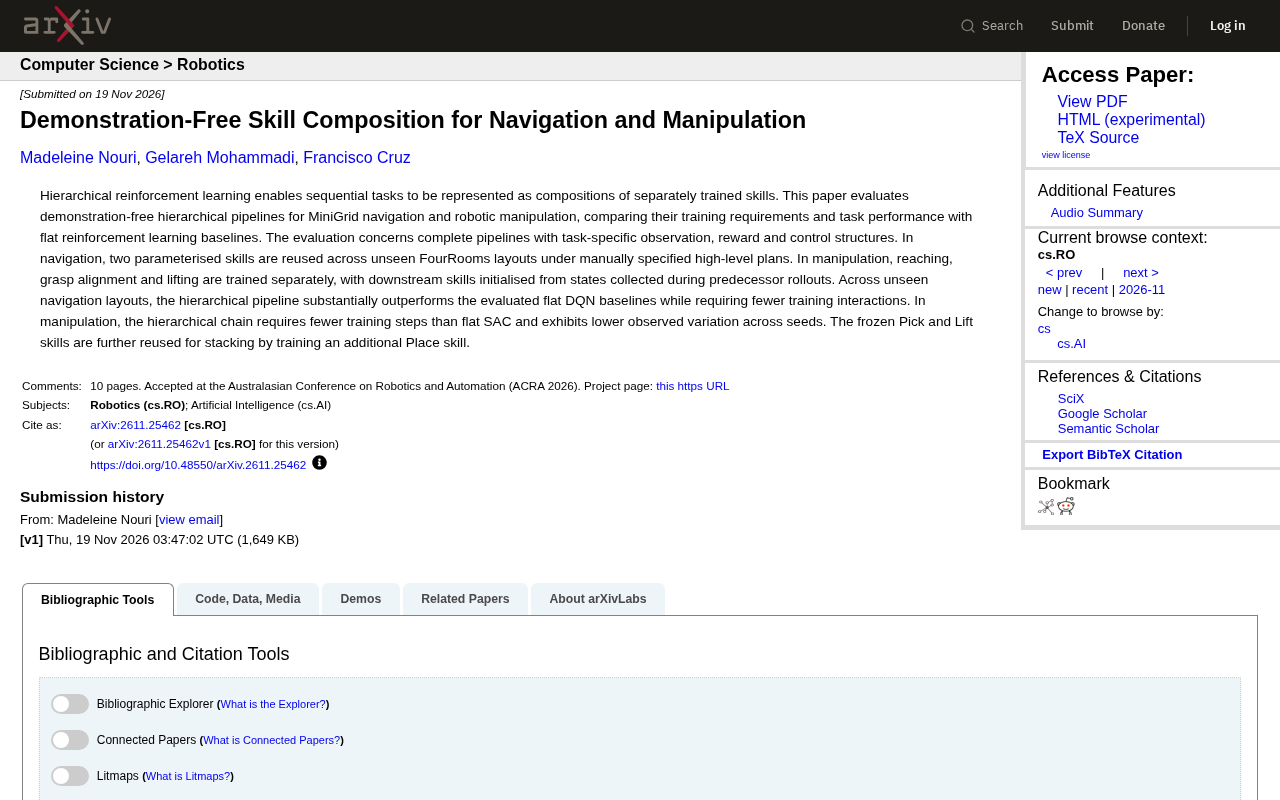
Demonstration-free hierarchical RL outperforms flat baselines in navigation and manipulation, showing skill reuse benefits.
This paper evaluates a demonstration-free hierarchical RL pipeline against flat baselines in MiniGrid navigation and robotic manipulation. In navigation, two parameterized skills reused in unseen layouts substantially beat flat DQN with fewer interactions. In manipulation, three skills trained in a chain with downstream initialization from predecessor rollouts require fewer steps than flat SAC and show lower cross-seed variance. Frozen Pick and Lift skills transfer to stacking with only a Place skill added. Limitations include hand-specified high-level plans, fixed skill order, single-source evaluation, and limited baselines.
Hierarchical reinforcement learning (HRL) offers an intuitive path: break a complex task into independently trained skills, then compose them through high-level planning. But a key question remains—can these skills be trained without relying on human demonstrations and be reused in new scenarios? A recent paper (source: rss) evaluates a demonstration-free hierarchical pipeline in two scenarios, MiniGrid navigation, and robotic manipulation, and compares it against flat reinforcement learning baselines.

Why "No Demonstrations" Matters
Traditional skill composition methods often rely on demonstration data to initialize skills or provide high-level supervision. This paper takes a stricter route: all skills are trained from scratch via reinforcement learning, without any expert trajectories. The evaluation targets the complete pipeline, including task-specific observations, rewards, and control structures, rather than isolated algorithm modules.
This setting is closer to the constraints of real-world deployment—in many scenarios, collecting high-quality demonstrations is extremely costly or even infeasible. If a hierarchical pipeline can still outperform flat baselines without demonstrations, its practical value increases significantly.
Parameterized skills refer to skill policies that accept continuous or discrete parameters as input. For example, in navigation, a skill might accept target position coordinates as parameters and thereby output a sequence of actions toward that target. Unlike fixed skills (such as "take one step forward"), parameterized skills can generalize to different subtask goals, reducing the number of skills and improving reusability. In hierarchical reinforcement learning, parameterized skills are typically selected by a high-level policy, which passes in parameters, and executed by a low-level policy. This design allows skills to quickly adapt to new tasks by adjusting parameters without retraining.
Navigation Task: Two Skills Reused in Unseen Layouts
In the MiniGrid navigation environment, the researchers defined two parameterized skills and, under a hand-specified high-level plan, reused them in an unseen FourRooms layout. "Parameterized" here means the skills accept goal parameters, allowing them to adapt to different subtask goals.
The results are quite clear: in unseen navigation layouts, the hierarchical pipeline substantially outperforms the evaluated flat DQN baseline while requiring fewer training interactions. This advantage comes from skill-level reuse—low-level skills do not need to be relearned for each new layout, and the high-level plan only needs to recombine existing skills.
You may not have noticed that the high-level plan is hand-specified rather than learned. This reduces the learning difficulty of the overall system, but it also means the generalization ability of high-level decision-making has not yet been validated.
Manipulation Task: Chained Training and Skill Reuse
In the robotic manipulation scenario, the pipeline is split into three skills: Reaching, Grasp Alignment, and Lifting. They are trained separately, and the initialization states for downstream skills come from states collected during rollouts of the predecessor skills. This chained initialization lets subsequent skills learn in a state space closer to the real distribution.
Compared with the flat SAC baseline, the hierarchical chain requires fewer training steps and exhibits lower observed variance across different random seeds. Lower variance means more stable and reproducible training results, which is especially important in robotic manipulation.
Furthermore, the researchers reused the frozen Pick and Lift skills for a stacking task, requiring only additional training of a Place skill. This pattern of "freezing existing skills and learning only new ones" is precisely one of the core advantages promised by hierarchical reinforcement learning.
Chained initialization is a skill training strategy in which the initial state distribution of a downstream skill does not come from the environment's initial states, but from states visited during the execution of predecessor skills. For example, the grasp alignment skill learns from states after the reaching skill succeeds, and the lifting skill learns from states after grasp alignment succeeds. The benefit is that each skill is trained on the state distribution it is likely to encounter during actual execution, avoiding exploration in meaningless state spaces, thereby accelerating training and improving final performance. Chained initialization requires skills to be trained in sequence but allows skill reuse.
Positioning and Limitations from a Multi-Source Perspective
According to the paper's evaluation, the hierarchical pipeline shows advantages over flat baselines in both navigation and manipulation tasks. As an additional note, these conclusions come from a single-source evaluation, and independent reproduction has not yet been seen. Based on public information, the work focuses on MiniGrid and specific manipulation tasks, and the environment complexity is relatively controlled.
The limitations are also obvious: the high-level plan in navigation is manually specified, and the skill chain in manipulation follows a fixed order. Whether the system can automatically discover skill compositions and maintain its advantages in more complex open environments remains an open question. In addition, the flat baselines compared in the paper are DQN and SAC, and do not cover other potentially stronger flat methods.
Nevertheless, this evaluation sends a clear signal: demonstration-free hierarchical skill composition has measurable advantages in training efficiency and stability, and the skill freezing and reuse mechanism can significantly reduce training costs when extending to new tasks. For researchers focused on robot learning and the practical deployment of reinforcement learning, this is a direction worth following.
One-line Summary
Demonstration-free hierarchical reinforcement learning outperforms flat baselines in navigation and manipulation tasks, demonstrating the advantages of skill reuse.
Paragraph Summary
This paper evaluates a demonstration-free hierarchical reinforcement learning pipeline and compares it with flat baselines in MiniGrid navigation and robotic manipulation tasks. In the navigation task, two parameterized skills are reused in unseen layouts under a hand-specified high-level plan, substantially outperforming flat DQN with fewer interactions. In the manipulation task, three skills are trained in a chain, with downstream skills initialized from predecessor rollout states, requiring fewer training steps than flat SAC and showing lower variance across seeds. The frozen Pick and Lift skills can be directly reused for a stacking task, requiring only additional training of a Place skill. Limitations include the hand-specified high-level plan, the fixed skill chain order, single-source evaluation, and limited baselines.
Related articles

Nothing CMF Buds 2A Drops to $17.89 on Black Friday: A New Low for ANC Earbuds
Nothing CMF Buds 2A wireless earbuds Black Friday deal: just $17.89 on Amazon, about $11 off retail and a record low. ANC earbuds at an entry-level price.

When AI Creation Gets Accused of "Spitting": Hacker News Heats Up Over the Glaude Controversy
A Hacker News post, "Spitting in the Face of Glaude," sparks debate on AI creation transparency and attribution ethics. This analysis examines the blurred creator identity behind the controversy and offers practical advice for AI content production.

Akai Embraces Custom Firmware: MPC Sample 1.4 Lets Users AI-Program Their Sampler
Akai embraces the modding community with MPC Sample 1.4 firmware, supporting vibe-coded custom firmware and effects. We analyze the impact of this open strategy on music hardware and AI-assisted programming.