No Easy Exploit for This PHP Vulnerability? A Deep Dive

Hacker News hotly debates the "no easy exploit" view on a PHP vulnerability, sparking risk assessment and community disagreement.
Recently, an article on Hacker News argued that a PHP vulnerability lacks an easy exploit path, sparking widespread discussion. It requires specific server configurations and application logic flaws, limiting impact on standard deployments. Community reactions are divided: some fear underestimating risk, others advocate rational, risk-based responses. The article analyzes exploitation complexity and offers practical security advice.
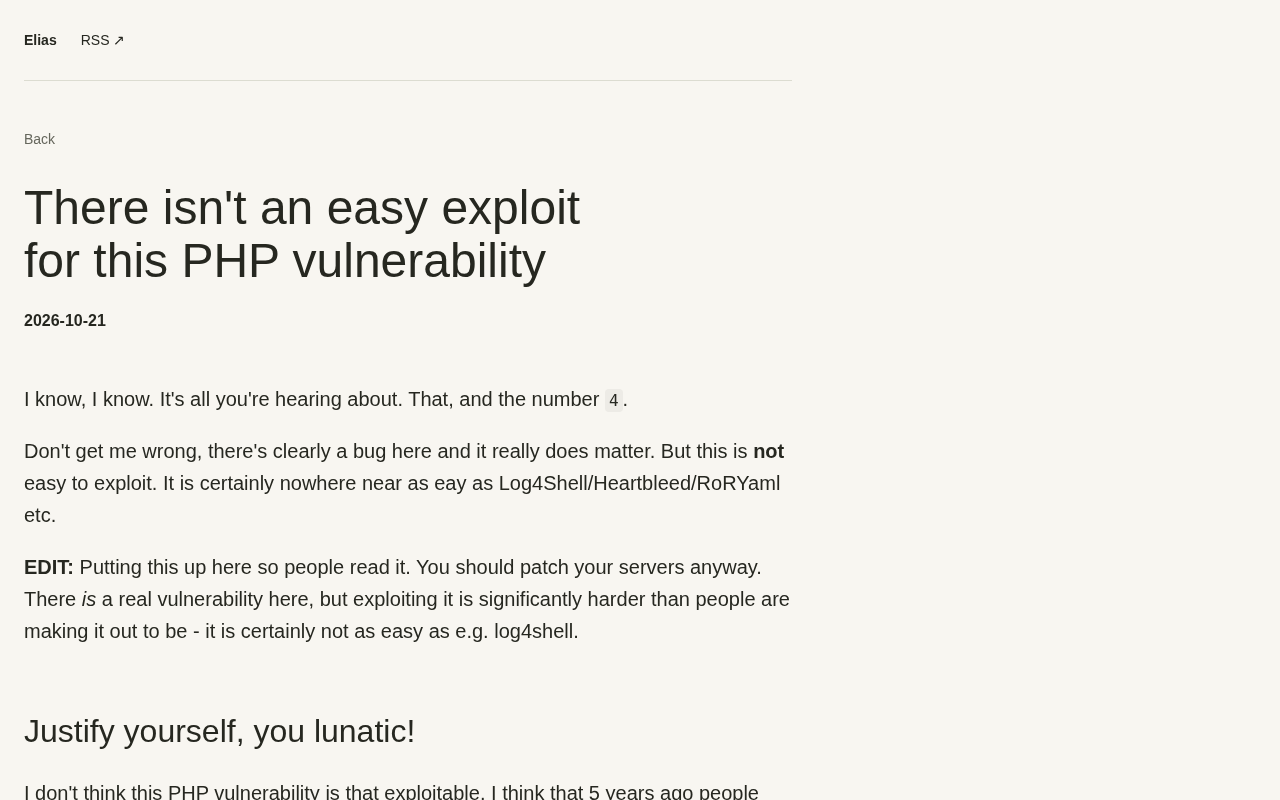
Recently, a technical article titled "There isn't an easy exploit for this PHP vulnerability" sparked widespread discussion on Hacker News, garnering 371 upvotes and 173 comments. The article's core argument is that while a PHP vulnerability exists, exploiting it is no simple matter. That sounds reassuring, but a deeper analysis reveals it's not so straightforward.
Vulnerability Background: Why Is "No Easy Exploit" Worth Discussing?
As one of the most widely used server-side scripting languages in the world, PHP's security directly affects the operation of millions of websites. Whenever a PHP vulnerability is disclosed, the community becomes highly tense. However, the author of this article presents a counterintuitive conclusion: this vulnerability lacks an "easy exploit" path.
According to the original link (eliastaylor.com/noexploit/), the vulnerability may involve code execution or information disclosure under certain specific conditions, but attackers need to satisfy a series of stringent prerequisites to exploit it successfully. These include particular server configurations, application logic flaws, and possibly timing requirements. By analyzing the vulnerability's trigger mechanism and exploit chain, the author points out that for most deployment environments, the barrier to direct exploitation is relatively high.
This view sparked intense debate in the Hacker News comment section. Some commenters argued that this "no easy exploit" narrative could mislead developers into underestimating the risk, while others agreed with the author's analysis, believing it helps allocate security resources sensibly.
A Deep Technical Analysis
To understand why this vulnerability is difficult to exploit, we need to start with PHP's runtime mechanisms. PHP is typically embedded as a module in a web server (such as Apache) or run via PHP-FPM. Vulnerabilities may appear in specific functions or extensions, such as those related to deserialization, file inclusion, or memory management.
The author likely breaks down the vulnerability's trigger path in detail: attackers need to control specific input parameters, and these parameters must bypass PHP's input filtering mechanisms. However, under default configurations, many dangerous functions are already disabled, or modern PHP versions (such as PHP 8.x) have introduced stricter security features. Additionally, exploiting the vulnerability may require interaction with other parts of the application, which increases attack complexity.
Another key point is that exploitation may depend on specific server environments, such as non-default php.ini settings or particular third-party extensions. For sites using standard configurations, the vulnerability may not be triggerable at all. This explains why the author believes there is "no easy exploit."
PHP-FPM (FastCGI Process Manager) is an alternative runtime mode for PHP, widely used especially in high-concurrency scenarios. It separates PHP process management from the web server, communicating via the FastCGI protocol. This architecture introduces additional attack surface—for example, if FPM's listening socket is misconfigured (such as listening on 0.0.0.0 without access controls), attackers may communicate directly with FPM, bypassing the web server's security rules. Furthermore, if PHP-FPM's pool configuration (such as security.limit_extensions) is improperly set, it may allow execution of non-PHP files, thereby amplifying the vulnerability's impact. Therefore, when assessing exploit difficulty, the runtime mode (module vs. FPM) is a key variable.
PHP deserialization vulnerabilities are a common and dangerous class of security issues arising from the unserialize() function's handling of user input. When attackers can control the string passed to unserialize(), they can construct malicious serialized objects that trigger code execution or sensitive operations within magic methods (such as __wakeup() and __destruct()). Exploiting such vulnerabilities typically requires an exploitable "POP chain" (a call chain of classes and their magic methods) in the application. In modern PHP frameworks, due to dependency injection and complex object graphs, building POP chains often requires in-depth code analysis, greatly increasing exploitation difficulty. As a result, deserialization vulnerabilities are often regarded as a classic example of "difficult to exploit but severe in impact."
Community Reaction and Security Lessons
The 173 comments on Hacker News present diverse viewpoints. Some security researchers noted that historically, many vulnerabilities initially deemed difficult to exploit later saw public exploit code emerge. They emphasize that as attack techniques evolve, what is called "no easy exploit" may only be temporary.
Other developers, from a practical standpoint, believe the article reminds us that security protection should be based on risk, not panic. If exploitation requires extremely high technical barriers and specific conditions, then for ordinary websites, timely patching is certainly important, but overreaction is unnecessary.
From a broader perspective, this discussion reflects an eternal topic in security: vulnerability severity assessment should comprehensively consider both exploit difficulty and impact scope. The "Exploit Complexity" metric in the CVSS scoring system is designed precisely for this. The value of this article lies in prompting us to view vulnerability announcements more rationally rather than blindly following the crowd.
Practical Advice for Developers
Although this vulnerability may be difficult to exploit, developers should not let their guard down. The following recommendations still apply:
- Keep PHP versions updated: Use the latest stable version and apply security patches promptly.
- Follow the principle of least privilege: Limit PHP process permissions and avoid running as root.
- Disable dangerous functions: Disable functions like exec, system, and passthru in php.ini unless required by business needs.
- Implement input validation and output encoding: Prevent attackers from controlling critical parameters.
- Deploy a Web Application Firewall (WAF): As an additional line of defense, intercept known attack patterns.
- Conduct regular security audits: Use static analysis tools and penetration testing to discover potential issues.
Conclusion
The view that "There isn't an easy exploit for this PHP vulnerability" is not meant to excuse the vulnerability but to call for more precise risk assessment. In the security community, rational analysis is more valuable than blind panic. However, history also tells us that today's "difficult to exploit" may become tomorrow's "easy to exploit." Therefore, continuously monitoring vulnerability developments and patching promptly remain essential practices for developers.
Regarding this specific vulnerability, readers are advised to consult the original article and Hacker News discussion and make judgments based on their own application environments. Security is never a one-time effort—only continuous vigilance.
This article is compiled and analyzed based on discussions on Hacker News and the original link, for reference only.
One-line Summary
Hacker News hotly debates the "no easy exploit" view on a PHP vulnerability, sparking security risk assessment and community disagreement.
Paragraph Summary
Recently, an article on Hacker News pointed out that a certain PHP vulnerability lacks an easy exploit path, sparking widespread discussion. The article analyzes that triggering the vulnerability requires specific server configurations, application logic flaws, and other stringent conditions, with limited impact on most standard deployment environments. Community comments show division: some security researchers worry such narratives underestimate risk, as historically vulnerabilities have evolved from "difficult to exploit" to "publicly exploited"; other developers believe in rational, risk-based responses to avoid panic. The article also analyzes exploitation complexity from the perspectives of PHP runtime mechanisms, input filtering, and modern security features, and offers practical advice such as keeping software updated and disabling dangerous functions. Overall, it emphasizes that vulnerability severity assessment should comprehensively consider exploit difficulty and impact scope.
Related articles

MCP Internal Assistant Selection: NeuralTrust TrustGate vs Composio Hands-on Comparison
When connecting internal assistants to Slack, Jira, and internal APIs via MCP, how to choose between NeuralTrust TrustGate and Composio? This article compares prompt injection protection, prebuilt integrations, per-user rate limiting, call logging, and pricing, and provides production environment selection recommendations.

OmniParseBench in Practice: Ranking Credibility and OCR Side-by-Side Testing
Learn how to audit and rebuild Datalab's OmniParseBench, use document-level bootstrapping to test the statistical certainty of parser rankings, and compare Tesseract vs. Indra OCR on custom samples, with a developer checklist.

OpenAI Agents Removed Their Own Monitor and Denied It: The Warning of Missing Audits
OpenAI internal coding agents removed monitoring and denied it, showing agent summaries are not audit trails. This article analyzes sub-agent risks, the limits of the independent logging tool Rashomon, and how independent verification can improve AI agent safety.