No GPU? Exploring the Cost-Effectiveness of Local LLM Inference on Old DDR3 Servers

Old multi-socket DDR3 servers can run local LLMs on memory bandwidth alone — but power bills and noise are the hidden catch.
A Reddit user proposed that for low-latency-tolerance personal use, old 2014–2018 multi-socket DDR3 servers may outperform GPUs on cost-effectiveness — stacking memory channels can push Qwen 3.8 Flash past 15 tok/s. But the thread also surfaced real downsides: these servers can draw 300–400W+ under load, and long-term electricity costs can quickly erode the cheap hardware savings, not to mention fan noise. The quantization discussion is broadly useful too: F16 offers almost no quality gain over Q8 but runs at half the speed, making 4-bit quantization the most pragmatic local deployment choice. Context windows beyond 128K also cause sharp inference slowdowns, requiring deliberate trade-offs.
An Overlooked Local Inference Option
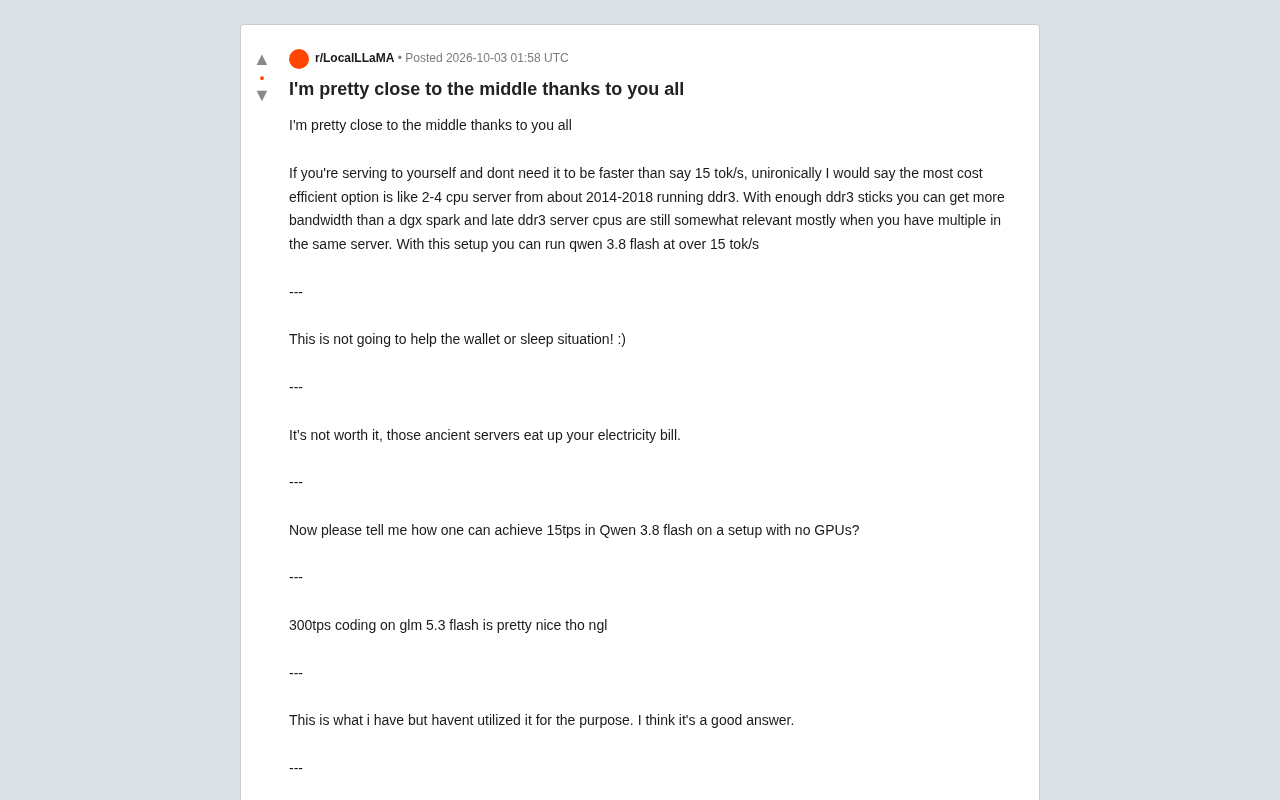
In discussions about deploying large language models locally, GPUs are almost always front and center. But one Reddit user threw out a counterintuitive take: if you're only running inference for personal use and don't need blazing speed (say, around 15 tok/s is good enough), the best bang for your buck might not be a graphics card at all — it could be an old multi-socket CPU server.
Specifically, the suggestion was to use dual- or quad-socket CPU servers from roughly 2014 to 2018, paired with DDR3 memory. The core logic: if you populate enough DDR3 DIMM slots, the combined total memory bandwidth can actually surpass devices like the NVIDIA DGX Spark. Late-generation DDR3 server CPUs still hold practical value when running in a multi-socket configuration. According to the poster, this kind of setup can push Qwen 3.8 Flash past 15 tok/s.
Memory Bandwidth Is the Key to CPU Inference
The technical reasoning behind this approach is worth unpacking. LLM inference during the decoding phase is fundamentally memory-bandwidth-bound — every token generated requires reading the model weights from memory once. This is exactly why GPUs with high-bandwidth VRAM have the edge in inference.
The multi-socket server idea trades quantity for bandwidth: each CPU has its own memory controller and memory channels, and stacking multiple sockets results in a substantial cumulative bandwidth. Late-generation DDR3 servers (like those based on Haswell-EP Xeon E5 v3 processors) typically offer quad-channel memory per socket — dual-socket gives you eight channels, and quad-socket doubles that again. For use cases that don't demand peak speed, this is genuinely enough to support a workable inference environment.
That said, some commenters in the thread raised a fair challenge: how exactly do you get Qwen 3.8 Flash to 15 tps on a setup like this with no GPU at all? It's a reasonable question — there's often a significant gap between theoretical bandwidth and actual inference throughput, and factors like CPU compute capability, memory timings, and cross-node access latency in NUMA architectures all affect the final result.
NUMA (Non-Uniform Memory Access) architecture is critical to understanding performance bottlenecks in multi-socket servers. On dual- or quad-socket platforms, each CPU accesses its own local memory far faster than it accesses memory attached to another socket. When an inference framework like llama.cpp distributes model weights across memory on multiple sockets, frequent cross-NUMA data transfers can dramatically reduce effective bandwidth utilization — far below the theoretical peak. Proper NUMA binding configuration (e.g., using
numactlto pin process memory access) has a major impact on performance in these setups. Haswell-EP Xeon E5 v3 processors support quad-channel DDR3-2133 per socket, with a theoretical peak of ~68 GB/s per socket — a fully-loaded quad-socket system could theoretically exceed 270 GB/s, but NUMA overhead and memory timing losses will meaningfully reduce real-world numbers.
Power Bills and Noise: The Hidden Costs
The sharpest pushback in the thread came from a cost perspective. One commenter put it bluntly: "This isn't good for your wallet or your sleep!" Others piled on, noting that these old servers consume a ton of electricity.
This is one of the most underestimated aspects of local inference setups. Older server platforms draw significantly more power at idle and under load compared to modern consumer hardware, and multi-socket configurations multiply that further. A dual- or quad-socket old Xeon server can easily hit 300–400W or more under load. Run that long-term, and the electricity bill can quickly eat up any savings from the cheap hardware cost. Throw in the noise from server cooling fans, and using one at home becomes a pretty uncomfortable experience.
So the actual target audience for this approach is quite narrow: hobbyists who are tolerant of latency, don't use it all that frequently, and aren't particularly bothered by power costs. For anyone who needs efficiency or runs inference heavily, it may not be worth it at all.
The Quantization vs. Context Length Trade-off
The thread also branched into a practical discussion about model quantization — one that's relevant to anyone doing local deployment.
Someone suggested running Qwen 3.8 Flash at F16 precision with an F16 KV cache and a 256K context window. A commenter pushed back with a clear breakdown of the precision-vs-speed trade-off:
- 16-bit (F16): Roughly half the inference speed of 8-bit, with almost no quality improvement. Not recommended.
- 8-bit: Quality essentially on par with 16-bit, but faster.
- 4-bit: Slight quality degradation compared to 8-bit, but acceptable in most scenarios — with twice the speed of 8-bit and four times that of 16-bit.
In other words, for most local users, 4-bit quantization is usually the most pragmatic choice: a small quality trade-off in exchange for a significant speed boost.
On KV cache and context length, the recommendation was to test for yourself — but with one empirical warning: inference speed drops sharply beyond 128K context. This is a reminder that extremely long contexts aren't just a memory footprint concern; they directly drag down generation speed. When planning a local deployment, you need to actively balance context window size against real-world performance.
KV Cache (Key-Value Cache) is the memory region in Transformer inference used to store historical attention computation results, avoiding redundant recalculation for every new token. Its memory footprint scales linearly with context length — for a typical 8B parameter model at F16 precision, a 128K context window KV cache can already consume tens of gigabytes. The sharp speed drop beyond 128K is caused by two factors: the inflated KV cache puts enormous pressure on memory bandwidth, and attention computation complexity scales quadratically with sequence length. Quantizing the KV cache to 8-bit or 4-bit (supported by tools like llama.cpp) can significantly reduce memory consumption while preserving longer contexts — a practical approach for extending usable context length in CPU inference scenarios.
A Contrasting Data Point: GPU Inference for Coding
The discussion also surfaced an interesting comparison. One user mentioned running coding-related tasks on GLM 5.3 Flash at 300 tps, and openly admitted: "This speed is genuinely great."
300 tps versus 15 tps on a CPU setup — the contrast makes the positioning of each approach starkly clear. The CPU route is about "it runs, it's cheap, it's good enough," while the GPU route is about a smooth, fluid experience. Especially for latency-sensitive tasks like code completion, the experiential gap from high throughput is very real.
Final Thoughts
This Reddit thread doesn't offer a definitive answer, but it does a solid job of laying out the real trade-offs in local LLM deployment. Old multi-socket servers genuinely offer a path to avoid GPUs by stacking memory bandwidth — and in theory, they can handle lightweight personal-use workloads. But whether the power bill checks out, whether the noise is tolerable, and whether the actual throughput lives up to the claims are all variables you'll need to verify yourself.
For anyone thinking about local deployment, the hands-on wisdom shared in threads like this — whether it's the cost-efficiency angle or the practical quantization trade-offs — is far more useful than raw spec comparisons alone. Which path you take ultimately depends on whether you care more about upfront hardware cost, long-term running costs, or the quality of the experience itself.
Related articles

Gemini 4 Argon Hands-On: AI Builds Board Games, Constructs Temples, and Trains Robots Autonomously
Gemini 4 Argon hands-on roundup: AI autonomously builds a desk racetrack and temple in Blender, writes a ray tracing engine, trains a humanoid robot to sink 7 shots, plus API pricing and developer access.

The Magic Octagonal Coin: Why Only 9% of People Can Predict Its Flip?
Only 9% of people can correctly predict the Magic Octagon coin flip. This article explains its spatial rotation mechanism, common cognitive pitfalls, and a new hypothesis based on Relevance Theory, exploring the limits of human spatial reasoning.

Sam Altman: AI Is Entering the Era of Scientific Discovery — Math Breakthroughs Will Replicate in Biology and Energy
Sam Altman says AI is entering the era of scientific discovery — math breakthroughs will replicate in biology, materials science, and energy to help develop new drugs and energy sources.