No Hidden Chain-of-Thought Needed: CoT-Proxy Distills Long-Horizon Strategies from Strong Models

CoT-Proxy shows long-horizon strategies can be distilled from action trajectories and reasoning summaries alone, even without the teacher's chain-of-thought.
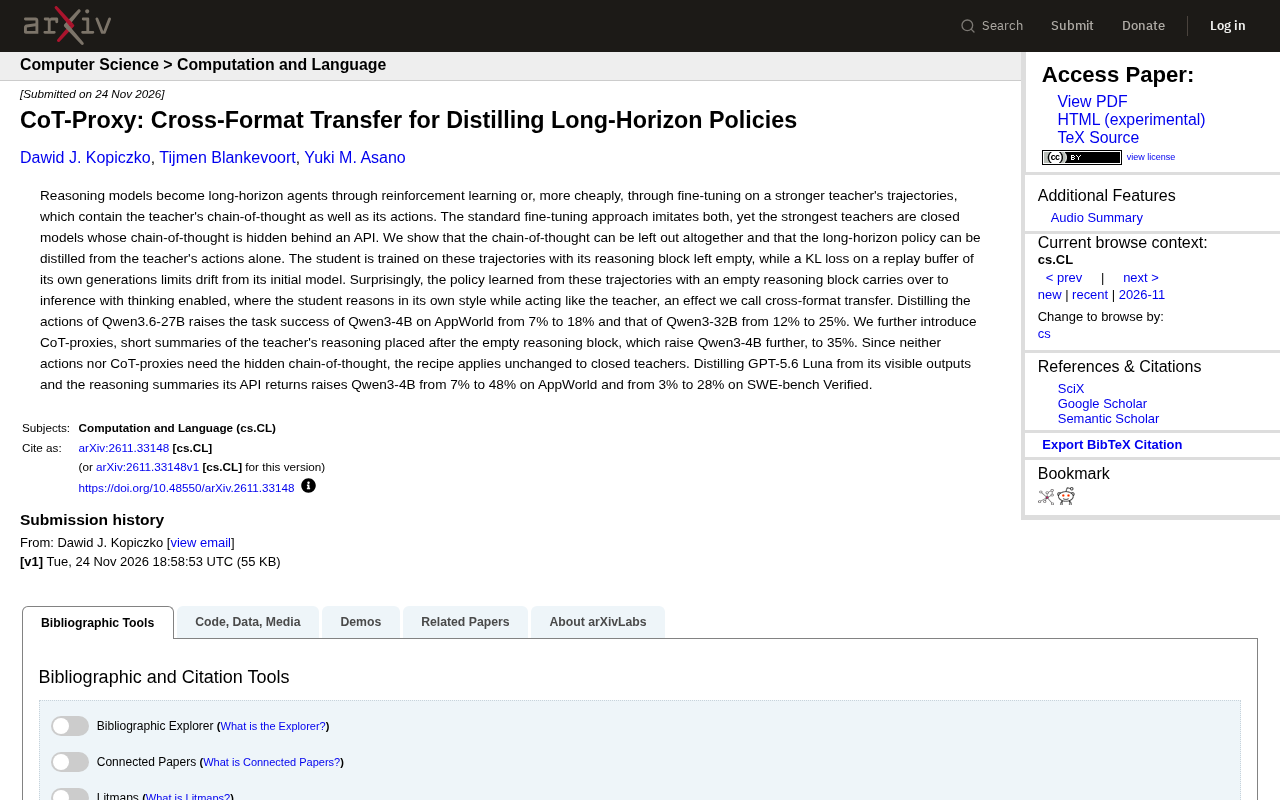
CoT-Proxy proposes a distillation method that bypasses the teacher's chain-of-thought: train the student on action-only trajectories with empty reasoning blocks, and apply a KL loss on a replay buffer of student-generated samples to prevent policy drift. The student thinks in its own style but acts like the teacher—what the authors call cross-format transfer. On AppWorld, distilling Qwen3.6-27B actions raised Qwen3-4B from 7% to 18%; adding brief reasoning summaries (CoT-proxies) further raised it to 35%. With a closed-source teacher (GPT-5.6 Luna), Qwen3-4B rose from 7% to 48% on AppWorld and from 3% to 28% on SWE-bench Verified.
When the teacher won't hand over its "scratch paper," how can we still learn?
Training reasoning models with reinforcement learning to become long-horizon agents works well, but it's expensive. A more economical approach is "distillation": fine-tuning a small model on trajectory data from a stronger teacher, where the trajectories contain both the teacher's chain-of-thought (CoT) and the actions it took. Conventional fine-tuning imitates both.
The problem is that the strongest teachers tend to be closed-source models whose chains-of-thought sit behind an API and simply can't be obtained. This stalls the standard distillation pipeline at the very first step. The CoT-Proxy work puts forward a counterintuitive conclusion: the chain-of-thought can be omitted entirely, and long-horizon strategies can be distilled from the teacher's actions alone.
The key observation behind this is that when students are trained with an empty reasoning block, they still exhibit the teacher's behavioral style in reasoning scenarios where thinking is enabled. The authors call this phenomenon "cross-format transfer."
Why does training on empty reasoning blocks work when "thinking" is turned on?
CoT-Proxy's approach is simple: train the student on teacher trajectories (keeping only actions, with reasoning blocks left empty), while applying a KL loss on a replay buffer composed of samples generated by the student itself, constraining the student not to drift too far from the initial model.
The KL loss here is an easily underestimated design choice. Simply imitating teacher actions tends to cause policy drift—especially with small models, which may gradually lose their original reasoning ability. The KL constraint on the replay buffer acts as a "safety rope," ensuring the student retains its own distributional foundation while learning the teacher's behavior.
The result is that at inference time the student thinks in its own style but acts like the teacher. This means the "strategy at the action level" and the "expression at the reasoning level" can be decoupled—the student doesn't need to replicate the teacher's reasoning text to inherit its behavioral patterns for solving long-horizon tasks.
KL divergence and replay buffers: KL divergence (Kullback-Leibler divergence) measures the difference between two probability distributions and is often used in distillation as a regularization term constraining the student model's output distribution not to deviate from a reference model. The replay buffer (replay buffer) here is originally a concept from reinforcement learning, referring to a data structure that stores historical experience samples for repeated sampling during training. CoT-Proxy uses it to hold samples generated by the student itself and computes the KL loss between the student's current policy and the initial model on these samples, effectively using the old policy as an anchor to limit parameter drift. This mechanism is homologous to the KL penalty common in RLHF; both aim to prevent the model from losing existing abilities while optimizing its objective, but here the reference distribution comes from the student's own pre-training self rather than an external teacher.
Empirical data: from 7% to 18%, then to 35%
The paper provides comparisons on AppWorld. After distilling Qwen3.6-27B's action trajectories, Qwen3-4B's task success rate rose from 7% to 18%, and Qwen3-32B's from 12% to 25%.
A further improvement is CoT-proxies: placing a brief summary of the teacher's reasoning after the empty reasoning block. These summaries don't contain the full chain-of-thought—just a compressed description of the reasoning process. With CoT-proxies added, Qwen3-4B on AppWorld improved further to 35%, nearly double the 18% from action-only distillation.
This shows that actions provide the signal for "what to do," while reasoning summaries provide the clue for "why do it this way." Combined, the student can generalize more accurately to unseen task states.
AppWorld and SWE-bench Verified: AppWorld is a long-horizon task benchmark for interactive digital assistants, requiring agents to chain operations across multiple simulated applications (such as email, calendar, and banking), maintain state, and accomplish multi-step goals. Task success requires precise execution sequences rather than single-step correctness, making it well suited to evaluating long-horizon strategies. SWE-bench Verified, meanwhile, is the manually curated subset of SWE-bench, built from issues in real GitHub repositories and their corresponding fix PRs, requiring the model to generate patches that pass tests and measuring code-repair capability in software engineering scenarios. The two benchmarks represent two types of long-horizon tasks—"multi-application operations" and "code repository modifications"—and reporting them together reflects the method's transfer effects across different action spaces.
Closed-source teachers work too: distillation results from GPT-5.6 Luna
Since neither the actions nor the CoT-proxies depend on the teacher's hidden chain-of-thought, this method can be used as-is with closed-source teachers. The authors distilled from GPT-5.6 Luna's visible outputs and the reasoning summaries returned by its API, with considerable results: Qwen3-4B improved from 7% to 48% on AppWorld and from 3% to 28% on SWE-bench Verified.
The significance of these numbers isn't just the magnitude of improvement but that they open a previously restricted channel. Closed-source model capabilities can usually only be obtained through API calls, making their internal reasoning processes hard to distill directly. CoT-Proxy shows that even when the teacher exposes only actions and brief reasoning summaries, the student can still achieve considerable gains in strategy transfer.
The difference between reasoning summaries and hidden chains-of-thought: The APIs of some closed-source reasoning models return, in addition to the final answer, a compressed or summarized reasoning explanation—but it is not the model's complete internal chain-of-thought text; its length, granularity, and information content are all controlled by the provider. CoT-Proxy's feasibility rests precisely on this exposed surface: even without a complete token-by-token reasoning trace, as long as you have action sequences and such summaries, you can construct a training signal. This also means the method's upper bound on gains is constrained by summary quality; if an API returns no reasoning explanation at all, the method degrades to pure action distillation, and the extra gains from CoT-proxies cannot be obtained.
Implications for distillation practice
The value of this work can be understood on three levels.
First, it lowers the data barrier to distillation. In the past, distilling a strong reasoning model required complete chain-of-thought data, which was often available only from open-source models. Now, as long as you can collect the teacher's action sequences and the reasoning summaries returned by its API, you can carry out distillation.
Second, it suggests the separability of reasoning and action. The cross-format transfer phenomenon shows that a model doesn't necessarily need to have "seen" a particular reasoning format during training in order to use it at inference time. This has direct reference value for designing mixed training strategies.
Third, the role of the KL constraint deserves attention. Under the setting of learning only actions and not reasoning, the student is more prone to losing its original reasoning ability. The KL loss on the replay buffer is key to maintaining this ability, and practitioners should not omit it.
One caveat: the improvements reported so far are concentrated on specific benchmarks, and generalization across domains and task types still requires more validation. How CoT-proxies' summary quality affects final results has also not yet been discussed in depth. But as for the question of "whether distillation can be accomplished when the teacher's chain-of-thought is invisible," the answer is already fairly clear.
One-line Summary
CoT-Proxy demonstrates that long-horizon strategies can be distilled from action trajectories and reasoning summaries alone when the teacher's chain-of-thought is inaccessible.
Paragraph Summary
CoT-Proxy proposes a distillation method that bypasses the teacher's chain-of-thought: train the student on teacher trajectories that keep only actions with empty reasoning blocks, and apply a KL loss on a replay buffer of student-generated samples to prevent policy drift. Experiments show that at inference time the student thinks in its own style yet imitates the teacher in action, which the authors call cross-format transfer. On AppWorld, distilling Qwen3.6-27B's actions raised Qwen3-4B from 7% to 18%; adding brief summaries of the teacher's reasoning (CoT-proxies) further raised it to 35%. The method also works with closed-source teachers: distilling GPT-5.6 Luna raised Qwen3-4B from 7% to 48% on AppWorld and from 3% to 28% on SWE-bench Verified.
Related articles

Nothing CMF Buds 2A Drops to $17.89 on Black Friday: A New Low for ANC Earbuds
Nothing CMF Buds 2A wireless earbuds Black Friday deal: just $17.89 on Amazon, about $11 off retail and a record low. ANC earbuds at an entry-level price.

When AI Creation Gets Accused of "Spitting": Hacker News Heats Up Over the Glaude Controversy
A Hacker News post, "Spitting in the Face of Glaude," sparks debate on AI creation transparency and attribution ethics. This analysis examines the blurred creator identity behind the controversy and offers practical advice for AI content production.

Akai Embraces Custom Firmware: MPC Sample 1.4 Lets Users AI-Program Their Sampler
Akai embraces the modding community with MPC Sample 1.4 firmware, supporting vibe-coded custom firmware and effects. We analyze the impact of this open strategy on music hardware and AI-assisted programming.