No Need to Wait Another 13 Years: Rockstar Hints at Significantly Shorter Development Cycles for Future GTA Titles

Rockstar's technical director says the engine, tools, and team accumulated during GTA VI will accelerate future projects, and players may not have to wait another decade-plus.
According to Bloomberg, Rockstar technical director Phil Hooker said the RAGE engine upgrades, toolchain restructuring, and mature team collaboration built during GTA VI's development will enable faster future projects. More than a decade passed between GTA V and GTA VI, during which games-as-a-service rose and the competitive landscape shifted, leaving single-player fans waiting. Hooker's remarks suggest that tech accumulation can reduce redundant work and let teams focus on creativity. But the report notes development wasn't smooth sailing, and creative uncertainty, management inertia, and talent attrition remain real obstacles. If Rockstar compresses cycles, it offers a key reference for the AAA industry's 'bigger means slower' dilemma.
Rockstar Games has finally broken its silence, offering players who have waited years a glimmer of comfort. According to Bloomberg's in-depth report on the development history of GTA VI, Rockstar technical director Phil Hooker revealed that the engine, toolchain, and talent pipeline the team built during this project will enable future projects to move forward faster. This means players may not have to endure yet another wait spanning more than a decade.
Engine and Tool Accumulation: The Technical Foundation for Shorter Cycles
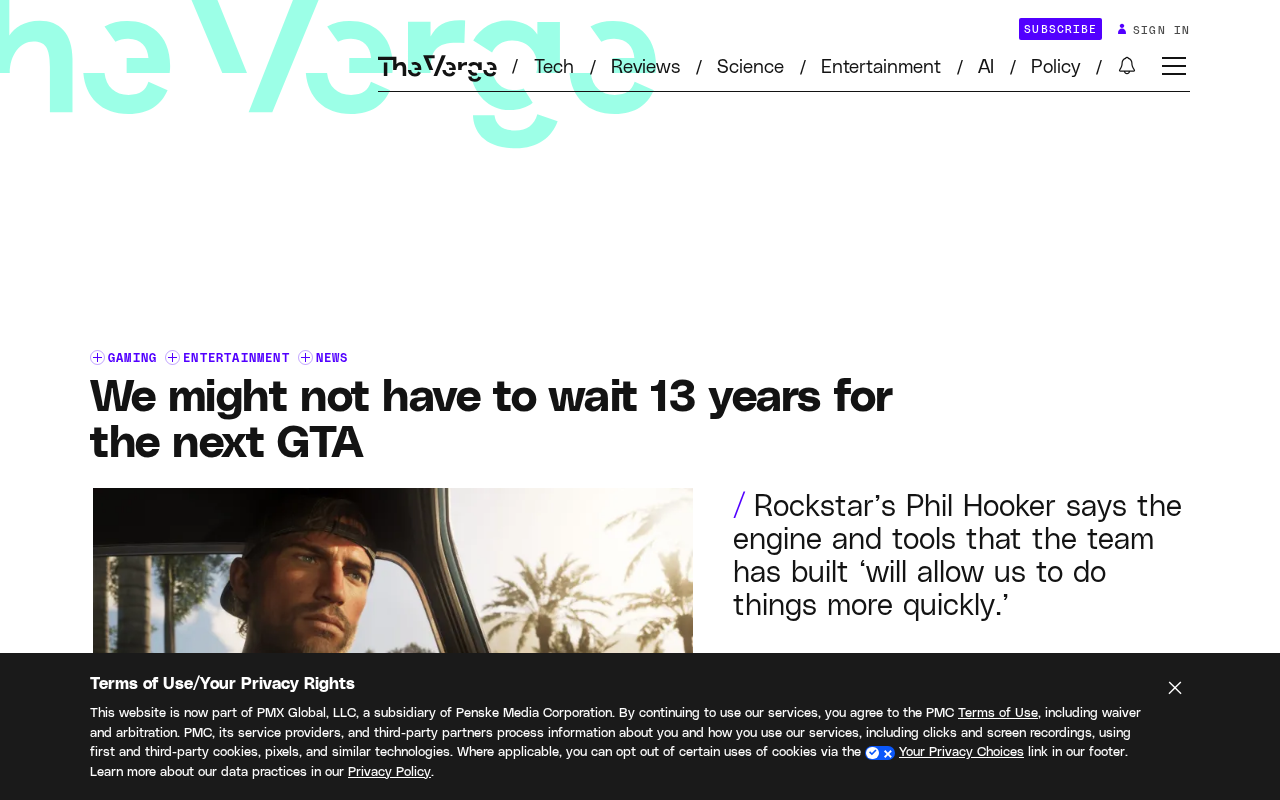
Hooker's exact words were: "The engine, tools, and team we've built on this project will allow us to [complete subsequent work more efficiently]." This statement may seem understated, but it reveals a core pain point of the game industry — the ballooning development cycles of AAA titles often stem from each new project requiring the rebuilding of the tech stack and the re-gelling of teams.
Bloomberg's report detailed the technical challenges encountered during GTA VI's development, including major upgrades to the RAGE engine, restructuring of the toolchain, and the additional workload brought by cross-generational hardware adaptation. These investments may only manifest in GTA VI itself as more refined visuals and more complex systems, but the real payoff lies in the next title — when the underlying technology no longer needs to be rebuilt from scratch, the development team can focus its energy on creativity and content rather than reinventing the wheel.
RAGE engine (Rockstar Advanced Game Engine) is a proprietary game engine independently developed and continuously iterated by Rockstar Games since 2006, first applied on a large scale in GTA IV. It integrates multiple subsystems including rendering, physics simulation (such as the Euphoria character animation system), audio, networking, and AI, serving as the technical foundation for all of Rockstar's AAA titles. Unlike commercial engines such as Unity and Unreal, RAGE fully serves Rockstar's internal needs, allowing the team to deeply customize it for open-world scenarios. However, this closed nature also means that with each generational transition, engine upgrades must be driven from scratch by internal teams, without the ability to leverage ready-made solutions from external ecosystems. According to Bloomberg, GTA VI involved "substantial upgrades" to RAGE, including reconstruction of the lighting system, streaming loading, and cross-platform rendering pipeline. The engineering effort was enormous, but once completed, subsequent projects can directly inherit it — this is precisely the core of the "engine accumulation" value Hooker referred to.
The Cost of a 13-Year Wait: Player Patience and Industry Shifts
From GTA V to GTA VI, the gap exceeds a decade. During this period, the gaming industry experienced the rise of games-as-a-service, the proliferation of subscription models, the diversion toward mobile, and a fundamental shift in players' expectations for content update speeds. Rockstar maintained momentum through the continuous operation of GTA Online, but loyal fans of the single-player mode have been waiting for a proper sequel all along.
The decade-plus gap also gave competitors room to breathe and expand. The open-world赛道 is no longer dominated solely by Rockstar, with multiple titles challenging it in gameplay innovation and narrative density. If the next installment still requires a wait of over ten years, Rockstar's market dominance will face a substantive threat. Therefore, Hooker's statement is not just technical optimism but also a necessary signal of business strategy.
Games as a Service (GaaS) is one of the most important business model shifts in the gaming industry over the past decade. Unlike the traditional "one-time purchase + optional DLC" model, GaaS games continuously release paid content such as seasons, battle passes, and limited-time events after launch, extending player retention cycles from weeks to years. GTA Online was an early benchmark for this model: since its launch in 2013, it has generated sustained revenue far exceeding single-player sales for Rockstar through continuously updated online modes and virtual currency systems. This model has profoundly changed the resource allocation logic of the AAA industry — publishers are more inclined to invest teams in operating existing successful products rather than risk launching new projects with long cycles and uncertain returns. This is also one of the structural reasons why GTA VI has taken so long: when GTA Online was still printing money efficiently, the commercial urgency to release a sequel was greatly diminished.
Team and Process Maturity: Assets Harder to Replicate Than Technology
While the reuse of technical tools is important, Hooker specifically mentioned "team" — an asset even harder to accumulate than code. In large-scale game development, the loss of tacit knowledge due to personnel turnover is often the primary cause of project delays and quality fluctuations. Although GTA VI's development cycle was lengthy, it also allowed Rockstar's various studios to form more mature collaboration patterns.
Bloomberg's report noted that during GTA VI, Rockstar integrated resources from multiple global studios and adjusted its internal management structure to reduce friction. If this organizational-level optimization can be continued in subsequent projects, the improvement in development efficiency could be more significant than any engine upgrade. Of course, the premise is that core talent does not experience large-scale attrition and that management does not once again fall into the inertia of "over-polishing."
Tacit Knowledge is a core concept in organizational management, referring to experiential knowledge that is difficult to codify and transfer through documents or process manuals — such as senior developers' intuitive judgment of an engine's "temperament," informal collaboration chemistry between teams, and the decision-making rhythm formed through long-term磨合. In large-scale game development, the loss of tacit knowledge is often more fatal than the loss of technical assets. A key lead programmer leaving may take away decades of accumulated optimization experience; a core designer jumping ship may cause the entire level design language to fall into discontinuity. During GTA VI's development, Rockstar integrated multiple global studios (such as Rockstar North, Rockstar San Diego, etc.), and this cross-timezone, cross-cultural collaboration itself constitutes a scarce organizational capability. Even if engine code can be inherited, if core talent is lost in large numbers, new teams still need to rebuild tacit knowledge, and the improvement in development efficiency becomes impossible to achieve.
Cautious Optimism: The Distance Between Promise and Reality
It is important to recognize that Hooker's remarks did not provide a specific timeline, nor did he promise that "the next installment will only take five years." He merely stated a technical fact: the foundation has been laid. But game development cycles are influenced by too many variables — creative direction adjustments, sudden technical challenges, market strategy changes, or even a public relations crisis triggered by an unexpected leak.
Moreover, Bloomberg's report itself mentioned that GTA VI's development was not smooth sailing, having undergone multiple restarts and directional corrections. This shows that even with tools and teams in place, uncertainty at the creative level still exists. Players can hold expectations for "shorter cycles," but should not misinterpret it as "rapid iteration." Rockstar's DNA is engraved with an obsession with detail — this is both a guarantee of quality and a time sink.
What It Means for the Industry
If Rockstar can truly compress the development cycle of its next title to a reasonable range, it will be an important reference for the entire AAA industry. Currently, the development costs of multiple flagship open-world games have exceeded hundreds of millions of dollars, with cycles often spanning six to eight years. Rockstar's experience — long-term investment in underlying technology, cross-project reuse of toolchains, maintaining core team stability — may offer a path for other studios trapped in the "bigger means slower" dilemma.
However, every studio differs in scale, resources, and product characteristics, and Rockstar's model may not be simply replicable. But at least it proves one thing: shortening cycles is not about squeezing developers, but about smarter technology accumulation and organizational building. For players, less agonizing waiting and more high-quality titles is the best news.
One-line Summary
Rockstar's technical director says the engine, tools, and team accumulated during GTA VI will accelerate future projects, and players may not have to wait another decade-plus.
Paragraph Summary
According to Bloomberg, Rockstar technical director Phil Hooker stated that the RAGE engine upgrades, toolchain restructuring, and mature team collaboration patterns built during GTA VI's development will enable future projects to advance faster. From GTA V to GTA VI, the gap exceeded a decade, during which games-as-a-service rose, the competitive landscape shifted, and Rockstar's single-player fans waited for a long time. Hooker's remarks suggest that the accumulation of underlying technology can reduce redundant construction and allow teams to focus on creativity. But the report also noted that development was not smooth sailing, and creative uncertainty, management inertia, and talent attrition remain real obstacles to shortening cycles. If Rockstar succeeds in compressing cycles, it will provide an important reference for the AAA industry mired in the "bigger means slower" dilemma.
Related articles

iPhone Duo Battery Life Tested: One Charge a Day Is Unavoidable, and the Large Screen Is the Culprit
iPhone Duo battery test: heavy use needs at least one charge a day, and about 30% remains after 6.5 hours of screen-on time. How often the large screen is unfolded is key; a MagSafe battery pack helps, and long-term degradation is also worth watching.

Kimi K3.1 Pro Open-Sourced: 2.8 Trillion Parameters Close In on Opus
Moonshot releases the open-source MoE model Kimi K3.1 Pro, with 2.8T total parameters and 104B activated, trailing Opus 5.5 by under 1 point on Terminal Bench 4.0.

Costco Tech Price Guessing: Are Monitors, Keyboards, Mice, and Bose Speakers Worth It?
A YouTube blogger guesses prices of Costco tech products: 2K 180Hz monitor, Logitech keyboard and mouse, Bose speaker, and CyberPower UPS, revealing warehouse-store selection and brand premium.