No Real Text Required: Synthetic Priors Enable Models to Learn Languages In-Context

A 300M-parameter model trained only on synthetic data learns six real languages in-context without any fine-tuning.
Researchers extend the Prior-fitted Networks (PFN) framework from tabular data to natural language, training a 300M byte-level Transformer exclusively on synthetic sequences from random recurrent causal models — no real vocabulary or grammar included. At inference time, the frozen model reads Wikipedia text and reduces prediction loss from near the theoretical ceiling of 8 bits/byte down to 0.9–2.4 across six typologically diverse languages (English, Chinese, Hindi, Arabic, Japanese, Korean). The same model also handles counting, approximate addition, and Kolakoski sequence prediction in-context. The key finding: in-context language learning ability can arise from purely synthetic, non-linguistic priors, offering a "prior engineering" alternative to data-heavy pretraining for low-resource settings.
A Counterintuitive Experiment: Teaching a Model to Learn Language with Synthetic Data
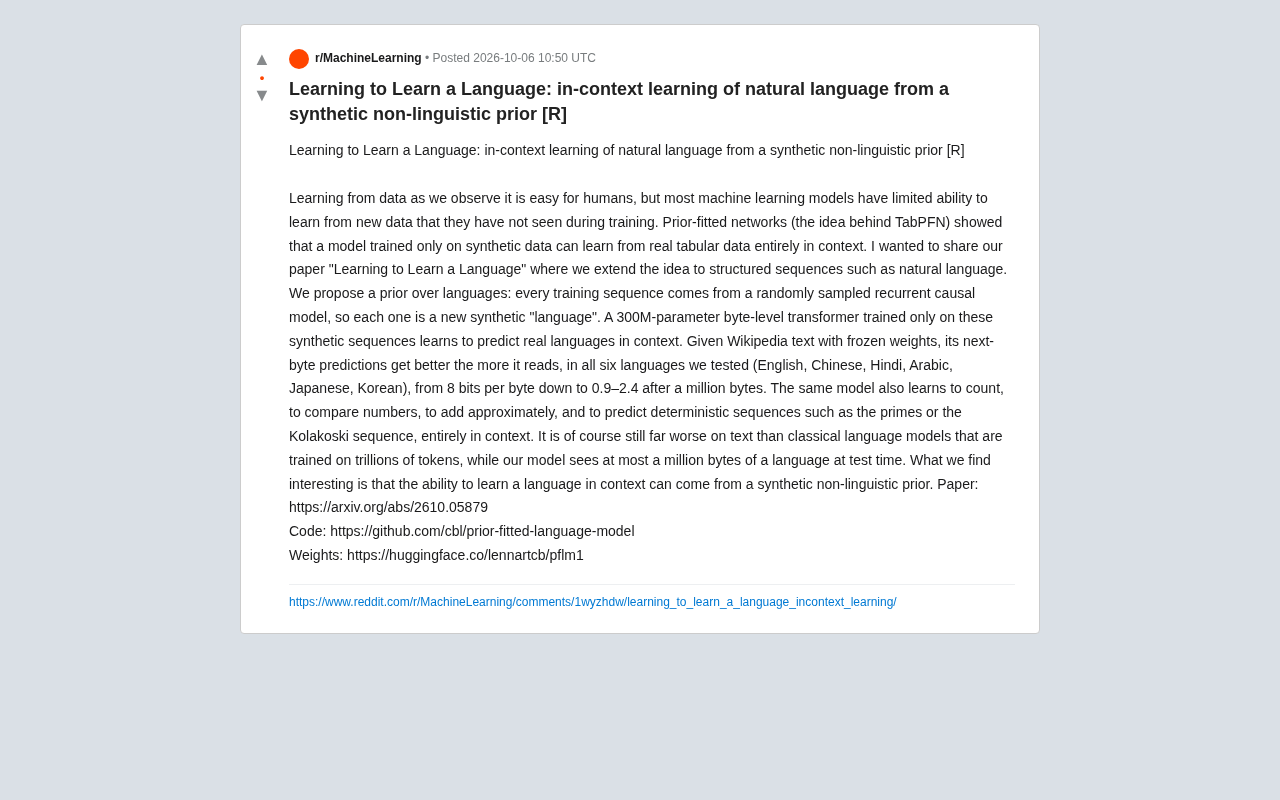
Humans learn effortlessly from observed data, but most machine learning models struggle to learn from new data they've never seen during training. A research paper titled Learning to Learn a Language proposes a provocative idea: train a model on nothing but synthetic data, then have it learn to predict real natural language purely at inference time — in-context.
This work follows the line of Prior-fitted Networks (PFN), the core idea behind TabPFN. TabPFN demonstrated that a model trained exclusively on synthetic data can learn real tabular data entirely through context. This paper extends that idea from tables to structured sequences — that is, more complex objects like natural language.
The Core Method: Defining a Prior Over "Language" Itself
The key insight is constructing a prior distribution over languages. Concretely, every training sequence is drawn from a randomly sampled recurrent causal model, so each sequence is essentially a brand-new synthetic "language."
In other words, the model never encounters a single real word, character, or grammatical rule during training — only byte sequences generated by random rules. Rather than memorizing any specific language, the model is asked to learn the meta-skill of "how to learn a language" (learning to learn).
The model itself is a byte-level Transformer with 300 million parameters. Byte-level modeling means it doesn't rely on any predefined tokenizer and works directly on raw bytes, which naturally makes it language-agnostic.
Results: The More It Reads, the Better It Predicts
The most compelling results come from cross-lingual tests. With frozen weights, the model reads Wikipedia text — no fine-tuning, no parameter updates; all "learning" happens within the context window.
The results show that as the number of bytes read increases, the model's next-byte predictions improve steadily. This pattern holds across all six tested languages (English, Chinese, Hindi, Arabic, Japanese, Korean): prediction loss drops from an initial ~8 bits/byte to 0.9–2.4 bits/byte after reading one million bytes.
This trend is direct evidence of in-context learning — the model is never retrained; it simply reads the context and figures out the statistical structure of an unfamiliar language. Given how dramatically these six languages differ in writing systems and grammar, the model's ability to adapt universally suggests it has learned a truly abstract "learning mechanism," not surface features of any particular language.
Bits per byte (bits/byte) is the standard evaluation metric for byte-level language models. It measures how many bits the model needs on average to encode one byte — essentially cross-entropy in base 2. A uniform distribution with no knowledge of byte statistics has a theoretical ceiling of 8 bits/byte (since one byte has 256 possible values, and log₂256 = 8). Lower values indicate better capture of the sequence's statistical structure: mature large language models typically achieve below 1 bit/byte on English text. Dropping from near the theoretical ceiling (~8) down to 0.9–2.4 means the model has built quite effective predictive ability over the byte distributions of all six languages — purely from in-context reading — even if it still lags behind models trained on massive real corpora.
Beyond Language: Numbers and Deterministic Sequences
Even more intriguing, the same model demonstrates capabilities beyond language — all in-context, without any additional training:
- Counting
- Comparing numbers
- Approximate addition
- Predicting deterministic sequences, such as the prime sequence and the Kolakoski sequence
The emergence of these abilities is revealing. They suggest that a model trained on synthetic, non-linguistic priors acquires a more fundamental capacity for inducing regularities from sequences. Language is just one application of this capacity; numerical reasoning and deterministic sequence prediction are others.
The Kolakoski sequence is a classic self-describing integer sequence: 1, 2, 2, 1, 1, 2, 1, 2, 2, 1, 2, 2, 1, 1, … defined by the property that the run-length encoding of the sequence equals the sequence itself. Because it is neither random nor capturable by simple statistical patterns — owing to its complex self-referential structure — it serves as a strong benchmark for testing whether a model has truly inferred an underlying generative rule. The model's ability to predict this deterministic sequence in-context suggests it has learned something more abstract than probabilistic statistics — a form of rule induction qualitatively different from the statistical compression logic of language modeling. This is key evidence for the authors' claim that their prior captures "sequence-generating mechanisms" rather than surface patterns of language.
How to Interpret the Significance of This Work
The researchers are candid about limitations: on text tasks, this model is still far behind classical language models trained on trillions of tokens. This is an admittedly uneven but instructive comparison — classical LLMs see massive real corpora during training, while this model reads at most one million bytes of a given language at test time, having seen zero real vocabulary during training.
What truly matters is not the absolute performance, but the core finding: the ability to "learn a language in-context" can emerge from a purely synthetic, non-linguistic prior.
This directly informs our understanding of what in-context learning really is. It suggests that in-context learning ability may not depend on exposure to similar real data during pretraining — it may instead stem from the model's mastery of the meta-task of "how to induce regularities from sequences." For data-scarce domains, low-resource languages, or scenarios requiring rapid adaptation to entirely new structures, this "prior engineering" approach offers a path distinct from simply accumulating more data.
Reproducibility Resources
This work provides complete open resources for community verification and follow-up:
- Paper: arXiv:2610.05879
- Code: GitHub repository
cbl/prior-fitted-language-model - Model weights: Hugging Face
lennartcb/pflm1
For researchers interested in in-context learning, the PFN paradigm, and data-efficient learning, this is an experiment worth reproducing firsthand.
Background
Prior-fitted Networks (PFN) are meta-learning models trained within a Bayesian inference framework. The core idea: manually design a prior distribution for the target task, then sample from that prior to generate large amounts of synthetic training data, letting the model learn to "infer through context" rather than learn a specific task's solution. At inference time, the model simply takes the new sample's context as input and produces predictions — no gradient updates required. TabPFN applies this to tabular classification: the prior generates synthetic tables from random decision trees, and the trained model classifies small real tables in milliseconds, matching the performance of tuned gradient boosting methods.
Recurrent causal models are the prior generation mechanism this paper designs for language sequences: each sequence is produced step-by-step by a randomly sampled state machine or probabilistic automaton, so every sequence follows a self-consistent but mutually independent "grammar." This exposes the model during training to as diverse a range of sequence-generating rules as possible, without any statistical patterns from a specific natural language.
Related articles

Should U.S. College Fraternities Be Banned? A Researcher's Incisive Observations
Why not just ban U.S. college fraternities? A researcher finds the key resistance comes from decision-makers' own fraternity identities and schools' "willful ignorance."

Microsoft Discovery: Accelerating Scientific Discovery with AI Agents
Microsoft's Discovery platform runs specialized AI agents to help researchers screen and prioritize the most promising compounds and experimental paths, reducing experiments and accelerating scientific discovery.

Cambridge Heavy Industries Secretly Develops Desktop-Scale Nuclear Fusion Device
Cambridge Heavy Industries is secretly developing a desktop-scale laser-driven nuclear fusion device, targeting the equipment supply market for fusion power plants. This article analyzes its miniaturization technology path, commercialization logic, and unique positioning in the fusion startup wave.