No-Regret Generation: A New Theoretical Framework for Online Learning in Language Models
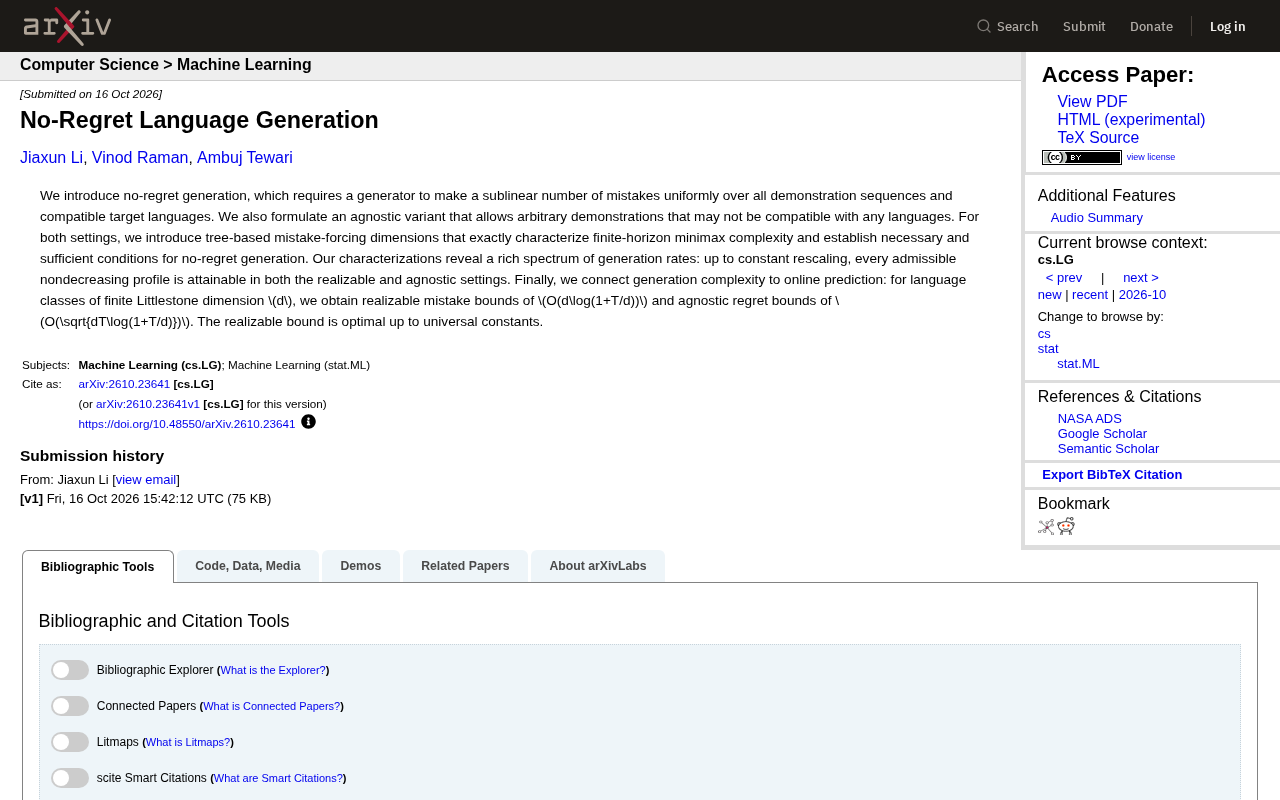
The paper proposes a no-regret generation framework, proving that language generation can continuously improve from mistakes like online learning, with a rate spectrum and regret bounds.
"No-Regret Language Generation" models language generation as an online decision-making problem, where the generator outputs step by step based on historical demonstrations, requiring sublinear mistake growth. It distinguishes realizable and agnostic settings, introduces tree-based mistake-forcing dimensions to characterize minimax complexity, and provides necessary and sufficient conditions for no-regret generation. Theoretical analysis reveals a complete rate spectrum: up to constant scaling, every non-decreasing rate curve is achievable in both settings. For finite Littlestone dimension language classes, it gives mistake bound O(d log(1+T/d)) and regret bound O(√(dT log(1+T/d))), embedding language generation into online learning.
Can language generation models continuously improve from mistakes without regret, just like online learning algorithms? A new paper titled "No-Regret Language Generation" proposes a theoretical framework called "no-regret generation," attempting to establish regret bound analysis for language generation tasks similar to that of online prediction. This work treats the generation process as an online decision-making problem: the generator produces output at each step based on the history of demonstration sequences, and is expected to make mistakes a sublinear number of times within a finite number of steps.
Core Setup: Learning from Demonstration Sequences
The paper defines two settings. In the realizable setting, there exists a target language set compatible with all demonstration sequences, and the generator needs to produce correct outputs within this set. In the agnostic setting, demonstration sequences may not be compatible with any language, and the generator still needs to guarantee sublinear regret. This is analogous to the realizable and agnostic cases in online learning, but extends the prediction target from a single label to language sequences.
The authors introduce "tree-based mistake-forcing dimensions" to precisely characterize the minimax complexity under finite horizons, and provide necessary and sufficient conditions for no-regret generation. This dimension tool is similar to the role of Littlestone dimension and covering numbers in online learning, but targets the structured output space of language generation.
Online Learning and Regret Bounds: Online learning is a branch of machine learning where a model receives data sequentially over time steps, makes predictions, then obtains true labels and incurs losses. Regret is defined as the difference between the model's cumulative loss and the cumulative loss of the best fixed strategy in hindsight. If regret grows sublinearly with the number of steps T (e.g., O(√T)), the algorithm is called "no-regret," meaning the average loss is asymptotically optimal. This framework is widely used in online convex optimization, expert advice, and bandit problems.
Littlestone Dimension: The Littlestone dimension is a combinatorial quantity measuring the complexity of online learning for binary classification concept classes, defined as the maximum length of a sequence that can be "mistake-forced" by the concept class. If the concept class can label any sequence such that the learner makes a mistake at every step, that sequence length is the mistake-forcing number. The Littlestone dimension is finite if and only if there exists a no-regret online learning algorithm with mistake bound O(d log T). It is analogous to the role of VC dimension in batch learning, but directly characterizes online mistake upper bounds.
Generation Rate Spectrum: Almost All Rates Are Achievable
Theoretical analysis reveals a rich spectrum of generation rates: up to constant scaling, every admissible non-decreasing rate curve can be achieved in both the realizable and agnostic settings. This means the theoretical framework is not limited to a specific convergence rate, but provides a complete collection of achievable rates.
This "rate spectrum" result is uncommon in online learning theory, where we typically only care about the optimal rate itself. The authors prove this conclusion through constructive methods, showing that the complexity of generation tasks can be flexibly mapped onto the rate space.
Minimax Complexity and Rate Spectrum: Minimax complexity refers to the minimum possible regret under the worst case (adversary choosing demonstration sequences) and the best case (generator choosing strategy), and is the standard measure of the intrinsic difficulty of a learning problem. The rate spectrum refers to the set of all achievable regret growth rate curves. The paper proves that up to constant scaling, every class of non-decreasing rate curves corresponds to a realizable generator, which is more refined than merely giving the optimal rate, revealing a flexible mapping between complexity and rates.
Deep Connection to Online Prediction
Another key contribution of the paper is linking generation complexity to online prediction complexity. For language classes with finite Littlestone dimension (d), the authors obtain the mistake bound in the realizable setting: (O(d\log(1+T/d))), and the regret bound in the agnostic setting: (O(\sqrt{dT\log(1+T/d)})). The realizable bound is optimal up to constant factors.
This set of results rigorously embeds the language generation problem into the online learning framework. The Littlestone dimension is a classic quantity measuring the online learning difficulty of concept classes, and the paper shows it also applies to language generation—as long as the language class has finite Littlestone dimension, guarantees similar to online prediction can be obtained.
Why This Theoretical Work Deserves Attention
Current language models mainly rely on offline training and maximum likelihood estimation, lacking theoretical guarantees for "online continual learning" behavior. The no-regret generation framework provides an analytical perspective: if the rate at which the generator makes mistakes during interaction is sublinear, then it gradually converges to correct behavior in an average sense. This framework does not require the model to know the target language in advance, but rather adapts gradually through demonstration sequences.
Of course, the conclusions of this work currently remain at the theoretical level, and there is still a considerable distance to practical large model training. How to compute the Littlestone dimension of language classes and how to choose the length scale of demonstration sequences are questions that need to be answered subsequently. But as a new language for generation theory, it at least provides a rigorous mathematical foundation for the generation paradigm of "learning from mistakes."
Offline Training and Online Continual Learning: Offline training refers to a model learning once through maximum likelihood estimation on a fixed dataset, unable to adapt to new data; online continual learning requires the model to update gradually during interaction, avoiding catastrophic forgetting. The no-regret generation framework provides theoretical guarantees for online learning behavior: as long as the mistake rate is sublinear, average performance converges to optimal. This provides a mathematical foundation for language models to continuously improve from demonstrations.
One-line Summary
The paper proposes a no-regret generation framework, proving that language generation can continuously improve from mistakes like online learning, and provides a rate spectrum and regret bounds.
Paragraph Summary
"No-Regret Language Generation" models language generation as an online decision-making problem, where the generator outputs step by step based on historical demonstration sequences, requiring the number of mistakes to grow sublinearly. The paper distinguishes between realizable and agnostic settings, introduces tree-based mistake-forcing dimensions to characterize minimax complexity under finite horizons, and provides necessary and sufficient conditions for no-regret generation. Theoretical analysis reveals a complete generation rate spectrum: up to constant scaling, every class of non-decreasing rate curves can be achieved in both settings. For language classes with finite Littlestone dimension, the authors obtain a realizable mistake bound of O(d log(1+T/d)) and an agnostic regret bound of O(√(dT log(1+T/d))), with the former optimal up to constant factors. This work rigorously embeds language generation into the online learning framework, providing a rigorous mathematical foundation for the generation paradigm of learning from mistakes.
Related articles

Why Does the Tesla Roadster Need to Fly? A Deep Dive into Musk's Wild Demo
Tesla's Roadster launch showed wall-climbing, upside-down driving, and flying stunts—but The Vergecast notes the demo car may lack a battery, the Rocket version is invite-only and not street-legal, and the website terms don't guarantee delivery. After nine years of delays, why does this car still need to exist?

AI Is Not a Replacement: Human-AI Collaboration Through the Lens of Factory Root Cause Analysis
Starting from factory root cause analysis, this article explains how AI accelerates evidence chain construction rather than replacing human experts, exploring the pragmatic implementation logic and business value of 'AI supporting people rather than replacing them.'

AI Agent Decision Auditing: Building an Evidence Chain in Regulated Workflows
Starting from a Reddit discussion, this article analyzes three core issues in AI agent decision auditing within regulated workflows: what fields audit records should contain, how to handle feedback latency for erroneous decisions, and how to continuously calibrate LLM judge consistency with human judgment.