No Rocket Needed: Longshot Wants to Fire Cargo Into Space With a Cannon

Longshot proposes replacing rockets with a giant cannon to make space data centers economically viable.
Longshot is attempting to fire cargo directly into space using a giant cannon, bypassing the fuel cost bottleneck of traditional chemical rockets. The article analyzes its core goal of making space data centers viable — leveraging continuous solar power and cold-space heat dissipation to avoid the energy and land pressures of ground-based data centers. But cannon launch's fundamental challenge is the extreme instantaneous acceleration's impact on precision electronics, plus post-launch attitude and orbital correction. This non-rocket orbital approach isn't new — historical projects repeatedly failed to materialize. Longshot will present at TechCrunch Disrupt 2026; the key question is whether it can provide engineering data on cost, G-forces, and payload types.
While Everyone Watches Rockets, This Company Is Building a Cannon
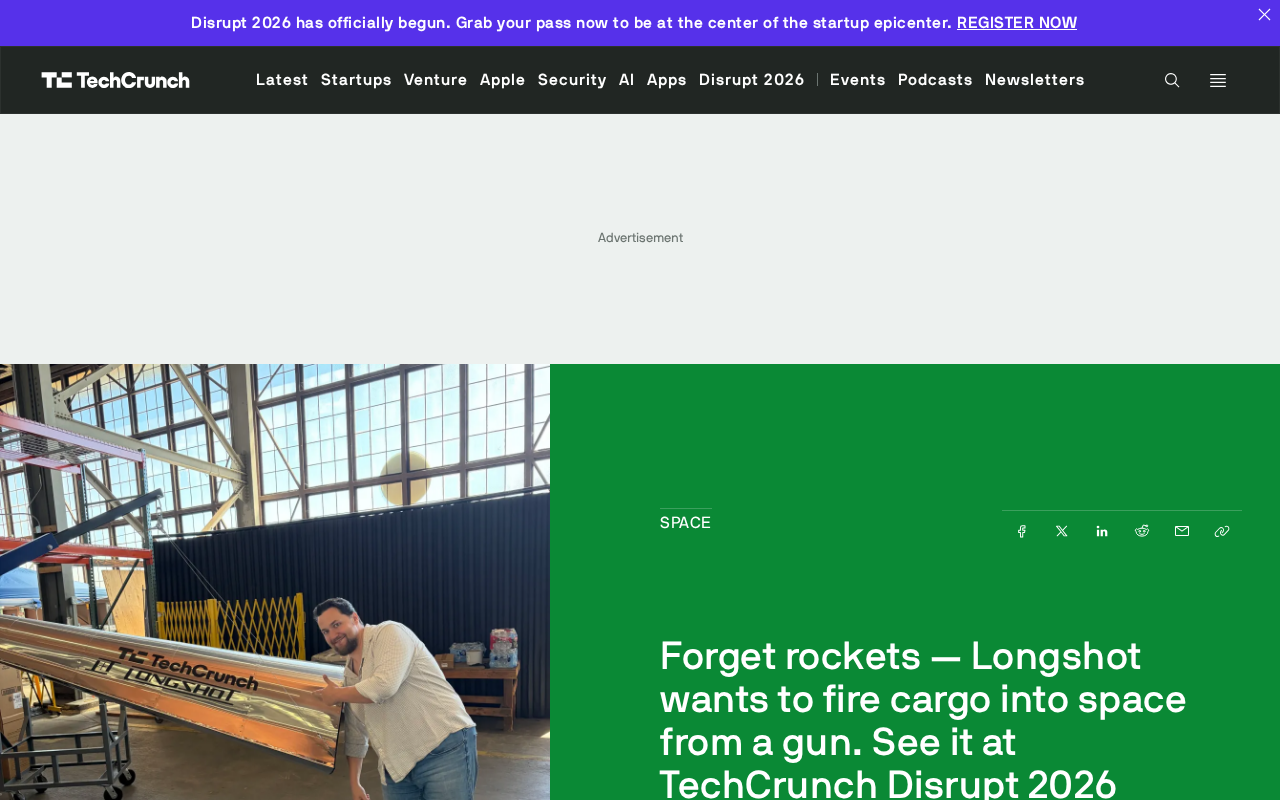
According to TechCrunch, a company called Longshot is pursuing a completely different path to orbit: no rocket — just a cannon big enough to shoot cargo straight into space. Its goal sounds even more sci-fi: making "space data centers" a reality this way.
This isn't an incremental improvement in launch technology. It's a re-questioning of the assumptions underpinning the entire space industry supply chain.
What Longshot Is Actually Trying to Do
Longshot's vision can be summarized as: build a "space gun" far larger than any traditional cannon, using a ground-based launcher to impart extremely high initial velocity to a payload, allowing it to escape the atmosphere without carrying large amounts of propellant.
The problem with traditional chemical rockets is that the vast majority of mass is fuel — you have to fly with your fuel, and that fuel itself requires more fuel to accelerate. Cannon launch logic is entirely different: the energy supply stays on the ground, and the vehicle only needs to withstand the acceleration at the moment of launch.
This is the crux of Longshot's argument: if launch costs can be driven low enough, space applications that were previously economically unviable become feasible — and space data centers are one of them.
Why "Space Data Centers"
Putting data centers in orbit seems counterintuitive at first glance — electricity and maintenance are far cheaper on the ground. But space has a few conditions that are hard to replicate on Earth:
- Near-continuous solar power: No day-night cycle or weather effects means higher power supply stability and energy density.
- Different thermal environment: The cold background of space offers an alternative approach to thermal management.
- No consumption of ground land or water resources: For a data center industry under enormous pressure on energy consumption and site selection, this is a long-term potential attraction.
The only prerequisite for these advantages to materialize is that the cost of sending massive amounts of hardware into orbit must be absurdly low. The high unit price of rocket launches is precisely what's blocking this vision — and it's exactly what Longshot is betting on.
Heat dissipation in space is actually harder than on the ground. In a vacuum, convection cooling is impossible; heat can only be radiated away as infrared, far less efficient than air or liquid cooling on Earth. So the "cold background" doesn't mean cooling is easier — on the contrary, satellites typically need large radiators and complex pumped fluid loops. Similarly, while solar power is continuous, geostationary orbit or suitable inclinations still experience eclipse periods (roughly dozens of times per year, up to about 72 minutes each), and in low Earth orbit, about one-third of each orbital period is spent in shadow.
What space data center proponents are really betting on is that future high-frequency launches will make hardware cheap enough, and that radiator and solar panel area will no longer be bottlenecks. This logic remains at the concept stage — no commercial-scale in-orbit data center is yet operational.
Where the Technical Challenges of Cannon Launch Lie
Using a gun to launch satellites is not a new concept — there have been multiple historical studies. The difficulty has always been clear: instantaneous acceleration.
Rocket launch G-forces are typically within a few g's, while cannon launch G-forces can be orders of magnitude higher. This places severe demands on payload structures, electronics, and subsequent orbital adjustments. The core problems Longshot needs to solve include:
- How to protect precision electronics at the moment of launch;
- Who performs attitude and orbital correction after exiting the barrel;
- The engineering scale and site selection requirements of the launch device itself.
These are aspects not yet fully elaborated in public information, and they are key to judging the viability of this approach.
Non-rocket orbital launch is not a new idea. As early as the 1960s, Canadian-born engineer Gerald Bull led Project HARP (High Altitude Research Project), using modified naval guns to shoot payloads into the upper atmosphere, achieving a suborbital flight of 180 km altitude in 1966 — still the record for gun-launched altitude. More ambitious proposals emerged in the 1990s: Lawrence Livermore National Laboratory proposed the Super High Altitude Research Project (SHARP), attempting to use electromagnetic railguns to place small satellites into low Earth orbit; the U.S. Navy later invested long-term in railgun technology, ultimately shelving it around 2021 due to barrel erosion, power supply scale, and cost issues.
The common conclusion of these historical projects: achieving high velocity isn't hard — what's hard is making barrel life acceptable, keeping payloads alive, and meeting commercial launch frequency requirements. Longshot claims to solve these problems, but no publicly available engineering validation data exists yet.
The distinction between suborbital and orbital launch is worth noting. Suborbital only requires vertical velocity to exceed the Kármán line (about 100 km), while true orbital insertion also requires horizontal velocity of about 7.8 km/s (first cosmic velocity). HARP only solved the former back then, which is the fundamental reason it couldn't replace rockets.
A More Noteworthy Signal
Setting aside technical details, what makes Longshot worth watching is the shift in thinking it represents: while mainstream aerospace companies are optimizing rocket reusability and launch frequency, someone has picked up the old proposition of "non-rocket orbital launch" and tied it to today's hottest data center demand.
Longshot will present its approach at TechCrunch Disrupt 2026. What the outside world should focus on then isn't how flashy the demo is, but whether it can provide substantive data on cost, G-forces, and payload types.
In aerospace, being able to propose an alternative that sounds crazy but is logically coherent has value in itself — whether it holds up depends on engineering data, not press conferences.
Related articles

Gemini 4 Argon Hands-On: AI Builds Board Games, Constructs Temples, and Trains Robots Autonomously
Gemini 4 Argon hands-on roundup: AI autonomously builds a desk racetrack and temple in Blender, writes a ray tracing engine, trains a humanoid robot to sink 7 shots, plus API pricing and developer access.

The Magic Octagonal Coin: Why Only 9% of People Can Predict Its Flip?
Only 9% of people can correctly predict the Magic Octagon coin flip. This article explains its spatial rotation mechanism, common cognitive pitfalls, and a new hypothesis based on Relevance Theory, exploring the limits of human spatial reasoning.

Sam Altman: AI Is Entering the Era of Scientific Discovery — Math Breakthroughs Will Replicate in Biology and Energy
Sam Altman says AI is entering the era of scientific discovery — math breakthroughs will replicate in biology, materials science, and energy to help develop new drugs and energy sources.