No Weight Perturbations Needed: Rethinking the Neural Thickets Hypothesis

Neural thicket gains actually stem from output diversity, selection, and voting—no weight geometry required.
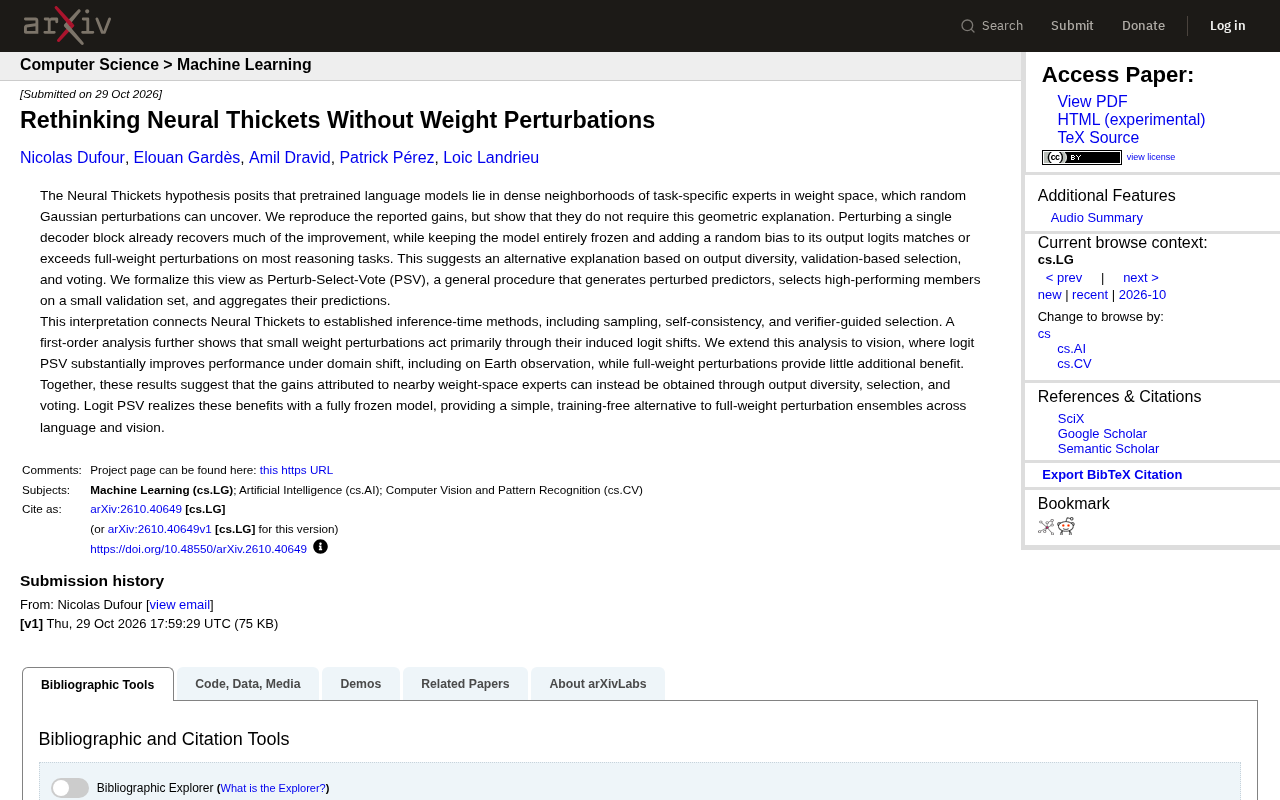
This article reexamines the Neural Thickets hypothesis and finds that the reasoning gains from random Gaussian perturbations do not require an explanation based on weight-space geometry. After reproducing the gains, researchers show that perturbing just a single decoder block recovers most of the improvement; keeping the model completely frozen and merely adding random bias to output logits matches or even exceeds full weight perturbations on most reasoning tasks. They propose the general Perturb-Select-Vote (PSV) framework: generate perturbed predictors, select high-performing members on a small validation set, and aggregate predictions. First-order analysis shows that small weight perturbations act mainly through induced logit shifts, linking neural thickets to sampling, self-consistency, and verifier-guided selection. Vision domain-shift experiments further confirm that logit PSV significantly improves performance while full weight perturbations provide almost no additional benefit.
The Neural Thickets Hypothesis: A Misread Finding
Do pretrained language models really contain dense neighborhoods of experts in weight space? The Neural Thickets hypothesis once proposed that random Gaussian perturbations could reveal these neighborhoods, thereby improving model performance on reasoning tasks. But a new study, after reproducing these gains, offers a very different explanation: these improvements do not require an explanation based on weight-space geometry.
Researchers found that perturbing just a single decoder block recovers most of the improvement, and that keeping the model completely frozen while merely adding random bias to its output logits matches or even exceeds the effect of full weight perturbations on most reasoning tasks. This points to a simpler mechanism: output diversity, validation-based selection, and voting.
Perturb-Select-Vote: A General Framework
Researchers formalized this new perspective as Perturb-Select-Vote (PSV), a general procedure: generate perturbed predictors, select high-performing members on a small validation set, and aggregate their predictions.
The elegance of PSV lies in its natural connection to existing inference-time methods. It links neural thickets with established techniques such as sampling, self-consistency, and verifier-guided selection. A first-order analysis further shows that small weight perturbations act primarily through the logit shifts they induce.
This means that the gains attributed to so-called "weight-space experts" can in fact be obtained through output diversity, selection, and voting. Logit PSV achieves these benefits on a completely frozen model, offering a simple, training-free alternative to full weight-perturbation ensembles for both language and vision tasks.
Self-consistency is a widely used inference-time technique: sample multiple reasoning paths for the same question, then take a majority vote on the final answer. It works because language models have randomness during generation, and different sampling paths may lead to the same correct answer. Verifier-guided selection, by contrast, generates multiple candidates and then uses an independently trained verifier model to score the candidates and pick the best one. The PSV framework unifies these two ideas: perturbation generation plays the role of sampling, validation-set selection corresponds to verifier screening, and vote aggregation aligns with self-consistency. Understanding this correspondence helps situate the neural thickets phenomenon within the existing spectrum of inference-time methods rather than treating it as an independent geometric discovery.
Cross-Modal Validation: From Language to Vision
The study did not stop at language models. The authors extended the analysis to the visual domain, and the results show that under domain shift (including Earth observation tasks), logit PSV significantly improves performance, while full weight perturbations provide almost no additional benefit.
This cross-modal consistency reinforces the core argument: the improvement comes from output-level diversity aggregation, not from local geometric structure in weight space. For practitioners, this means that without fine-tuning or perturbing weights, simply operating on logits at inference time can yield ensemble-like benefits.
Domain shift refers to the situation where the test data distribution differs from the training data distribution—for example, training on natural images but performing inference on satellite remote sensing imagery. Under domain shift, model performance usually drops significantly, and ensemble methods are regarded as a means of improving robustness. The vision experiments in this paper show that logit PSV still delivers clear gains under domain shift, while full weight perturbations provide almost no additional benefit. This contrast is crucial because it rules out "local geometric structure in weight space" as the source of the gains: if the gains truly came from expert structure in weight neighborhoods, full weight perturbations should outperform the lightweight approach that only operates on logits, but the experimental results are exactly the opposite.
Implications for AI Research and Applications
This reexamination of the Neural Thickets hypothesis has multiple implications.
On the theoretical level, it challenges overinterpretation of weight-space geometry. The first-order analysis shows that the effect of small weight perturbations is linear and explainable through logit shifts, providing a cleaner mathematical framework for understanding perturbation ensembles.
On the practical level, Logit PSV offers a training-free, fully frozen alternative that lowers the barrier to deploying ensemble methods. This is especially attractive for resource-constrained scenarios or those requiring rapid adaptation.
On the methodological level, the study emphasizes the importance of validation-set selection. The "select" step in the PSV framework—choosing high-performing members on a small validation set—is the key link connecting perturbation generation and final voting, echoing the rise of verifier-guided selection among inference-time methods.
The researchers conclude that gains attributed to nearby weight-space experts can in fact be obtained through output diversity, selection, and voting. This conclusion not only simplifies our understanding of existing methods but also points the way toward designing more efficient inference-time ensemble strategies in the future.
Background Supplement
First-order analysis is the mathematical tool for understanding the core argument of this paper. Its basic idea is to Taylor-expand the effect of weight perturbations on model outputs, keeping only the first-order linear term: the change in output is approximately the inner product of the perturbation vector and the gradient of the output with respect to the weights. Under this approximation, a small weight perturbation is equivalent to applying a gradient-determined offset to the output logits. Therefore, directly adding random bias to the logits can, in a first-order sense, simulate the output change caused by weight perturbations without actually modifying or copying model weights. This explains why logit PSV on a frozen model can match the effect of full weight perturbations, and it provides a formal basis for the claim that "the gains stem from output diversity rather than weight geometry."
Related articles

A New Paradigm for Text Editing in Compose: TextFieldState Replaces the Old API
Jetpack Compose introduces the TextFieldState API to fix dropped characters and cursor jumps from async input. The old value/onValueChange callbacks will be deprecated in 1.13. This article covers InputTransformation, OutputTransformation, four state hoisting patterns, and new formatted text editing capabilities.

Remote Compose: A New Document-Driven Paradigm for Cross-Platform UI on Android
Remote Compose transmits compact binary documents instead of screen pixels, enabling efficient UI rendering on remote surfaces like Wear OS and widgets. This article covers its document creation API, expression animations, size optimization techniques, and Wear OS progress.

How Crashlytics Eliminates Android Memory and Responsiveness Issues
Through the Chroma Clip case study, this article explains how Firebase Crashlytics uses Application Exit Info, Profiling Manager, GWP ASAN, and ARM MTE to pinpoint ANRs, OOMs, memory limit terminations, and native memory corruption—solving the challenge of stack traces that don't point to the real culprit.