Notion Co-founder: From Note-Taking Tool to AI Agent Workspace

Notion co-founder Simon Last on evolving from a note-taking tool to an AI agent workspace.
Notion co-founder Simon Last details Notion's evolution from a note-taking app into a human-agent collaboration platform: from first tasting GPT-4 in Mexico to personal and custom agents. He reveals why they rewrite their AI harness every six months, how engineers become "agent managers," and Notion's "Switzerland of models" strategy.
In the AI wave, few productivity tools have embraced large models as aggressively as Notion. Recently, Notion co-founder Simon Last spoke in detail on the No Priors podcast about Notion's complete journey from note-taking software to a "human-agent collaboration platform." The conversation not only reviewed key decisions in the technical roadmap but also revealed an emerging reality — software engineers are becoming "agent managers."
Starting with a First Taste of GPT-4 in Mexico
Simon revealed that Notion's deep engagement with AI began during a company retreat in Mexico in 2022. When he and co-founder Ivan first gained access to GPT-4 (which at the time was a ChatGPT-like prototype interface), two things made them instantly realize "the time had come."
GPT-4 is the multimodal large language model that OpenAI officially released in March 2023. Compared to its predecessor GPT-3.5, it showed significant improvements in reasoning ability, instruction following, and knowledge accuracy. Simon and his team were able to get access before the official launch thanks to the early testing channel OpenAI provided to enterprise partners. Such large language models (LLMs) learn linguistic patterns and world knowledge through pre-training on massive amounts of text, then align with human intent through RLHF (Reinforcement Learning from Human Feedback), giving them the ability to follow complex instructions. The arrival of GPT-4 was widely seen as a critical inflection point for generative AI, directly spawning a large number of AI-native products and features — Notion's early bet was a textbook case within this wave.
First, the model was "quite smart," able to follow relatively complex instructions and help you write and edit; second, its breadth and depth of knowledge were "absolutely astonishing." "After playing with it, the two of us immediately knew — now was the time to start thinking about how to apply it, and it would only get better."
Interestingly, from the very beginning they established both short-term and long-term roadmaps simultaneously. The short-term path was the obvious writing assistant: select text to rewrite, generate content, look up information, and provide sources. The long-term path was a grander general-purpose assistant — giving the AI all the tools a human has in Notion, enabling it to create databases, query, operate, generate and edit documents, and weave these capabilities together to complete long-horizon tasks.
The short-term AI Writer launched quickly in February 2023, while the long-term general agent vision "was completely infeasible at the time" and took several years to truly realize.
Indexing and Retrieval: A Multi-Year Battle
After AI Writer, Notion's next major project was Q&A — building a semantic index over the entire workspace so users could ask questions and get answers backed by sources. The beta version launched early, with the official GA in October 2023.

Semantic indexing here is the core technical foundation of modern AI Q&A systems, and it differs from traditional keyword-matching retrieval. Its principle is to convert text into high-dimensional vectors using an embedding model, so that semantically similar content is closer together in the vector space, enabling "retrieval by meaning" rather than "retrieval by literal words." This technique is typically combined with a RAG (Retrieval-Augmented Generation) architecture: the system first retrieves the text fragments most relevant to a question from the knowledge base, then feeds them as context to the large model to generate a well-grounded answer. This is precisely the technical foundation that allows Notion Q&A to provide "answers backed by sources."
Simon admitted that after getting Notion's own indexing working, the team went on to index all external data sources like Slack and Google Drive, and has now built a "fairly complete index." When asked "if these native products haven't even indexed their own content well, what makes Notion able to do it," he was blunt: "Most companies are pretty terrible at indexing, which honestly baffles us a bit."
He believes the secret to success lies in two things: first, "an acuity honed by AI," and second, craftsmanship and attention to detail. "Retrieval has to be very empirical and iterative — you really have to try all kinds of queries. Every data source has its quirks — querying Slack and querying Google Drive are two completely different information formats, and you can't apply a one-size-fits-all approach."
A detail worth noting: thanks to embedding technology, how users organize the structure of their workspace (the tree hierarchy) no longer matters as much. "The AI doesn't care about your folder structure; it only cares whether there's a passage of text containing the needed context that can be retrieved." This stems from the technical nature of vector retrieval, which relies on semantic similarity rather than manual hierarchy to locate information. As a result, Notion now advises users to "not obsess over organization — just find a way to dump everything in."
Rewriting Every Six Months: Embracing the Rhythm of Model Evolution
A recurring theme in the conversation was that Notion rewrites its AI harness roughly every six months, which has almost become an inside joke at the company.

The "AI harness" refers to the engineering system that wraps around the underlying model to orchestrate agent behavior, including tool-calling logic, context management, task planning, and more. Because large model capabilities often leap forward generationally every six months, a harness designed around an old model's capabilities quickly becomes obsolete — capabilities that once required complex engineering to compensate for may now be handled natively by a new model. This is exactly why Notion needs to frequently rewrite its harness.
Simon considers this precisely where many companies go wrong: "Many companies build it once and then keep using it forever. You have to be acutely aware of the current state of the models and technology, then deeply design your harness, systems, and products around it. This basically means you have to rewrite it every six months."
He also noted that as AI capabilities accelerate, the time required for rewrites keeps shrinking — because coding agents themselves are helping him do the work. And this has dramatically raised "the ambition of what the team dares to envision."
A Fundamental Transformation in Engineering and Product Organization
Simon detailed several eras that coding agents brought to Notion's engineering organization: from the earliest "tab autocomplete era" to agents beginning to truly work end-to-end. He started using Claude Code around April 2024, calling it a "huge unlock."
It's worth mentioning that an AI agent refers to an AI system that can autonomously perceive its environment, plan tasks, call tools, and execute multi-step operations to achieve goals — going beyond single-turn Q&A to have "the ability to act." A coding agent is an agent focused on software development scenarios, such as Anthropic's Claude Code and GitHub Copilot. They can understand requirements, write code, run tests, and fix errors, achieving end-to-end development tasks — this is the essence of what Simon calls the leap from "tab autocomplete" to "end-to-end work."
Regarding changes in team structure, he had several distinct viewpoints:
Individual Impact Vastly Amplified: 10x Becomes 100x or Even 1000x
"Everyone's output ceiling can be much higher, and your output increasingly depends on your ability and willingness to use the tools." He emphasized that the gap between engineers is widening: "The floor hasn't changed, but the ceiling has been raised enormously. With the right tools, you can become a 100x or even 1000x engineer."
Small Tiger Teams Remain Optimal
The impact on team size isn't significant. "We mostly like using small tiger teams. If you can keep the team small, it's almost always better — this held true before and still holds true now."
Messier, but More Productive
"Overall it feels messier and noisier, but I quite like this state." He gave the example that the design team built a Git repository called "design playground," containing a simplified version of Notion plus various UI primitives, so designers can quickly deploy high-fidelity prototypes — no longer discussing "how would this look" against a static mock, but directly handing you a deployed URL.
Regarding code quality and security, Notion still reviews all PRs. "Now all PRs are written by agents, and they're often larger and more complex — that's the worst part; but the good part is they're usually more thoroughly tested. I now never ship a PR that hasn't been fully tested." He specifically cautioned that this is not "vibe coding" (shouting requirements on a whim), but rather seriously thinking about "what change I want to make, how to verify it, how to deploy it safely," and then having the agent assist in completing it.
Personal Agents and Custom Agents: The Vision Comes True
Notion "failed" three or four times on the general agent front, until fall 2024 when it truly launched a usable personal agent — available to nearly every user, able to access everything the user has permission to, create databases, update content, generate documents, search the web, and do research.
Last week (at the time of the interview), Notion also released Custom Agents. Unlike the personal agent, it has no access permissions by default and requires manual authorization, but once authorized it can run autonomously in the background. For example, it can be attached to a Slack channel to automatically respond to others' messages and archive tasks.

What excites Simon most about the future is having agents bootstrap their own capabilities: "Starting from an initial kernel, letting it self-bootstrap to do anything. For example, building an integration we don't yet support, deploying it, and then using it."
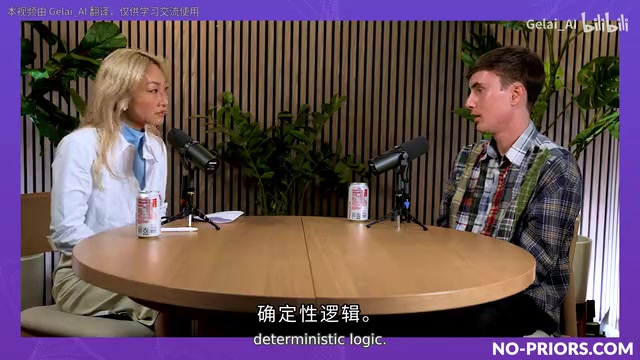
In his view, a coding agent is "the kernel of AGI": "AGI will be a coding agent. Code is an extremely useful primitive for expressing deterministic logic." Endowing knowledge-work agents with this capability means that when an integration doesn't exist, it can build one itself; when it needs to connect to a new data source, it can do it on its own.
"Switzerland of Models" and the Rise of Open-Source Models
Facing competition from larger-scale platform players like Microsoft, Simon positions Notion as "the Switzerland of models" — neutral and non-locking. "Our customers don't want to be locked into one lab's model. Every lab ships new versions every month, each with its own strengths and weaknesses. We want to be a place where you can conveniently access all the best models at any time and easily switch between them."
He's especially bullish on open-source models: "Open-source models are really good now. There are already four different Chinese models that are quite excellent. We just shipped one of them in our agent last week, and the other four are all coming next. They're great, and they're much cheaper than frontier models."
Over the past two years, the capabilities of open-source large models have rapidly closed in on — and in some tasks matched — closed-source frontier models. The "Chinese models" Simon mentioned likely include a group of high-performing open-source or open-weight models such as DeepSeek, Qwen, Kimi, and GLM. They deliver near-top-tier performance at much lower inference costs, posing strong competition to closed-source frontier models represented by OpenAI and Anthropic. For application-layer companies like Notion, a multi-model strategy means being able to flexibly switch based on cost, performance, and task type, avoiding lock-in to a single vendor — this is precisely the business logic behind the "Switzerland of models" positioning: stay neutral and hand the model choice to the user.
To make agents work well, Notion also redesigned its API specifically for "the new customer that is the agent": transforming the originally verbose and intimidating JSON block format into an enhanced Markdown dialect; and using SQLite for databases so agents can directly "speak SQLite," which works very well.
From "Writing Code" to "Managing Agents"
Toward the end of the conversation, Simon shared the dramatic change in his personal work style: "I stopped writing code myself starting last summer." His goal now is to "run as many agents in parallel as possible, and keep them running around the clock."
He even has a "bedtime ritual" — every night he makes sure to give his agents enough tasks so that when he wakes up in the morning they still haven't finished, "and that's a win." His personal record is keeping a coding agent running continuously for 13 days straight.
On the Notion agent side, he heavily uses the personal agent daily, and has also built several custom agents. His favorite is the email triage agent: it accesses all his work and personal inboxes and automatically archives emails he doesn't need to see every day. The training method is extremely simple — create a blank page as "memory," have the agent review emails and interview the user about their preferences, gradually generating rules. "For the first few days I was still correcting it, and after a few weeks I completely removed the approval step. Now it automatically archives all the emails I don't need to see, and it has completely solved my email problem."
From "building tools for humans to work directly" to "building tools for humans to manage agents' work," Simon believes this is a fundamental shift, but the underlying primitives are remarkably consistent: "You still need documents (agents love writing Markdown), and you still need databases (when you have a hundred background coding agents, you don't want a hundred chat threads, you want a kanban board)."
As Simon summed up: "I'm an agent manager now, not a coder." This may well be the future all knowledge workers are about to face.
Key Takeaways
Related articles

The Truth Behind Codex 'Build a Website in 5 Minutes': AI Isn't Creating Sites—It's Helping You Copy Them
Exposing the truth behind viral Codex 5-minute website videos: creators aren't building original sites with AI—they're copying shared prompts or scraping others' work. Learn AI coding tools' real limits.

Getting Started with AI Agent Development: A Complete Guide from Concept to Practice
A comprehensive guide to AI Agent architecture and development, covering automated marketing, intelligent customer service, and investment analysis scenarios with single and multi-agent collaboration.

The Truth Behind Codex 'Build a Website in 5 Minutes': AI Isn't Creating Sites — It's Helping You Copy Them
Exposing the truth behind viral Codex 5-minute website videos: creators aren't building original sites with AI — they're copying shared prompts or scraping others' work.