NS1 Review: Quantify Your Nervous System's Stress Resilience in 5 Minutes

NS1 quantifies your nervous system's stress resilience in 5 minutes with personalized training paths.
NS1 is a personalized nervous system training tool by Jonny Miller that delivers a regulation score, five-skill scorecard, and customized training path through a 5-minute assessment. Rooted in autonomic nervous system science and Polyvagal Theory, it aims to bridge the gap between health data and actionable improvement. While the concept is promising, questions around scientific rigor, true personalization, and long-term retention remain to be validated.
When Health Tech Meets Nervous System Regulation
On Product Hunt, a product called NS1 landed at #11 on the daily leaderboard with 83 upvotes. Its positioning is quite unique — "Personalized Nervous System Training." At a time when most AI applications are crowding into productivity tools and content generation, NS1 turns its attention to a more fundamental aspect of human function: how our nervous system handles stress.
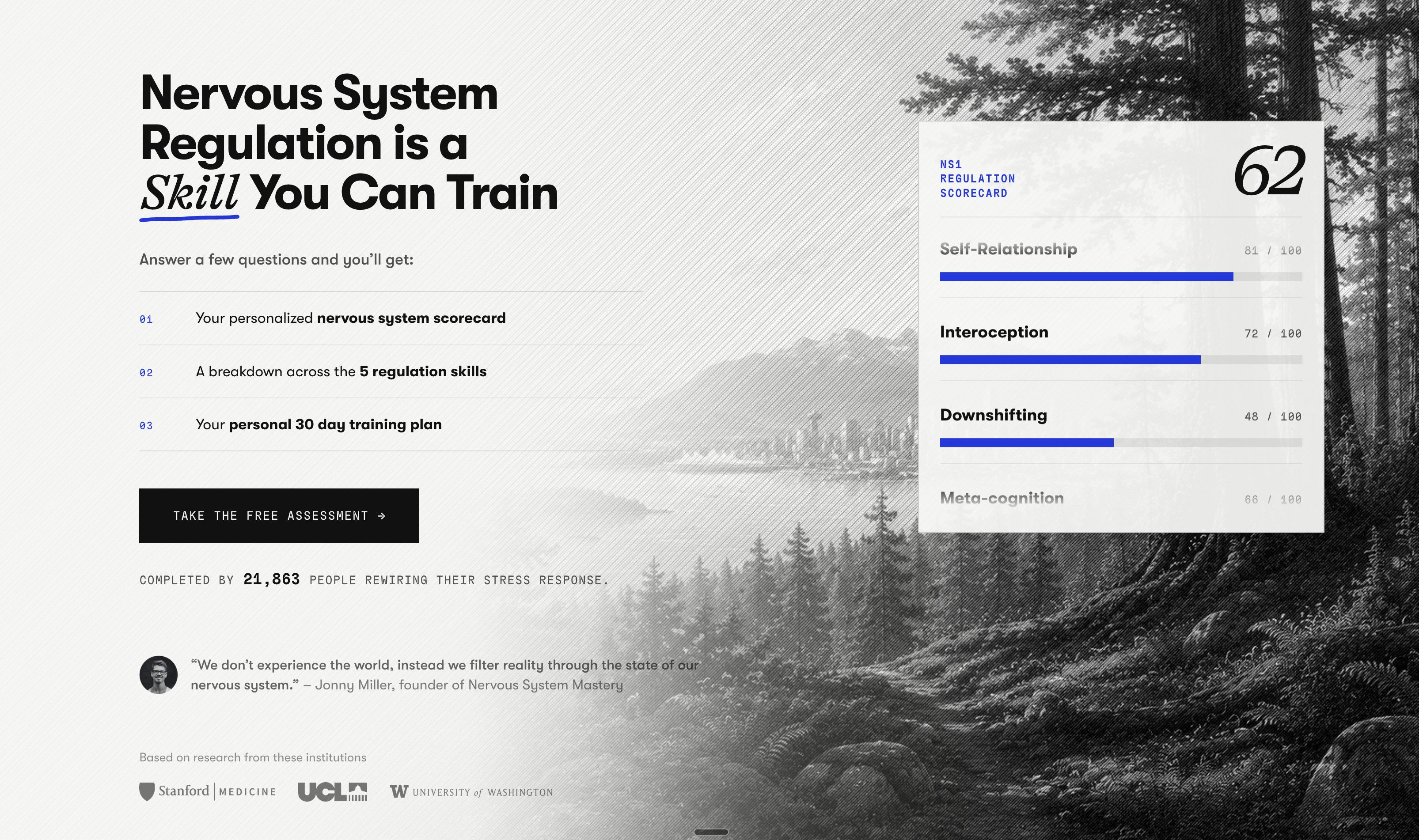
Built by Jonny Miller, the product is categorized under both Education and Health. Miller is the founder of the "Nervous System Mastery" course and has long been deeply involved in teaching breathwork, interoception, and nervous system regulation. Having built a core user base through his paid courses, NS1 can be seen as the productization of his methodology — condensing what previously required weeks of coursework into a 5-minute digital experience. It attempts to answer a question we all care about but struggle to quantify: when stress hits, how quickly can your body actually return to calm?
NS1's Core Feature: A Nervous System Health Report in 5 Minutes
Three Assessment Outputs
At its core, NS1 is an assessment tool that claims to deliver a complete breakdown of your personal stress response mechanisms in just 5 minutes. After completing the assessment, users receive three things:
- Regulation Score: A baseline value reflecting your nervous system's ability to recover stability after stress, giving you a clear picture of your stress resilience "foundation."
- Five-skill Scorecard: Spanning core capability dimensions, it highlights your strengths and identifies areas that need development.
- Personalized Path: A structured learning journey to help you gradually improve your stress capacity and regain control over your state.
From a product logic perspective, NS1 takes concepts from psychology and neuroscience around "Autonomic Nervous System Regulation" and packages them into a measurable, trackable, and improvable productized workflow.
To understand the significance of this concept, it helps to know how the autonomic nervous system (ANS) works. The ANS is the body's neural regulatory system that operates outside direct conscious control, divided into two main branches: the sympathetic and parasympathetic nervous systems. The sympathetic nervous system activates the "fight or flight" response when threats are perceived — manifesting as increased heart rate, dilated pupils, and slowed digestion. The parasympathetic nervous system handles "rest and digest," helping the body restore balance. The dynamic equilibrium between the two determines a person's stress recovery capacity. In recent years, Stephen Porges' Polyvagal Theory has further subdivided autonomic nervous system states into three levels — the ventral vagal (safety and social engagement), sympathetic (fight or flight), and dorsal vagal (freeze and shutdown) — providing a more nuanced framework for understanding stress responses across different situations. NS1's assessment logic is very likely informed by this theoretical framework.
The Product Narrative of "Reclaiming Agency"
NS1's messaging repeatedly uses the phrase "reclaim agency." This points to a topic gaining increasing attention in mainstream health: modern humans are chronically stuck in a state of stress, with the sympathetic nervous system (responsible for the "fight or flight" response) chronically overactivated, while the parasympathetic nervous system (responsible for recovery and relaxation) struggles to effectively intervene.
What NS1 aims to do is first help you see clearly where your regulatory capacity stands, then provide targeted training plans.
Why Nervous System Quantification Tools Deserve Attention
The Next Frontier of Health Quantification
Over the past decade, wearable devices have made us accustomed to quantifying sleep, heart rate, and step counts. But "nervous system regulation capacity" — a more abstract metric that gets closer to the essence of psychological resilience — has rarely been productized before. NS1 represents a trend: health tech is extending from "measuring external physiological data" to "assessing internal regulatory mechanisms."
Metrics like heart rate variability (HRV) have become an important reference for measuring autonomic nervous balance in recent years. HRV refers to the degree of fluctuation in time intervals between consecutive heartbeats — counterintuitively, higher HRV typically indicates a more flexible and adaptive autonomic nervous system, rather than an irregular heartbeat. Clinical research shows that low HRV is significantly associated with increased risk of anxiety, depression, and cardiovascular disease. Devices like Whoop, Apple Watch, and Oura Ring have all integrated HRV monitoring, but most users face a common dilemma: they have the data but don't know what to do with it. This is precisely the cognitive gap NS1 aims to bridge. NS1's "Regulation Score" is very likely built on a similar scientific framework, but presented to everyday users through more accessible assessment questionnaires or interactive formats, significantly lowering the barrier to understanding.
The Education + Health Dual Positioning Creates a Closed Loop
NS1's dual categorization under Education and Health indicates it's not merely a diagnostic tool — it emphasizes a "learning path." It wants to teach users to understand and actively train their nervous systems.
This closed-loop design from "measurement" to "education" to "training" is exactly what many health-focused AI applications are striving for today: not just handing you a cold number, but providing actionable improvement plans.
A Sober Perspective: Three Questions NS1 Still Needs to Answer
Despite its novel concept, NS1's traction based on current Product Hunt data is still in its early stages — 83 upvotes and only 2 comments. This means it has yet to undergo large-scale user validation.
For assessment tools dealing with physical and mental health, several questions are worth watching:
- Scientific rigor: Can a 5-minute self-assessment truly reflect the complex state of the nervous system? Is the algorithm behind its Regulation Score supported by reliable research? It's worth noting that clinical-grade autonomic function assessments typically rely on physiological signal collection (such as HRV analysis, galvanic skin response, tilt-table tests, etc.). Purely questionnaire-based assessments inherently have limitations in validity, although validated psychological scales (such as the PSS — Perceived Stress Scale) can also provide valuable reference points.
- The true degree of personalization: Is the so-called personalized path dynamically generated based on assessment results, or is it simply matching users to a few preset templates?
- Long-term retention value: A one-time assessment is easy to deliver, but getting users to continue training and see measurable improvements is the real moat for products like this.
Conclusion: The Deeper Possibilities of AI Health Applications
The emergence of NS1 reflects an exploration direction worth watching in health tech: turning the previously vague concept of "stress coping ability" into something measurable and trainable. In an era where everyone is besieged by stress, a tool that can help you see the state of your nervous system clearly and provide a path to improvement does hold real appeal.
Whether it can grow from a proof of concept into a product with truly validated effectiveness will require time and more user data to answer. But at the very least, it reminds us that the intersection of AI and health goes far beyond generating diet plans or exercise recommendations — there is enormous untapped potential in the deeper realm of mind-body regulation.
Related articles

OpenAI Partners with Shield: How the Astra Agent Revolutionizes IT Troubleshooting
OpenAI and Shield launch the Astra agent, which autonomously logs into computers and legacy systems to fix IT issues in real time, 35-40% faster than traditional models, with humans involved only when judgment is needed.

iPhone Duo Battery Life Tested: One Charge a Day Is Unavoidable, and the Large Screen Is the Culprit
iPhone Duo battery test: heavy use needs at least one charge a day, and about 30% remains after 6.5 hours of screen-on time. How often the large screen is unfolded is key; a MagSafe battery pack helps, and long-term degradation is also worth watching.

Kimi K3.1 Pro Open-Sourced: 2.8 Trillion Parameters Close In on Opus
Moonshot releases the open-source MoE model Kimi K3.1 Pro, with 2.8T total parameters and 104B activated, trailing Opus 5.5 by under 1 point on Terminal Bench 4.0.