NVIDIA cuPotential: A New Paradigm for Accelerating Molecular Dynamics Simulations

NVIDIA launches cuPotential, a primitive library that accelerates molecular dynamics simulations with accurate and composable GPU primitives.
NVIDIA introduced cuPotential in a developer blog post, a GPU acceleration primitive library for molecular dynamics (MD) simulations. It distills recurring computational patterns such as force field evaluation, neighbor list construction, and short-range and long-range interactions into accurate, flexible primitives, balancing numerical precision and composability. Aimed at scientific software developers, it lowers the engineering barrier to porting custom force fields to GPUs rather than competing with mature MD engines. No performance benchmarks have been released yet.
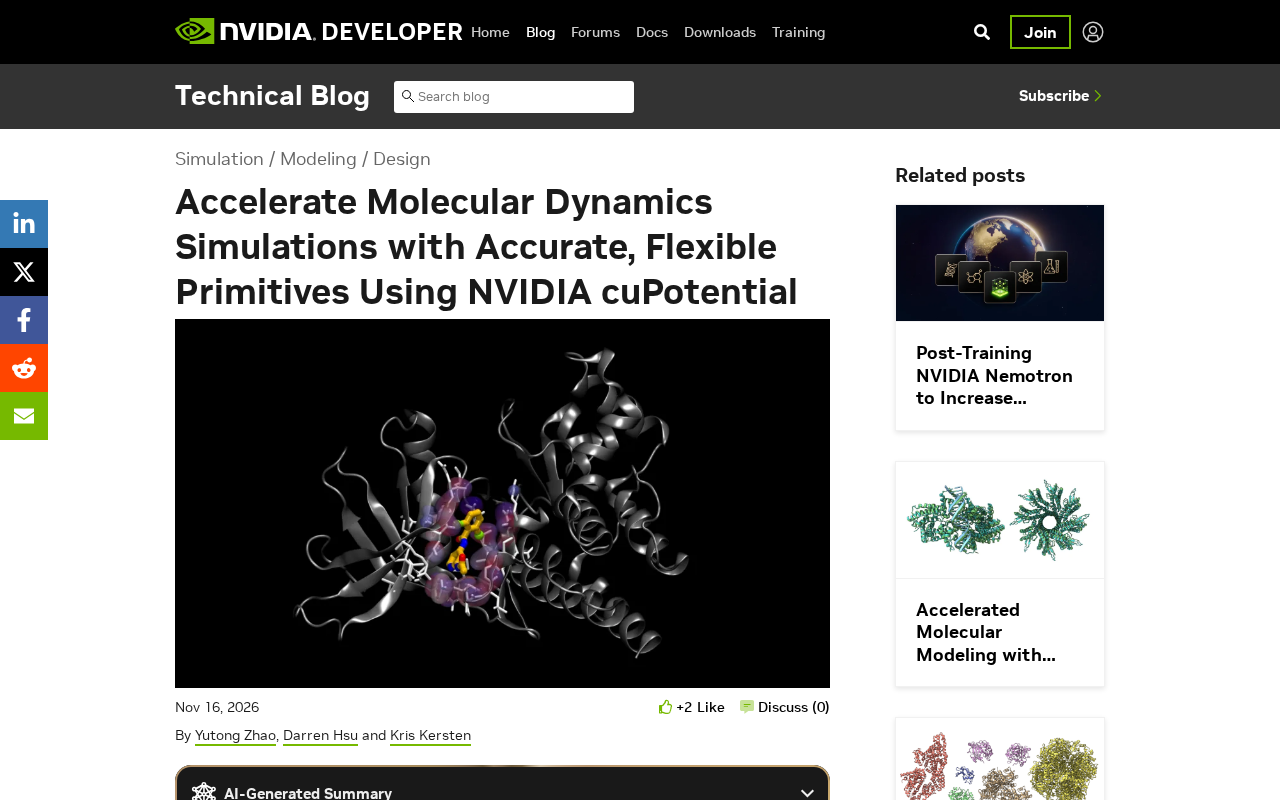
NVIDIA introduced cuPotential in a developer blog post—a library of acceleration primitives for molecular dynamics simulations. For researchers in physics, chemistry, biology, and materials science, molecular dynamics (MD) is an indispensable research tool, and cuPotential seeks to bring GPU acceleration to this traditional workload by starting at the level of arithmetic structure.
Why Molecular Dynamics Needs Dedicated Acceleration Primitives
The core computational loop of molecular dynamics simulations is highly regular: at each step, forces must be computed for every particle in the system, and positions and velocities are then updated accordingly. This "compute forces—integrate—recompute forces" cycle repeats millions to billions of times, accumulating an enormous volume of floating-point operations.
NVIDIA points out in the blog that it is precisely this arithmetic structure that makes MD an ideal candidate for GPU acceleration. The problem is that general-purpose GPU programming models do not automatically abstract the recurring patterns in MD—force field evaluation, neighbor list construction, short-range and long-range interactions—into efficient implementations. Researchers often have to rewrite kernels themselves, which is time-consuming and prone to sacrificing accuracy. cuPotential's role is to distill these recurring computational patterns into accurate and flexible primitives, so developers don't have to build from scratch.
Force field is the set of mathematical models and parameters in molecular dynamics simulations that determine the form of interactions between particles, typically composed of bonded terms (bond stretching, angle bending, dihedral torsion) and non-bonded terms (van der Waals, electrostatics). The potential function is the specific mathematical expression of the force field, and the force on a particle is given by the negative gradient of the potential energy with respect to position. For this reason, the core computational load of each MD iteration is concentrated on evaluating the potential energy function and computing its gradient—precisely the part cuPotential aims to cover with reusable primitives. The accuracy and form of the force field directly determine the physical credibility of simulation results, so a primitive library must preserve numerical behavior equivalent to reference implementations while delivering GPU parallelism.
Neighbor lists and short-range/long-range interactions are two classic structural challenges in MD acceleration. Short-range forces (such as van der Waals interactions) decay rapidly with distance and are usually summed directly within a cutoff radius, which requires maintaining a list of nearby particles for each particle, rebuilding it periodically, and using a Verlet skin radius to avoid rebuilding at every step. Long-range electrostatic interactions cannot simply be truncated; Ewald summation and its mesh-based variants (such as PME) are commonly used to split the computation into a real-space short-range term and a reciprocal-space long-range term. These two types of computational patterns differ greatly in their efficient GPU implementations, involving different parallel granularities, memory access patterns, and reduction strategies. Abstracting them into general-purpose primitives is precisely the core engineering problem cuPotential aims to solve.
What cuPotential Provides
Judging from NVIDIA's description, cuPotential's keywords emphasize both "accuracy" and "flexibility." This actually responds to a long-standing tension in the MD community: when pursuing extreme performance, people tend to use single precision or even reduced-precision approximate algorithms; but molecular systems are extremely sensitive to energy conservation and trajectory stability, and loss of precision can render long simulations physically meaningless.
Making reusable computational primitives into a library has multiple benefits. Researchers can obtain GPU parallelism while ensuring numerical accuracy; at the same time, the primitives are composable, so simulations with different force fields and different ensembles can be assembled as needed without being locked into a single framework. This design approach aligns with the recent trend toward "composable infrastructure" in scientific computing.
Impact on Research Workflows
For frontline researchers, this kind of primitive library lowers the engineering barrier rather than the scientific barrier. In the past, if a materials science research group wanted to run its own force field on GPUs, it usually needed dedicated parallel programming manpower; with ready-made primitives, teams can focus their efforts on the physical correctness of the force field itself. This is also why NVIDIA chose to introduce it on a developer blog rather than through a product launch channel—the target audience is the scientific software developers who will directly call the low-level interfaces.
The blog's mention of "single precision or even reduced-precision approximate algorithms" points to the mixed precision strategy common in the MD field. GPU throughput on FP32 is usually far higher than on FP64, and the FP64 capability of consumer-grade GPUs is often drastically cut, so researchers tend to use single precision or lower precision for force calculations in exchange for speed. But MD is a long-time integration problem, and tiny rounding errors in forces accumulate gradually, potentially breaking energy conservation, causing trajectory drift, or even making the simulation "blow up." Common compromises include using low precision for force calculations and high precision for integration and accumulated quantities, or using compensated summation (Kahan summation) and deterministic reduction order in critical summation steps. cuPotential's emphasis on both "accuracy" and "flexibility" is essentially a response to this precision-performance trade-off.
Ecosystem Position and Questions Worth Watching
It should be viewed objectively that the information NVIDIA disclosed this time is mainly a capability overview, with no specific performance benchmarks, accuracy comparisons, or integration plans with existing MD engines yet provided. For serious scientific computing selection decisions, these data are the basis for decision-making. Whether cuPotential can be adopted by mainstream MD software also depends on the generality of its interface design and actual community validation.
Another direction worth observing is its synergy with NVIDIA's existing scientific computing stack. MD simulations are usually not isolated steps; they are often preceded and followed by visualization, data analysis, and even machine learning potential training. If the primitive library can be smoothly embedded into this pipeline, its value will far exceed单纯的 speedup numbers.
Summary
cuPotential represents a pragmatic acceleration approach: rather than competing head-on with mature MD engines, it turns low-level computational patterns into high-quality building blocks. For research teams seeking both accuracy and flexibility, this is a path worth watching; but until specific performance promises are fulfilled, cautious expectations are more appropriate.
One-line Summary
NVIDIA launches cuPotential, a primitive library that accelerates molecular dynamics simulations with accurate and composable GPU primitives.
Paragraph Summary
NVIDIA introduced cuPotential in a developer blog post, a GPU acceleration primitive library for molecular dynamics (MD) simulations. The article notes that MD's core computational loop is highly regular but repeated an enormous number of times, making it an ideal target for GPU acceleration; however, general-purpose GPU programming models cannot automatically abstract force field evaluation, neighbor list construction, and short-range and long-range interactions into efficient implementations. cuPotential's role is to distill these recurring computational patterns into accurate and flexible primitives that balance numerical precision and composability, addressing the MD community's long-standing tension between performance and accuracy. Its target audience is scientific software developers, and it aims to lower the engineering barrier to porting custom force fields to GPUs rather than competing head-on with mature MD engines. However, NVIDIA has not yet published performance benchmarks or accuracy comparison data, so actual adoption remains to be seen.
Related articles

Gemini 4 Neon Leak: A Potential Strong Contender Against Opus 5.5
A Hacker News thread suggests Gemini 4 Neon looks like an Opus 5.5 competitor. This article unpacks the product positioning behind this community signal, shifts in the top-model competitive landscape, and what it means for developers' model selection strategy.

Claude Fable 5.2's Self-Authored Short Film 'Fable' Sparks Discussion
A short film 'Fable,' credited to Claude Fable 5.2 for script, visuals, and directing, appears on Hacker News. This article analyzes the significance of full-pipeline AI creation, community reactions, and what it means for content creators.

Anthropic IPO Pricing: A Signal of AI Giants Going Public
Anthropic's IPO pricing draws attention. This article analyzes its potential impact on AI industry valuation, commercialization paths, and the competitive landscape, and highlights public-market expectations and challenges for AI companies.