NVIDIA DSX POD: Bringing AI Compute Online Faster

NVIDIA DSX POD tackles the system integration bottleneck before AI factories go live with standardized delivery units.
The article analyzes NVIDIA's DSX POD from its developer blog, noting that an AI factory turns electricity into intelligence and that the real bottleneck isn't single-GPU performance but integration and tuning across compute, networking, storage, power, and cooling. DSX POD treats "a complete runnable system" as the delivery granularity, moving integration work into design and validation to shorten launch cycles and reduce uncertainty. It also cautions that the original post stays at the philosophy and positioning level without disclosing specs, performance data, or delivery timelines; standardization may improve capacity planning predictability and fault-domain clarity but could sacrifice customization flexibility, and real-world results still need validation.
AI factories are, at their core, machines that turn electricity into intelligence. But before the first token is produced, operations teams must first bring an entire interlocking stack—compute, networking, storage, power, and cooling—into a usable state. NVIDIA's DSX POD, introduced in a developer blog post, targets this "pre-launch chaos" and aims to deliver production-grade AI capacity faster and more predictably.
The Real Bottleneck in AI Factories Isn't the Chip
NVIDIA offers a vivid framing in the original post: an AI factory turns energy into intelligence. Behind that statement is an easily underestimated fact—no matter how strong a single GPU is, it doesn't mean the cluster can achieve effective throughput.
For an AI workload to start producing results, compute, interconnect, storage, power, and cooling must form a coordinated system. If any link is misconfigured, it shows up during training or inference as lower utilization, queued jobs, and frequent failures. In other words, the bottleneck is often not the chip itself but the time cost of system integration and tuning.
The stated goal is "faster and more predictably." These two words point to different problems: faster means shortening the cycle from hardware arrival to business launch; more predictable means reducing uncertainty in the delivery process so that capacity planning, launch timelines, and performance all have a predictable baseline.
"Effective throughput" is a metric for a cluster's actual output capability, usually referring to the useful computation completed per unit time under real workloads (such as sample processing rate during training or token generation rate during inference), rather than the hardware's nominal peak performance. There is a significant gap between the two, because distributed training and inference require frequent cross-node communication, data loading, and checkpoint writes—any latency or bandwidth shortfall leaves GPUs waiting, which shows up as declining utilization. The industry commonly uses MFU (Model FLOPs Utilization) to quantify this gap, and production MFU is often far below theoretical peak. Therefore, when evaluating an AI factory, system-level effective throughput is more informative than single-GPU benchmarks.
What DSX POD Tries to Standardize
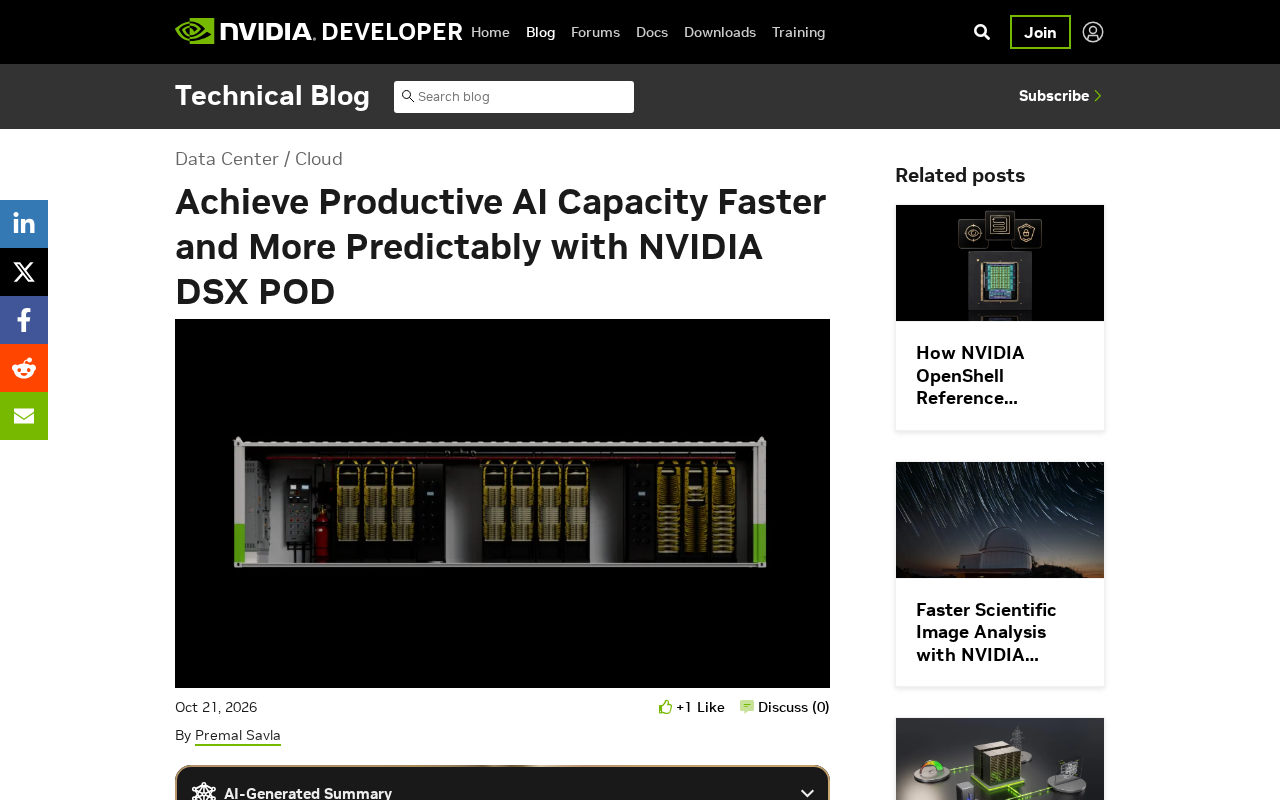
Based on NVIDIA's description, DSX POD is positioned as a reference architecture and delivery unit for production-grade AI capacity, not merely a hardware bill of materials. It treats "a complete, runnable AI system" as the delivery granularity, moving integration work that would otherwise require item-by-item tuning into the design and validation phase.
The value of this approach is that it shifts uncertainty from the deployment site to the design phase. In traditional practice, teams often discover only at the data center that network topology, power headroom, or cooling capacity doesn't match expectations—and rework is expensive. Delivering in POD units means these constraints are considered at design time, and on-site work becomes more about assembly and validation than trial and error.
It's worth noting that the original post focuses on philosophy and positioning and does not disclose specific configuration specs, performance numbers, or delivery timelines. Evaluations of DSX POD should therefore remain cautious, and one should not infer specific performance gains from it.
A reference architecture is a validated design blueprint from a vendor that specifies how compute, networking, storage, power, and cooling subsystems should be selected and combined, but it is not a mandatory bundled product. Its purpose is to let customers and integrators do engineering implementation on that basis, reducing compatibility risks from designing from scratch. A related concept is the "delivery unit"—delivering a set of pre-integrated, tested equipment as a whole for deployment and expansion, similar to containerization thinking. The term POD (Point of Delivery) in the data center field often refers to a modular infrastructure unit with independent power and cooling boundaries that can be deployed and scaled independently—key background for understanding DSX POD's positioning.
What It Means for Operations Teams
If DSX POD's standardization path holds, the most direct beneficiaries are the operations and platform engineering teams responsible for landing AI infrastructure. Their focus shifts from "getting the system running" to "getting the system running efficiently."
This brings two practical implications. First, capacity planning becomes more predictable: when delivery units have clear boundaries, expansion can be added unit by unit rather than re-evaluating the entire data center's capacity each time. Second, fault domains are more clearly defined, allowing operations teams to locate the affected subsystem faster during troubleshooting.
However, standardization also means trade-offs in flexibility. For highly customized workloads, whether standardized PODs can still meet requirements is not answered in the original post and needs to be tested in real deployments.
A "fault domain" refers to the maximum scope a single failure can affect in a system. In AI clusters, the clearer the fault domain boundaries, the more controllable the propagation of a single point of failure, and operations staff can quickly narrow down the investigation based on symptoms. When delivered in POD units, power, cooling, and networking are usually isolated per unit, so a switch or power distribution failure in one POD won't affect other units, improving overall availability. The companion concept is "blast radius," i.e., the scope of failure impact; one value of standardized units is confining the blast radius within known boundaries, which is especially important for the continuity of large-scale training jobs.
Several Questions Worth Watching
Around this type of "AI factory" solution, several questions deserve continued attention. Whether delivery timelines can truly be shortened depends on supply chain and on-site construction coordination, not just architecture design. Whether predictability can be quantified requires vendors to provide comparable baseline metrics. In addition, the fit between standardized units and heterogeneous workloads determines the boundaries of where this approach applies.
For teams planning AI infrastructure, the thinking behind DSX POD is worth borrowing: treat system integration as a first-class design concern rather than leaving it for the deployment phase. As for whether this approach can deliver on its promise of "faster and more predictable," more real-world data is needed.
Related articles

RAG Getting Started in Practice: From Principles to Building an Enterprise Knowledge Base
Bilibili RAG course highlights: from retrieval-augmented generation principles, document chunking and vectorization, to five accuracy factors and enterprise knowledge base boundaries, with fine-tuning vs RAG selection advice.

AI Model Selection Guide: DeepSeek vs. Qwen3 in Practice
How should AI developers choose models? Based on a Bilibili tutorial, this article breaks down the Function Calling differences between DeepSeek V3 and R1, Qwen3's programmatic thinking mode switching and agent capabilities, and outlines a multi-model learning path and practical selection logic.

Anchoring, Loss Aversion, and Nudges: 5 Psychological Tactics Retailers Use to Make You Spend
Behavioral economics reveals how retailers use anchoring, framing, loss aversion, and nudge theory to manipulate your spending decisions. This article breaks down 5 common psychological tactics and offers counterstrategies like slowing down decisions and setting your own anchors to see through the pricing design behind discounts.