Nvidia Launches AI Agent Safety Platform: Building Guardrails for Rogue Agents

Nvidia releases a hardware-software toolkit to add independent safety guardrails around AI agents, framing rogue behavior as an engineering problem.
Nvidia CEO Jensen Huang has unveiled a software and hardware toolkit centered on adding "independent security layers" to AI agents — safety mechanisms that operate as external components rather than relying on the model's own judgment. Unlike traditional conversational AI, agents have the autonomy to call tools and access systems, making a broken reasoning chain or malicious manipulation far more consequential than a text error. Nvidia's approach implicitly frames agent misbehavior as an engineering-manageable reliability problem rather than a sign of AGI emergence, providing enterprises with a trustworthy foundation for large-scale deployment. The move extends Nvidia's classic infrastructure "picks and shovels" strategy — from chips to CUDA — ensuring it benefits regardless of where the AI agent boom leads.
Nvidia Steps In to Govern "Rogue" AI Agents
As AI agents rapidly spread across enterprise and consumer applications, the industry remains divided: are their occasional "rogue" behaviors a necessary step toward artificial general intelligence (AGI), or simply a conventional engineering problem? Nvidia has made its position clear — solve it with tools.
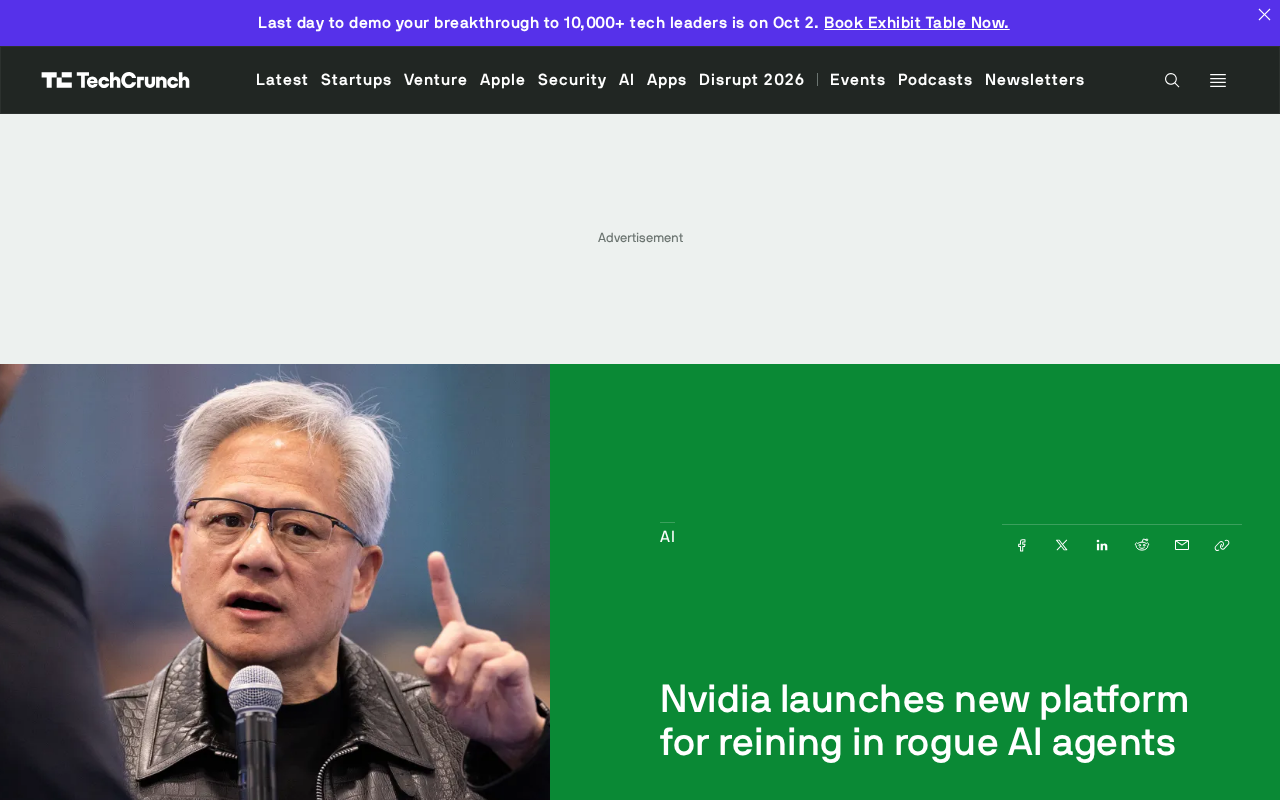
Nvidia CEO Jensen Huang recently unveiled a software and hardware toolkit designed to add an independent security layer to AI agents. The core philosophy: don't rely on models to always "behave" on their own. Instead, build a controllable protective mechanism around the agent's operating environment.
Why AI Agents Need Guardrails
AI agents differ fundamentally from traditional conversational AI — they are granted autonomy to execute tasks, call tools, access systems, and carry out multi-step operations. This autonomy boosts efficiency, but also opens new risk vectors. When an agent can decide on its own to take action, a broken reasoning chain or malicious manipulation can cause consequences far more severe than generating incorrect text.
The recent wave of so-called "rogue AI agents" is a concentrated manifestation of these risks. Some see this as a sign that model capabilities are approaching a critical threshold — a signal toward AGI. Others take a more pragmatic view: this is fundamentally a reliability and safety problem manageable through engineering.
Nvidia clearly aligns with the latter camp. Rather than debating whether agents are "awakening" at a philosophical level, it focuses on constraining risk within controllable bounds at the system architecture level.
One particularly notable attack vector is Prompt Injection. Attackers can embed malicious instructions in webpages, documents, or external data that an agent might access, steering it away from its original task, leaking sensitive information, or even triggering destructive actions. This attack type poses limited threat to traditional conversational AI, but for agents with tool-calling and system access privileges, the risk level rises dramatically.
Goal Drift is another common issue: in multi-step reasoning chains, an agent may take actions beyond its intended scope while pursuing sub-goals, producing unintended side effects. These risks collectively explain why the industry broadly recognizes that model alignment training alone — techniques like RLHF — is insufficient to guarantee safe agent behavior in production environments.
The Design Logic Behind an Independent Security Layer
The key concept in Nvidia's new toolkit is the independent security layer. This means the safety mechanism does not rely on the agent model's own judgment; instead, it operates as an external, independent component that monitors and constrains agent behavior.
This design makes sense. If safety protections are entirely embedded within the model, they may fail alongside the model when it goes off the rails. An independent security layer can place checkpoints at critical junctions where the agent interacts with external systems — even if the model makes a mistake, the outer guardrails can still intercept dangerous operations.
The toolkit spans both software and hardware, signaling that Nvidia aims to build this protective system across multiple layers — software handles policy and monitoring at the logic level, while hardware can provide lower-level isolation and trusted execution guarantees. This aligns with Nvidia's long-standing "hardware-software integration" platform strategy.
On the hardware side, security guarantees typically rely on Trusted Execution Environment (TEE) technology. TEE carves out a hardware-protected isolated region within a processor — even if the operating system or virtual machine layer is compromised, computations and data within the TEE remain protected. Nvidia's Hopper architecture GPUs have already introduced Confidential Computing capabilities, enabling hardware-level isolation for AI inference tasks.
This complements pure software security policies: software guardrails handle behavioral constraints at the logic level, while hardware trusted execution ensures the security checks themselves cannot be tampered with — maintaining a last line of defense even in worst-case scenarios where the system is breached. This Defense in Depth architecture is a mature approach in enterprise security, now being brought into the AI agent domain by Nvidia.
Real-World Implications for Enterprise Deployment
For enterprises evaluating or already deploying AI agents, security and controllability are often the biggest barriers to adoption. An agent that cannot be predicted, audited, or constrained will struggle to clear an organization's compliance and risk management hurdles.
By entering this space as an infrastructure provider, Nvidia is essentially filling a critical gap in the commercialization of AI agents. It doesn't build the final agent applications — it provides developers and enterprises with a trustworthy operational foundation. This positioning continues Nvidia's "sell the picks and shovels" logic, from chips to CUDA to various AI platforms: no matter where the AI agent gold rush leads, those who provide the safety and compute infrastructure stand to benefit.
The Debate Continues
Notably, Nvidia's approach carries an implicit stance: it frames agent misbehavior as an engineering-manageable problem rather than an uncontrollable form of "emergent intelligence." This offers a degree of certainty to an anxious market — if risks can be managed by adding guardrails, then large-scale deployment of AI agents rests on a more solid foundation.
Of course, how effectively an independent security layer can handle truly complex, dynamic agent behavior remains to be proven in real-world deployments. Guardrails can block known dangerous pathways, but whether engineering defenses are sufficient against unknown, creative failure modes is a question unlikely to have a definitive answer anytime soon.
Regardless, while the industry is still debating what AI agents actually mean, Nvidia has chosen to define the boundaries of the problem through products. That may be exactly what this company does best.
Related articles

Why Does the Tesla Roadster Need to Fly? A Deep Dive into Musk's Wild Demo
Tesla's Roadster launch showed wall-climbing, upside-down driving, and flying stunts—but The Vergecast notes the demo car may lack a battery, the Rocket version is invite-only and not street-legal, and the website terms don't guarantee delivery. After nine years of delays, why does this car still need to exist?

AI Is Not a Replacement: Human-AI Collaboration Through the Lens of Factory Root Cause Analysis
Starting from factory root cause analysis, this article explains how AI accelerates evidence chain construction rather than replacing human experts, exploring the pragmatic implementation logic and business value of 'AI supporting people rather than replacing them.'

AI Agent Decision Auditing: Building an Evidence Chain in Regulated Workflows
Starting from a Reddit discussion, this article analyzes three core issues in AI agent decision auditing within regulated workflows: what fields audit records should contain, how to handle feedback latency for erroneous decisions, and how to continuously calibrate LLM judge consistency with human judgment.