NVIDIA Open-Sources AI-Q: A Skill Pack That Gives Coding Agents Deep Research Capabilities

NVIDIA open-sources AI-Q skill pack to give coding Agents deep research capabilities
NVIDIA's open-source AI-Q skill pack addresses pain points in development efficiency, analytical depth, and security compliance through a four-stage deep research pipeline (intent routing, tiered research, hybrid model routing, closed-loop verification). It supports quick integration with mainstream tools like Claude Code, uses MCP protocol for data connectivity, offers three authentication modes for security, supports local deployment for data sovereignty, and achieves 94% accuracy in benchmarks.
When your Agent encounters complex deep research tasks, does it always feel like an "intern who only skimmed the headlines"? NVIDIA's recently open-sourced AI-Q skill pack aims to fundamentally solve this problem — giving coding Agents like Claude Code and Codex genuine deep research capabilities.
Three Pain Points of Existing Agent Orchestration Tools
Developers who've worked with Agent orchestration know the struggle: demos run great, but the moment you hit a deep task, everything falls apart. Agent Orchestration refers to the technical framework for coordinating multiple AI agents to collaboratively complete complex tasks. While frameworks like LangChain and AutoGen have lowered the barrier to Agent development, they commonly face the dilemma of "breadth over depth" when handling deep research tasks requiring multi-turn reasoning and cross-document synthesis. This fundamentally stems from the contradiction between LLMs' context window limitations and single-pass reasoning depth — models excel at pattern matching but struggle to autonomously plan long-chain logical reasoning. Whether it's LangChain, Claude Code, or other mainstream tools, simple conversations work smoothly, but asking them to run hours of complex logical research quickly leads to breakdowns.
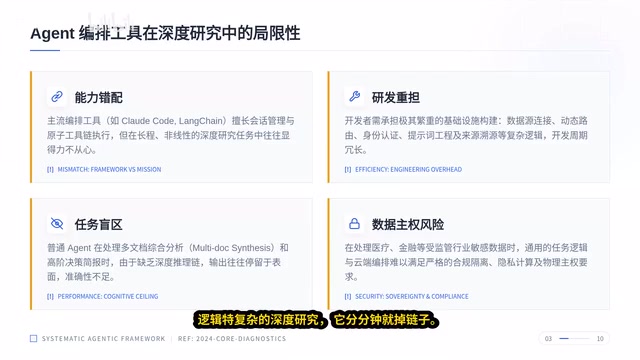
Specifically, current tools face three core problems:
First, low development efficiency. Developers spend enormous amounts of time tuning data connections, dynamic routing, and endless prompt optimization. Development cycles stretch indefinitely, leaving no time for actual business logic.
Second, insufficient analytical depth. When you feed ten documents to an Agent for analysis, the feedback lacks any real depth — it's essentially moving information around rather than performing logical reasoning. Most existing tools mechanically execute tasks like laborers following instructions.
Third, inability to meet security and compliance requirements. Especially in finance, healthcare, and other regulated industries, compliance and data sovereignty are hard red lines. Generic cloud-based tools simply can't clear this hurdle, leaving Agents forever hovering outside core business operations.
AI-Q's Four-Stage Deep Research Pipeline
NVIDIA's AI-Q (AIQ) is essentially a "ready-made researcher plugin." You throw a task at it, and it independently understands requirements, searches for materials, and directly outputs a report with citations. No more wrestling with complex logic or writing endless prompts — just plug it into your system and go.
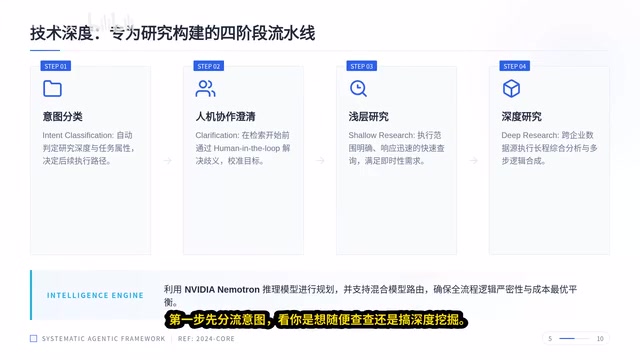
This pipeline consists of four stages:
Stage 1: Intent Routing
The system first determines your query type — is it a casual lookup or does it require deep exploration? If the instructions are ambiguous, the Agent proactively asks for clarification, avoiding assumptions that lead in the wrong direction. This step seems simple but is the prerequisite for all subsequent processes to run efficiently.
Stage 2: Tiered Research
Simple queries take the shallow research path with extremely fast responses; complex tasks are handed to the deep research module, which scans various enterprise data sources and performs long-cycle logical synthesis. This tiered design ensures efficiency without sacrificing depth.
Stage 3: Hybrid Model Routing
The underlying layer uses NVIDIA's reasoning model for global planning, paired with a Hybrid Model Routing mechanism. This is a key technique for reducing inference costs in enterprise AI systems — dynamically allocating models of different sizes based on task complexity: simple information retrieval tasks go to smaller parameter models, while complex logical reasoning calls upon larger models. In practice, this strategy can reduce token consumption by 40%-70% while maintaining overall output quality. NVIDIA's NIM (NVIDIA Inference Microservices) architecture provides the underlying support for this dynamic routing, allowing seamless switching between local GPUs and cloud compute. For enterprise AI applications, this design is crucial.
Stage 4: Closed-Loop Verified Output
All conclusions must be 100% verifiable. Every statement in the report can be clicked to trace back to its original source document — the AI absolutely cannot "make things up." From data retrieval to final verification, every step has an audit trail, making compliance checks completely stress-free.
Quick Integration: How to Connect Claude Code, Codex, and Other Tools
To get AI-Q running, first ensure your Python version is 3.10 or above. Different development tools have their own integration approaches:
- Claude Code: Simply create a symlink for instant recognition
- Codex: Copy the skill pack directly into the directory
- Open Code: Use the standard configuration path, convenient for multi-Agent collaboration
With a single command, the system automatically detects the environment, scans documents in the background, and handles complex logic — developers can focus directly on business logic.
Data Security Solution: MCP Protocol and Three Authentication Modes
AI-Q connects to data through its built-in MCP (Model Context Protocol). MCP is an open standard protocol proposed and promoted by Anthropic in late 2024, designed to solve the standardized connection problem between AI models and external data sources/tools. Before MCP, every AI application needed separate adapter layers developed for different data sources, with extremely high maintenance costs. Through unified protocol specifications, MCP enables AI models to access file systems, databases, APIs, and other resources in a consistent manner — it's widely regarded as the "USB port" of AI application integration. NVIDIA's built-in MCP support in AI-Q means developers can reuse thousands of existing connectors from the entire MCP ecosystem.
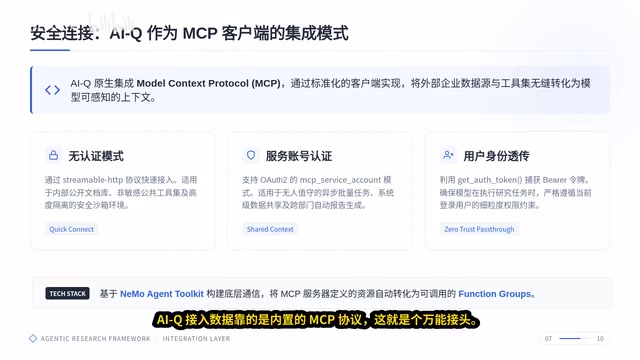
Three authentication modes are provided for development:
No Authentication Mode: Suitable for running public documents or sandbox code — plug and play with zero configuration cost.
Service Account Mode: Suitable for cross-department automation scenarios with system-level integration that requires no manual intervention.
Identity Pass-Through Mode: This is the most critical mode — the AI identifies your permissions in real-time. Confidential contracts you can't access? The AI can't read them either. Permissions are fully synchronized.
The underlying Nemo toolkit automatically converts server resources into AI plugins. No matter where your data resides, AI-Q can securely transform it into an instantly callable knowledge base.
Data Sovereignty: Programs Go to the Data, Not the Other Way Around
The biggest bottleneck in enterprise AI often isn't the algorithm — it's compliance. AI-Q's design philosophy is clear: airdrop the Agent directly into your data environment.
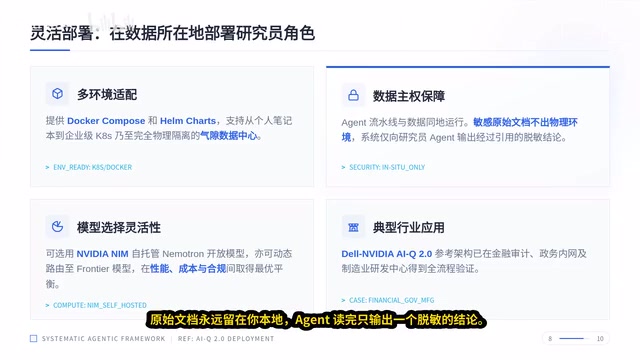
Whether you're developing on a laptop, in a K8s cluster, or in a completely air-gapped data center, this toolkit deploys like installing ordinary software. The core logic is making programs proactively seek out data rather than moving data to accommodate programs. Original documents always stay local, and the Agent only outputs desensitized conclusions.
Model selection is also flexible: for confidentiality, run local NVIDIA NIM (Inference Microservices) — NVIDIA's inference microservices platform that packages optimized AI models as standardized container images, supporting one-click deployment on enterprise local GPU infrastructure. For data-sensitive industries like finance and government, NIM's significance lies in completely eliminating data egress risks — model weights and inference computation all happen locally, with external networks only transmitting final desensitized conclusions, fundamentally different from traditional cloud API call patterns. For performance, dynamically switch to the cloud. According to reports, this solution is already running in financial and government intranets, finally providing a solution to the "data can't leave" problem.
Performance Validation: 94% Accuracy in Benchmarks
In benchmark testing, AI-Q achieved 94% accuracy on complex logic tasks — significantly more stable than general-purpose solutions. Understanding this figure requires context from AI research Agent evaluation frameworks: commonly used deep research evaluation dimensions include Factual Accuracy, Citation Coverage, Logical Coherence, and Hallucination Rate. AI-Q's emphasis on "100% verifiable" conclusions directly addresses the hallucination problem that has long plagued AI research tools, while its citation tracing mechanism ensures every conclusion can be validated against its source.
Related articles
 Tutorials
ChatGPT Plus Subscription Guide: Are GPT-5.5, image-2, and Codex Worth the Upgrade?
A detailed look at ChatGPT Plus features — GPT-5.5, image-2, and Codex — with a Plus vs Pro comparison and a complete step-by-step subscription guide for users outside the US.
 Tutorials
Harness AI Engineering in Practice: Using Claude Code to Master Enterprise-Level E-Commerce Development
Deep dive into Harness AI Engineering: master enterprise e-commerce development with Claude Code using the Rules, Skills, Wiki, and Changes framework.
 Tutorials
Cursor + Codex Dual-IDE Collaboration: A Practical Methodology for Open-Source Project Customization
A complete methodology for open-source project customization based on real-world experience, detailing the Cursor+Codex dual-IDE workflow, seven-stage process, MVP validation, and AI source code reading techniques.