NVIDIA Open-Sources Nemotron 3.5 Super VL: A 120B Multimodal Model Built for Agents
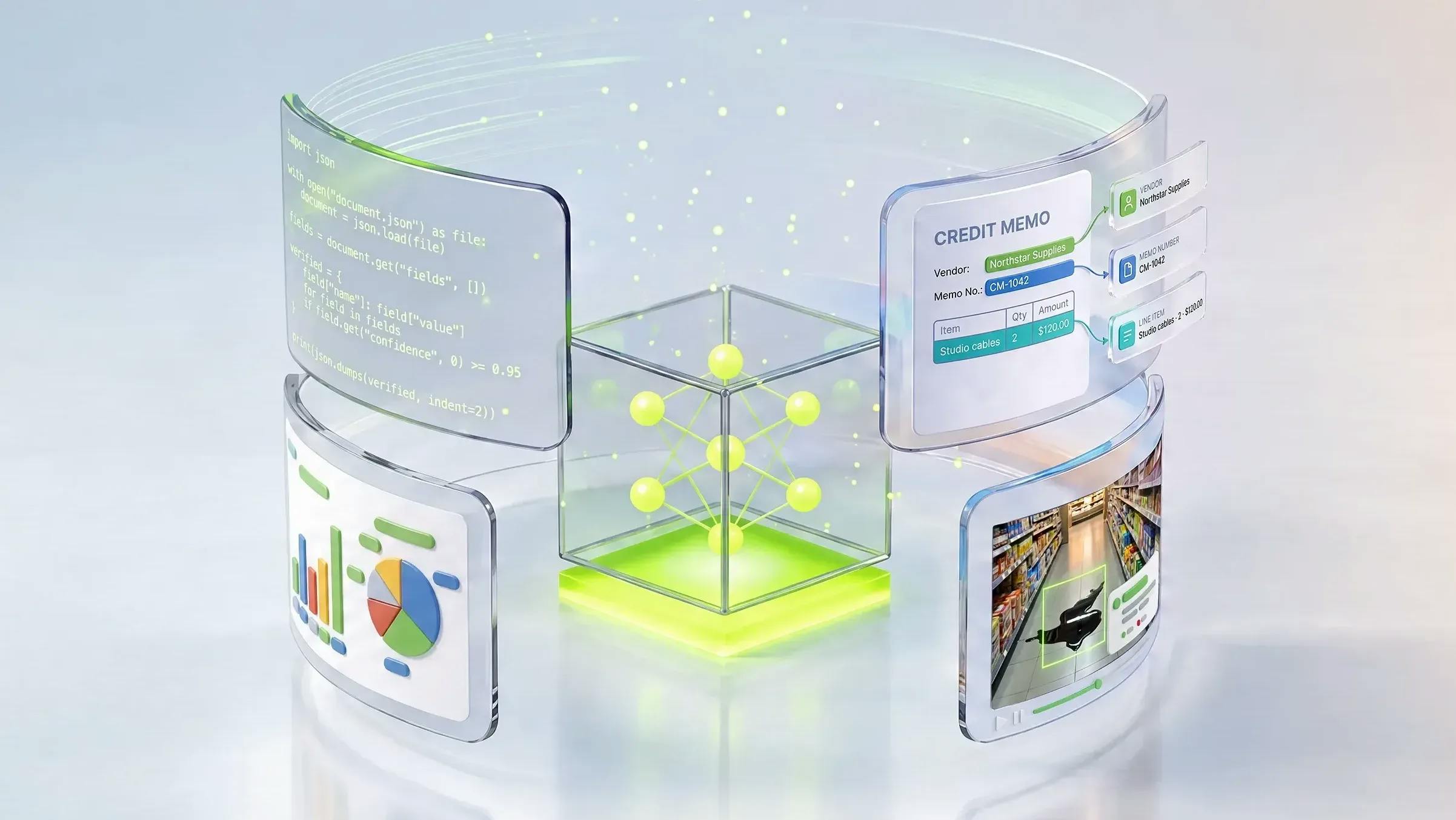
NVIDIA open-sources a 120B MoE multimodal agent model with 12B activated parameters, claiming 5x throughput gains.
NVIDIA has open-sourced Nemotron 3.5 Super VL on Hugging Face, a Mixture-of-Experts multimodal model with 120B total parameters and only 12B activated per inference pass. It unifies text, image, document, and video input with built-in reasoning and tool calling. NVIDIA claims up to 5x agent throughput versus comparable open-source models on a single GPU, but third-party reproduction is lacking. Open-source deliverables include checkpoints, training recipes, datasets, and NIM deployment containers, targeting specialized agents and private customization rather than general chat. The article notes that the 5x throughput claim, specific single-GPU configuration, and per-modality capability boundaries remain unverified, with the market currently in a wait-and-see phase.
NVIDIA has open-sourced Nemotron 3.5 Super VL on Hugging Face, a 120B-parameter multimodal Mixture-of-Experts model targeting specialized agent scenarios. It packs text, image, document, and video input, along with reasoning and tool-calling capabilities, into a single model.
Model architecture: a big-but-light MoE design
Nemotron 3.5 Super VL uses a Mixture-of-Experts (MoE) architecture with 120B total parameters, but only 12B are activated per inference pass. That means it can retain large-model capabilities while pushing inference costs down to near small-model levels.
For teams building agent applications, this trade-off is critical. Agent tasks often require multi-turn calls, tool orchestration, and long-context processing, which multiplies per-inference costs many times over. With 12B activated parameters, it delivers usable throughput on a single GPU.
NVIDIA's official figures claim that on a single GPU, agent throughput can be up to 5x higher than open-source models of comparable scale. That number is currently vendor-provided only, with no third-party benchmark reproduction, so real-world performance will depend on the specific task type and deployment configuration.
MoE (Mixture of Experts) is a sparsely activated model architecture: the model contains multiple parallel "expert" subnetworks (usually feed-forward layers), and a router/gating network dynamically selects a small number of experts to participate in computation based on each token's representation. As a result, total parameter count can be very large, but a single forward pass activates only a subset of parameters, so compute (FLOPs) is far lower than a dense model with the same total parameter count.
The key trade-off with MoE is: memory footprint is based on total parameters, compute cost is based on activated parameters. This means a model with 120B total parameters still needs to load all weights, placing high demands on VRAM, but per-token compute cost is close to that of a 12B dense model. Router load balancing and the communication overhead of expert parallelism are the most common engineering challenges in deployment.
Multimodal and tool calling: one model does it all
Nemotron 3.5 Super VL handles four input types within a single model: text, images, documents, and video. Combined with built-in reasoning and tool-use capabilities, it's more of an "all-in-one foundation" designed for agent workflows than a pure vision-language model.
The value of this integrated design lies in reducing model stitching. In traditional approaches, document parsing, image understanding, and video frame extraction often require chaining multiple models, which accumulates latency and error rates. Single-model processing simplifies the pipeline and makes unified fine-tuning easier.
However, the depth of multimodal capabilities needs to be assessed separately. NVIDIA has not disclosed specific benchmark scores for each modality, and the practical ceiling for high-difficulty tasks like video understanding remains unknown.
Tool use / function calling refers to a model generating structured call requests during reasoning, handing them off to external functions, APIs, or retrieval systems for execution, then merging the returned results into context to continue reasoning. It is one of the core capabilities for building agents, enabling models to break free from the limits of in-parameter knowledge and access real-time data, perform computations, or operate external systems.
Compared with pure text generation, tool calling requires the model to have reliable parameter-format output, multi-turn state maintenance, and error-handling capabilities. Building this in can eliminate extra prompt engineering and parsing layers, but it also means call accuracy directly determines the stability of the entire agent workflow, and validation and retry mechanisms are usually still needed in practice.
Open-source strategy: weights, recipes, and data together
The sincerity of this open-source release shows in the deliverables: checkpoints, training recipes, and datasets are all available on Hugging Face, along with NIM containers for deployment.
For researchers and enterprises, the value of training recipes and datasets is no less than the weights themselves—it means the model can be reproduced and modified, not just used for inference. NIM containers lower the engineering barrier to deployment, making them suitable for teams already using NVIDIA's inference stack.
This "full package" open-source approach is also NVIDIA's consistent playbook for expanding influence in the open-source model ecosystem: open-sourcing models drives demand for GPUs and NIM.
NIM (NVIDIA Inference Microservices) is NVIDIA's inference microservice container solution, packaging models, inference engines (such as TensorRT-LLM), runtime dependencies, and standard APIs into directly deployable container images. For teams using NVIDIA GPUs, NIM eliminates the engineering work of adapting inference backends, tuning batching, and quantization, providing inference services through a unified interface.
The cost is deep binding to NVIDIA's software and hardware stack. Choosing NIM deployment means building the subsequent model service layer around its ecosystem, and migrating to other inference frameworks requires additional rework. Therefore, when evaluating such open-source models, whether the deployment path locks you into a single vendor is also a factor to consider in selection.
Competitive position and questions to be verified
In terms of positioning, Nemotron 3.5 Super VL targets agent scenarios that require private deployment and deep customization, rather than general-purpose chat. Open-source weights plus customizable recipes make it attractive to data-sensitive industries.
Several questions are worth watching: the 5x throughput claim lacks independent verification; 120B total parameters still place considerable demands on VRAM, and the specific "single GPU" configuration is unspecified; and the capability boundaries of each multimodal dimension have no public benchmarks. All of these will affect teams' selection decisions.
On Product Hunt, the product received 77 votes and ranked 16th, with moderate discussion volume, indicating market demand for open-source multimodal agent models but a wait-and-see stance.
FAQ
Can Nemotron 3.5 Super VL be used commercially?
You'll need to check the specific license terms on Hugging Face; the original article does not disclose licensing details.
Is it suitable for replacing GPT-4V-class models for document understanding?
Its positioning leans toward agents rather than general-purpose multimodal Q&A. It's recommended to run small-scale evaluations with your own data first.
What hardware is needed for deployment?
The official materials only mention single-GPU throughput figures and do not specify VRAM requirements. A 120B MoE model typically requires high-spec accelerators.
One-line Summary
NVIDIA open-sources a 120B MoE multimodal agent model with 12B activated parameters, claiming up to 5x throughput gains.
Related articles

Why Does the Tesla Roadster Need to Fly? A Deep Dive into Musk's Wild Demo
Tesla's Roadster launch showed wall-climbing, upside-down driving, and flying stunts—but The Vergecast notes the demo car may lack a battery, the Rocket version is invite-only and not street-legal, and the website terms don't guarantee delivery. After nine years of delays, why does this car still need to exist?

AI Is Not a Replacement: Human-AI Collaboration Through the Lens of Factory Root Cause Analysis
Starting from factory root cause analysis, this article explains how AI accelerates evidence chain construction rather than replacing human experts, exploring the pragmatic implementation logic and business value of 'AI supporting people rather than replacing them.'

AI Agent Decision Auditing: Building an Evidence Chain in Regulated Workflows
Starting from a Reddit discussion, this article analyzes three core issues in AI agent decision auditing within regulated workflows: what fields audit records should contain, how to handle feedback latency for erroneous decisions, and how to continuously calibrate LLM judge consistency with human judgment.