NVIDIA Open-Sources Switchyard: An AI Task Scheduling Engine Built with Rust

NVIDIA open-sources Switchyard, a Rust-based AI task scheduling engine for the NeMo ecosystem.
NVIDIA's NeMo team has open-sourced Switchyard, a Rust-based AI task scheduling engine that quickly gained traction on GitHub. The project leverages Rust's zero-cost abstractions, memory safety, and concurrency model to handle complex AI workload scheduling with millisecond-level decision-making. Switchyard fills a gap in NVIDIA's software stack for service orchestration and intelligent routing, reflecting broader trends of Rust adoption in AI infrastructure.
What is Switchyard
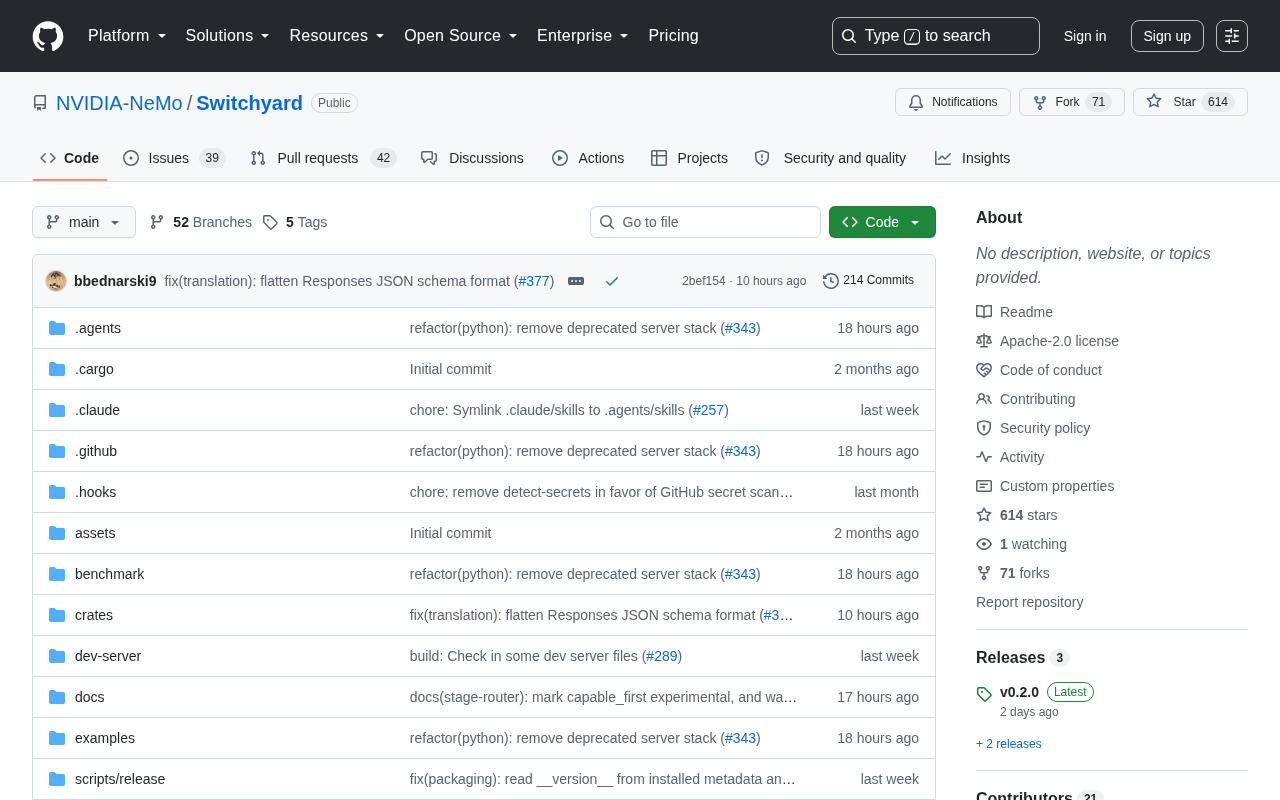
Recently, the NVIDIA-NeMo team open-sourced a new project called Switchyard on GitHub. Written in Rust, the project quickly climbed the GitHub trending charts upon release, gaining approximately 370 stars in a single day and accumulating 589 stars and 70 forks to date. This rapid growth reflects the developer community's intense interest in NVIDIA's new moves at the infrastructure level.
As part of the NVIDIA NeMo ecosystem, Switchyard's positioning is closely tied to the NeMo framework. NeMo (Neural Modules) is an open-source framework launched by NVIDIA in 2019 that initially focused on conversational AI and later expanded into an end-to-end platform covering large language model training, fine-tuning, alignment (RLHF/DPO), automatic speech recognition (ASR), text-to-speech (TTS), and multimodal models. NeMo 2.0 introduced deep integration with Megatron-LM distributed training strategies, supporting tensor parallelism, pipeline parallelism, and expert parallelism, enabling efficient training of models with tens of billions to trillions of parameters across thousands of GPUs. The framework also forms a complete production pipeline with NVIDIA's NeMo Guardrails (safety guardrails), NeMo Curator (data curation), and other toolchain components. The fact that Switchyard, as a component within this ecosystem, was built in Rust rather than the traditional Python or C++ is itself a noteworthy technical signal.
Why Rust for an AI Scheduling Component
In the AI infrastructure domain, Python has long held a dominant position due to its rich machine learning ecosystem and low barrier to entry. However, when it comes to core system components involving high-performance scheduling, concurrency handling, memory safety, and low-latency communication, Python's performance bottlenecks and runtime overhead become unavoidable issues.
Rust has risen rapidly in the systems software space in recent years, making it an ideal choice for building high-performance infrastructure thanks to its zero-cost abstractions, memory safety guarantees (no GC), and excellent concurrency model. Specifically, Rust's "zero-cost abstractions" mean that high-level language features (such as generics, iterators, and traits) incur no additional runtime overhead after compilation, producing machine code with efficiency comparable to hand-written C/C++. Its memory safety is achieved through compile-time static checking via three core mechanisms—Ownership, Borrowing, and Lifetimes—without requiring a garbage collector, thus avoiding the pause latency (Stop-the-World) that GC introduces. On the concurrency front, Rust's type system prevents data races at compile time through Send and Sync traits, and combined with async runtimes like Tokio, can efficiently handle hundreds of thousands of concurrent connections. These properties make Rust particularly well-suited for building scheduling systems that are extremely sensitive to latency jitter.
NVIDIA's choice to build Switchyard in Rust likely aims to achieve greater determinism and performance in the orchestration, routing, or scheduling layers of AI services.
Judging from the project name "Switchyard" (a railroad classification yard), it likely serves a role similar to a transportation hub—responsible for scheduling, routing, and distributing tasks across complex AI workloads, precisely the kind of scenario that demands extreme performance and reliability. Large model inference scheduling faces multiple technical challenges: different prompt lengths and generation lengths lead to vastly different computational loads; GPU memory for KV Cache during autoregressive generation requires dynamic allocation and reclamation; continuous batching requires real-time decisions about when to insert new requests into executing batches. Additionally, PagedAttention proposed by vLLM manages KV Cache in a manner similar to operating system virtual memory, dramatically improving memory utilization. In multi-model, multi-node scenarios, classic distributed systems problems like load balancing, failover, and priority queues must also be addressed. As a scheduling component, Switchyard likely needs to complete these complex decisions within millisecond-level time windows.
Switchyard's Strategic Significance in the NeMo Ecosystem
As large model inference and training scales continue to expand, relying solely on model optimization is no longer sufficient to support production-grade deployment requirements. System engineering aspects surrounding the model—service orchestration, request routing, and resource scheduling—are becoming the key factors determining overall efficiency.

Switchyard's emergence reflects NVIDIA's trend of extending its software stack toward lower-level, more engineering-oriented directions. NVIDIA's software ecosystem has formed a complete stack from hardware abstraction to the application layer: at the bottom is CUDA (Compute Unified Device Architecture), providing general-purpose GPU computing capabilities; above that are math acceleration libraries like cuDNN and cuBLAS; TensorRT and TensorRT-LLM handle model inference optimization, minimizing inference latency through operator fusion, quantization, speculative decoding, and other techniques; Triton Inference Server provides model serving capabilities with support for dynamic batching and model ensembles; and NIM (NVIDIA Inference Microservices) packages these capabilities into ready-to-use microservices. Switchyard's arrival fills the gap in service orchestration and intelligent routing, providing native high-performance support for production-grade needs such as multi-model collaboration, A/B test routing, and canary deployments.
In the past, NVIDIA was primarily known for hardware-related acceleration libraries like CUDA and TensorRT. Now, building higher-level scheduling components in Rust demonstrates that NVIDIA is completing a full technology loop from low-level hardware to upper-layer services.
For developers, this also means that deploying generative AI applications with NeMo in the future will come with stronger performance guarantees and more modern toolchain support.
Industry Trends Worth Watching
Switchyard's open-sourcing reflects several noteworthy industry trends:
- Rust is penetrating AI infrastructure: An increasing number of top-tier teams are rewriting performance-sensitive core components in Rust. Hugging Face wrote its Tokenizers library in Rust, achieving 10-100x speedups in tokenization; its Candle framework is a lightweight inference engine implemented entirely in Rust. The Burn framework provides Rust-native deep learning capabilities. At the broader data infrastructure level, Polars (DataFrame library) and DataFusion (query engine) are both implemented in Rust, providing high-performance support for AI data pipelines. Additionally, multiple LLM inference engines (such as mistral.rs and Rust bindings for llama.cpp) are actively developing. The core driver of this trend is that AI system performance bottlenecks are shifting from model computation itself to surrounding data processing, scheduling, and communication layers.
- Scheduling and orchestration are becoming competitive focal points: As model capabilities trend toward homogeneity, how to efficiently schedule and serve models is becoming a key differentiator.
- NVIDIA's software moat continues to expand: From hardware to frameworks to the scheduling layer, NVIDIA is building an increasingly deep software ecosystem barrier.
Summary
Although Switchyard is still in its early stages with limited public information, its rapidly rising attention and NVIDIA's official backing are enough to make it an open-source project worth tracking. For developers interested in AI engineering, system performance optimization, and the Rust ecosystem, this is a repository worth adding to your watch list.
As project documentation and more details are fleshed out, we can expect to learn more about Switchyard's specific role within the full NeMo stack and what kind of performance improvements it can bring to large-scale AI deployments.
Related articles

How AI Data Centers Are Reshaping Electricity Pricing: Cost Allocation and Energy Market Transformation
Surging AI data center power demand is reshaping electricity pricing. This article analyzes grid impacts, three pricing pathways, and implications for consumer bills and energy transition.

Chiplab: AI Tests Firmware on Virtual Chips Without Physical Development Boards
Chiplab enables AI coding assistants to compile, run, and debug embedded firmware on high-fidelity virtual chips via MCP protocol, supporting STM32 and Nordic platforms without physical hardware.

Muse Glimmer Local Testing: Meta's Open-Source 30B Multimodal Model Runs on a Single GPU
Meta releases Muse Glimmer, a 30B open-source multimodal model running on a single 24GB GPU. Tested at 233 tokens/sec with speculative decoding on RTX 5090, Apache 2.0 licensed with GGUF support.