NVIDIA Partners with Six Wall Street Giants to Unlock $500 Billion in AI Computing Capital

NVIDIA teams up with six Wall Street giants to mobilize $500B for AI computing infrastructure.
NVIDIA announced a partnership with Apollo, BlackRock, Blackstone, Brookfield, Goldman Sachs, and KKR to establish an AI computing infrastructure financing platform targeting over $500 billion in third-party capital. The collaboration aims to bridge the massive funding gap in AI data center construction through project finance and securitization, transforming AI infrastructure into a new institutional asset class while solidifying NVIDIA's dominance in the computing market.
A Market-Shaking Announcement
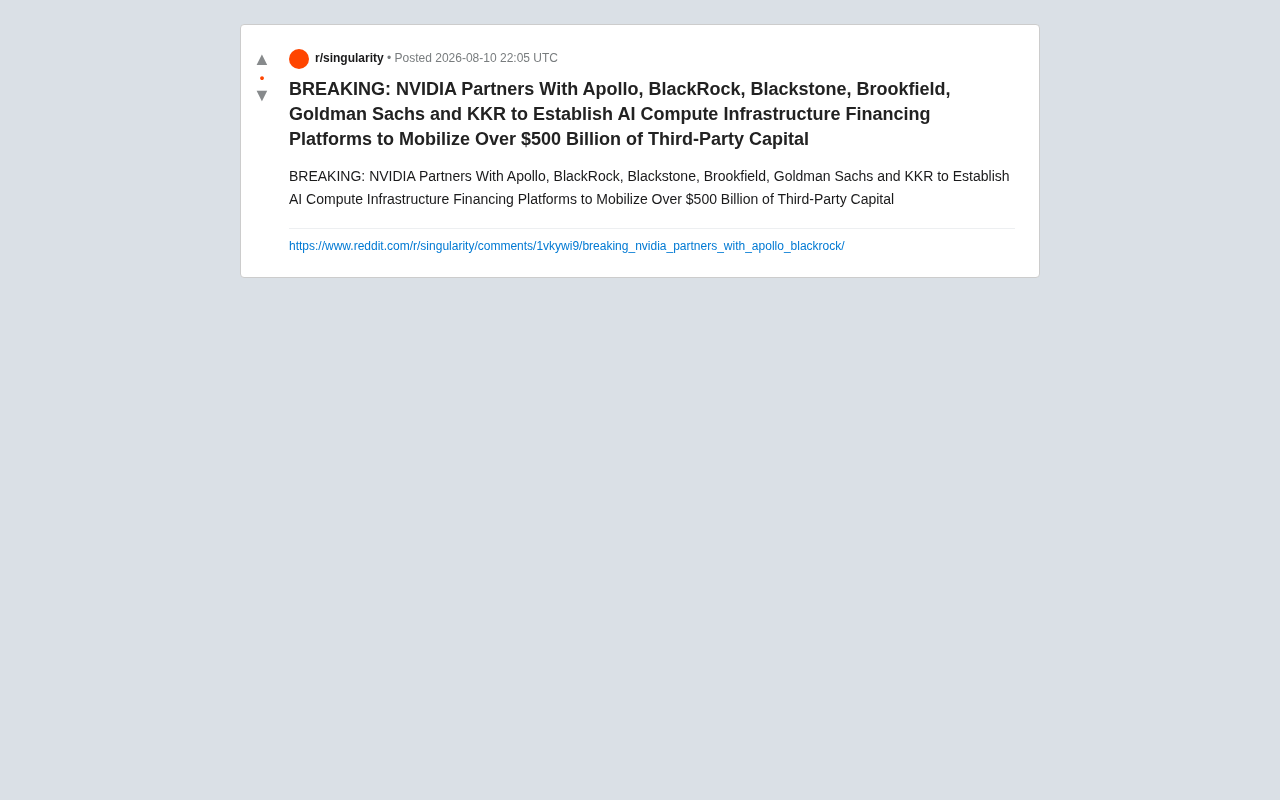
NVIDIA has announced a partnership with six of the world's leading financial institutions—Apollo, BlackRock, Blackstone, Brookfield, Goldman Sachs, and KKR—to establish an AI computing infrastructure financing platform, with the goal of mobilizing over $500 billion in third-party capital.
This is no ordinary investment partnership. It represents a deep integration between financial capital and computing hardware providers. The participants encompass virtually the most influential alternative asset managers and investment banks on Wall Street—collectively managing trillions of dollars in assets, now being channeled toward a common direction: AI computing infrastructure.
Notably, each of these six institutions brings distinct strengths: Apollo manages over $670 billion in assets, specializing in credit and private equity; BlackRock is the world's largest asset manager with over $10 trillion under management; Blackstone is the world's largest alternative asset manager, with decades of expertise in infrastructure and real estate; Brookfield manages over $900 billion in assets and is one of the world's largest infrastructure investors; Goldman Sachs' asset management division manages over $2.8 trillion; and KKR is a top-tier global private equity and infrastructure investment firm. Their common characteristic is access to vast pools of long-term capital (such as pension funds and sovereign wealth fund LP capital), making them naturally suited for allocating to infrastructure assets with longer return cycles.
Why NVIDIA Needs Financial Capital to Step In
Massive Funding Gap in Computing Infrastructure
The computing power required to train and deploy frontier AI models is growing at a staggering rate. Building a large-scale AI data center easily requires tens of billions or even over a hundred billion dollars, covering GPU clusters, power systems, cooling facilities, network architecture, and physical sites. The capital expenditures of cloud providers and tech companies alone can no longer sustain this exponential expansion.
Specifically, the astronomical cost of a hyperscale data center serving frontier AI training stems from multiple compounding cost layers. Take GPU clusters as an example: NVIDIA's latest GB200 NVL72 rack costs approximately $3 million per unit, and a top-tier AI training center may require thousands or even tens of thousands of GPUs. On the power infrastructure front, AI training power density far exceeds traditional data centers, with single rack power consumption exceeding 120kW, and a GW-scale data center requiring dedicated substations or even power plants. Add liquid cooling systems, high-speed network interconnects (such as InfiniBand or NVLink), and building engineering meeting physical security and redundancy requirements, and the construction cost per MW of IT load can reach $20 million to $30 million.
By partnering with infrastructure and alternative asset specialists like Apollo, Blackstone, and Brookfield, NVIDIA is effectively building a financing conduit for the entire AI supply chain. These institutions excel at packaging long-term infrastructure assets into financial products suitable for institutional investors through project finance, securitization, and similar mechanisms.
Project Finance is a financing model that uses a project's own future cash flows as the repayment source, widely applied in power plants, highways, pipelines, and other large infrastructure construction. In the AI data center context, this means using the data center's future computing lease revenue (such as long-term service agreements with cloud providers) as repayment collateral to raise funds from financial markets. Securitization involves packaging the cash flows of a group of assets into tradeable securities—for example, bundling lease contracts from multiple data centers into ABS (Asset-Backed Securities) and selling them to pension funds, insurance companies, and other investors seeking stable returns. The core advantage of these financial instruments is splitting single large-scale investments into standardized financial products, dramatically expanding the potential investor base.
From Selling Chips to Building an Industrial Ecosystem
For NVIDIA, the strategic significance of this move far exceeds simple chip sales. When capital can flow more smoothly into data center construction, market demand for GPUs gains more solid financial backing. In other words, NVIDIA isn't just selling chips—it's solving the "affordability and buildability" problem for downstream customers, thereby solidifying its core position in the AI computing market.
What $500 Billion Means
Unprecedented Capital Mobilization
$500 billion is a figure large enough to reshape the industry landscape. For reference, this scale approaches the magnitude set by the previously announced "Stargate" initiative driven by OpenAI, SoftBank, and others.
The Stargate project was jointly announced in January 2025 by OpenAI, SoftBank, Oracle, and others, planning to invest $500 billion in AI infrastructure over four years, with an initial investment of $100 billion and the first data center located in Abilene, Texas. Stargate represents the tech company-led path for AI infrastructure investment, while NVIDIA's partnership with Wall Street represents an alternative path—channeling broader institutional capital into AI computing construction through financial intermediaries. The highly consistent target scale of both (both at the $500 billion level) is no coincidence; it reflects an industry consensus on total AI computing infrastructure investment needs over the next five years.
When such massive third-party capital is systematically directed toward AI infrastructure, it signals that computing construction is evolving from an internal investment by tech companies into an independent asset class accessible to global institutional investors.
Opportunities and Risks of Financialization
This deep financialization brings both opportunities and concerns. On one hand, abundant capital can accelerate AI infrastructure deployment, bringing more computing power online faster. On the other hand, when Wall Street's leverage and securitization tools enter at scale into a field still rapidly evolving with extremely fast technological iteration, cyclical risks may be amplified.
Specifically, the following factors will directly impact the financing platform's long-term returns:
- GPU technology refresh cycles and hardware iteration speed: NVIDIA's GPU products iterate extremely quickly, from A100 to H100 to B200/GB200, with each generation delivering several-fold performance improvements. This means GPU clusters purchased with massive capital today may face performance obsolescence within 3-5 years. For infrastructure investors, this poses a unique Technological Obsolescence Risk: traditional infrastructure (such as toll roads, power plants) typically has a useful life of 20-30+ years, while AI computing hardware may have an economic life of only 5-7 years. How to properly reflect this accelerated depreciation in financing structures—for example, shortening loan terms, designing hardware upgrade provisions, or tying operating contracts to technology upgrades—will be a core structural challenge the financing platform must address.
- Data center asset depreciation and operating costs
- Whether AI demand growth can continue to meet market expectations
Profound Impact on the AI Industry Landscape
Computing Supply Will Accelerate Significantly
With financing channels now open, more hyperscale data centers will emerge in the coming years. For AI startups and cloud service providers that depend on computing power, this could mean more abundant computing resource supply, potentially alleviating the widespread "computing shortage" problem.
The current AI industry's computing shortage is multidimensional. On the supply side, NVIDIA GPU production is constrained by TSMC's advanced process capacity bottlenecks (currently primarily 4nm/5nm nodes), CoWoS advanced packaging capacity limitations, and HBM (High Bandwidth Memory) supply constraints. On the demand side, training GPT-4-class models requires tens of thousands of GPUs running for months, while next-generation model computing demands are growing at approximately 4x per year (according to Epoch AI research data). This supply-demand imbalance has led to GPU delivery wait times stretching to months and spawned premiums in the computing lease market. The establishment of the financing platform should accelerate data center construction from the funding side, but the ultimate release of computing supply still depends on chip physical production capacity and the pace of power infrastructure construction.
Deep Capital-Technology Binding Raises Industry Barriers
The collective entry of six major financial institutions signals that AI infrastructure has been formally recognized by mainstream finance as a long-term, high-certainty investment track. This strong binding between capital and technology suppliers further raises industry entry barriers—players without sufficient capital backing will find it increasingly difficult to compete in the computing race.
Conclusion
NVIDIA's partnership with Wall Street giants is essentially laying the financial plumbing for the AI era's "infrastructure boom." The $500 billion capital mobilization target both demonstrates the market's firm confidence in AI's long-term prospects and pushes computing construction into an unprecedented stage of financialization.
One detail worth noting: this article is based on publicly circulated announcement information; the specific platform architecture, capital deployment timeline, and division of responsibilities among parties still await further official disclosure. Regardless, this development deserves close attention from the entire tech and financial industry—it may be defining the capital logic of AI computing competition for the next decade.
Key Takeaways
Related articles

Workbuddy for Absolute Beginners: How a Desktop AI Agent Fits Into Real Workflows
A beginner's guide to the Workbuddy desktop AI agent: installation, claiming credits, file management, and building automated workflows—compared with CodeX for fit and cost, helping professionals shift from AI question-askers to AI managers.

OpenAI's New Agent Stack: Computer Use, Decisions API, and Ultra-Fast Workflows
OpenAI Dev Day unveiled a new agent stack: Computer Use outperforms humans, Decisions API delivers ultra-low-latency classification via Luna, Agents API opens the same Computer Use capabilities, and GPT-6.1 Sol costs only one-seventh of Astra. Core updates, benchmark data, and developer insights.

Liang Wenfeng Open-Sources DeepInfo Inference Framework, Takes On U.S. Ban
DeepSeek open-sources its DeepInfo inference framework after its models, featuring GPU/CPU cross-pipelining, small-model prediction with large-model verification, and full Huawei Ascend and NVIDIA chip support—facing the U.S. federal ban head-on. This article analyzes its significance for AI deployment and open-source strategy.