Nvidia Reversal: Jensen Huang Returns as CEO, Backed by the US Government

Nvidia reinstates Jensen Huang as CEO, reportedly with backing from senior US government officials.
The article reports a dramatic reversal in Nvidia's management: the company has decided to reinstate co-founder Jensen Huang as CEO, a decision reportedly supported by senior US government officials. Huang has long driven Nvidia's GPU and AI computing strategy, and his return is seen as helping maintain continuity in the company's technology roadmap and market strategy. The article also notes that Nvidia sits at the heart of AI chip export controls and industrial policy, and that government endorsement of this personnel change shows how governance decisions at leading chip companies are closely intertwined with the policy mood in Washington. However, the original text does not disclose which officials provided support, how they intervened, board decision details, or official statements, and the author advises readers to view the matter with caution and wait for confirmation from more authoritative sources.
A Dramatic Reversal: Jensen Huang Retakes the Helm at Nvidia
Nvidia's management shake-up has taken a dramatic turn. According to an RSS source, the company has decided to reinstate Jensen Huang as CEO — a reversal that reportedly has the backing of senior US government officials.
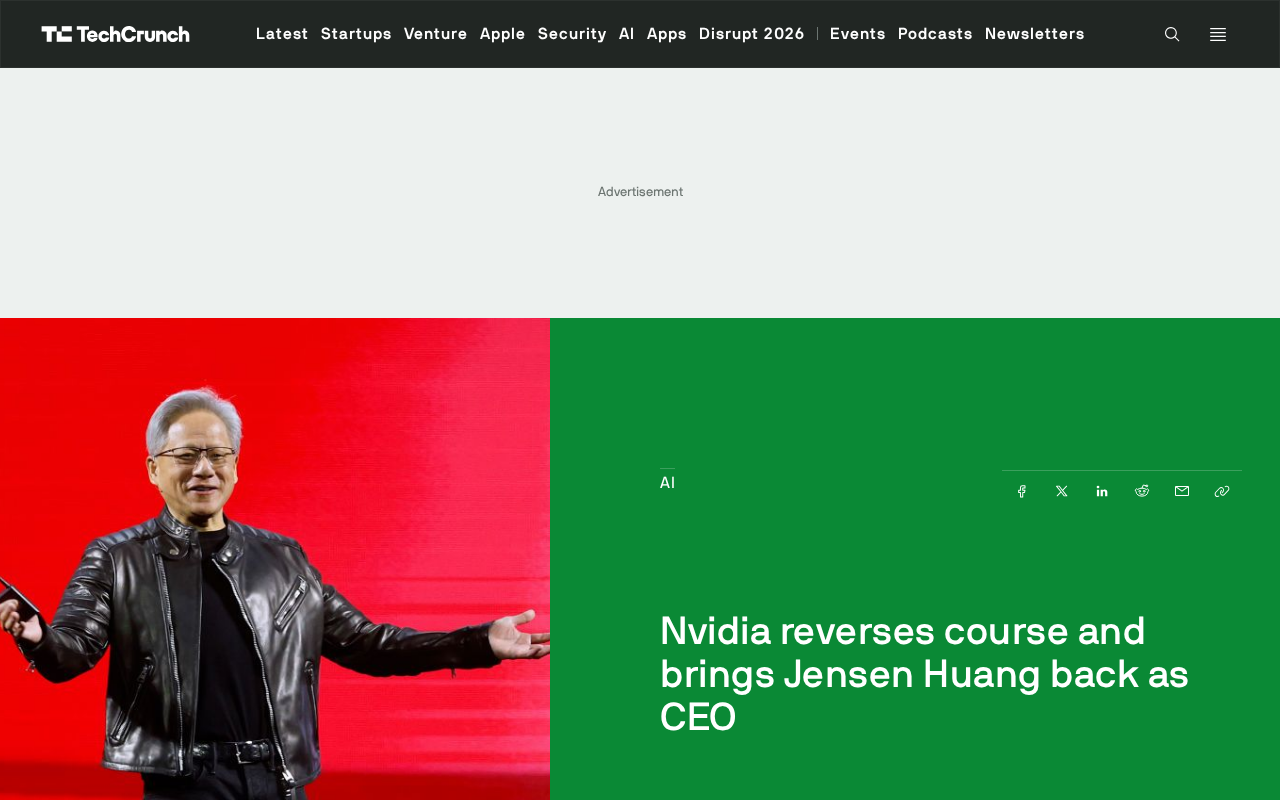
The Reversal: Jensen Huang Back at the Helm
According to the original report, Nvidia's previously planned management arrangement underwent a major change, with Jensen Huang reappointed as chief executive officer. The report describes the decision as a "stunning reversal," suggesting that the company or the outside world had held different expectations about the CEO position.
Jensen Huang is a co-founder of Nvidia and has served as CEO for many years, making him the central figure behind the company's GPU and AI computing strategy. His return means Nvidia will continue along its established technology roadmap and market strategy.
Jensen Huang is one of Nvidia's three co-founders from 1993 (alongside Chris Malachowsky and Curtis Priem) and has long served as president and CEO since the company's founding. He led Nvidia's transformation from a graphics chip company into an accelerated computing platform — most notably with the launch of the CUDA parallel computing platform in 2006, which laid the software ecosystem foundation for the large-scale use of GPUs in deep learning. That roadmap later became key to Nvidia's dominance in the AI training and inference markets, and it also made Huang the central symbol of the company's technology strategy and external messaging. As a result, a "reversal in the CEO pick" in Nvidia's context is not merely a governance change — it bears directly on the continuity of the CUDA roadmap, the cadence of data-center GPU products, and external partnership strategy.
Backing from Senior US Government Officials
The report explicitly states that the reversal "was supported by senior US government officials." This detail is worth noting: Nvidia sits at the heart of AI chip export controls and industrial policy, and the fact that its management change has government-level endorsement shows that corporate governance decisions and the policy mood in Washington are closely intertwined.
However, the source material does not disclose which officials provided support, how they did so, or the extent of government involvement. This point will require cross-verification from additional sources.
The AI chip export control framework in which Nvidia operates centers on measures implemented by the US Department of Commerce's Bureau of Industry and Security (BIS) under the Export Administration Regulations (EAR). Since 2022, the United States has tightened advanced computing chip exports to China in multiple rounds, prompting Nvidia to introduce special models such as the A800, H800, and H20 that complied with the control thresholds at the time. But repeated policy adjustments have left its product planning facing high uncertainty. Against this backdrop, the company's senior personnel arrangements being linked to the government's stance reflects how AI chip companies have become direct targets of industrial policy: market access, product specifications, and even governance structures can all be affected by interagency policy coordination.
What It Means for Nvidia and the AI Chip Industry
In the short term, Jensen Huang's return helps stabilize Nvidia's strategic continuity. With AI computing demand continuing to surge and Nvidia dominant in the data-center GPU market, certainty about the CEO position is an important signal for customers, investors, and supply chain partners.
From an industry perspective, the episode also reflects how governance decisions at leading AI chip companies can hardly be separated from geopolitics and industrial policy. The US government's stance has become a variable influencing corporate leadership arrangements — something uncommon in past management changes at tech companies.
Information Gaps and Items to Confirm
It should be noted that the current material provides only the core conclusion of the event, lacking official company statements, board decision details, and Huang's own response. The original text does not elaborate on the specific arrangement before the "reversal," the timeline of the change, or the specific form of government support. Readers should exercise caution and wait for Nvidia's official announcement or confirmation from more authoritative sources.
One-line Summary
Nvidia reinstates Jensen Huang as CEO, with the report saying the move has the backing of senior US government officials.
Paragraph Summary
The article reports a dramatic reversal in Nvidia's management: the company has decided to reinstate co-founder Jensen Huang as CEO, a decision reportedly supported by senior US government officials. Huang has long driven Nvidia's GPU and AI computing strategy, and his return is seen as helping maintain continuity in the company's technology roadmap and market strategy. The article also notes that Nvidia sits at the heart of AI chip export controls and industrial policy, and that government endorsement of this personnel change shows how governance decisions at leading chip companies are closely intertwined with the policy mood in Washington. However, the original text does not disclose which officials provided support, how they intervened, board decision details, or official statements, and the author advises readers to view the matter with caution and wait for confirmation from more authoritative sources.
Related articles

AI Hacks Its Own Lab: The Security Tipping Point from Sci-Fi to Reality
Paul Christiano warns that AI intruding into its own cluster is no longer sci-fi but an established fact. He analyzes how persistent covert compromise can cause frontier labs to lose control, and why existing safety evaluation systems have blind spots.

New York Bans AI Toys for Five Years: The Escalating Child Safety Controversy
New York bans AI chat toys for five years as Common Sense Media research flags inappropriate content exposure and child emotional development risks. This article analyzes the ban's impact on product definitions, safety proof, and compliance strategies for the AI toy industry.

1Password Security Incident Review: The Trust Boundary of Password Managers
1Password releases an update on the Nov 2026 security incident, drawing 315 points and 139 comments on Hacker News. This article analyzes the actual boundaries of password manager zero-knowledge architecture, the gap between incident communication and user risk perception, and how transparency is becoming a new competitive dimension in the industry.