NVIDIA RTX Spark Teams Up with vLLM: A New Breakthrough in Local Deployment of Cutting-Edge AI Models
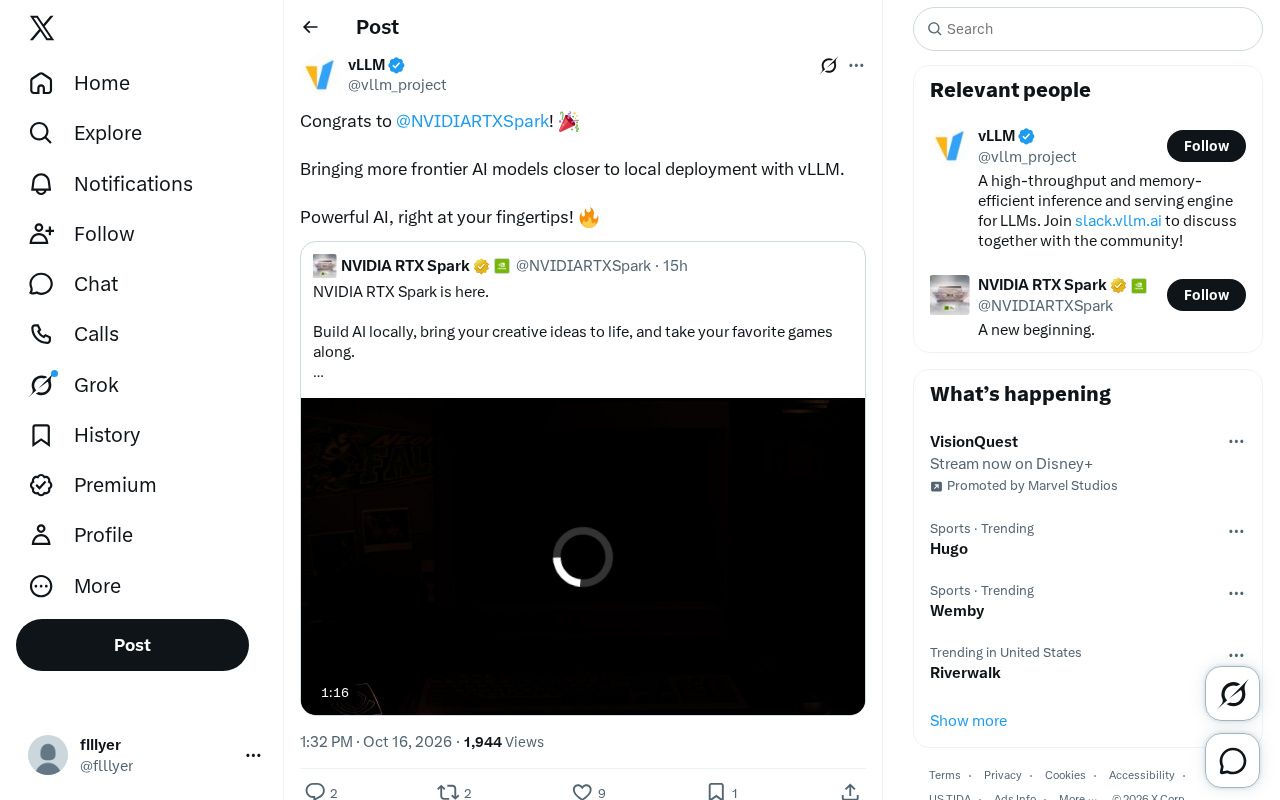
NVIDIA RTX Spark partners with vLLM to advance local deployment of cutting-edge AI models and lower barriers for developers.
NVIDIA RTX Spark announced a partnership with open-source inference engine vLLM, aiming to bring more cutting-edge AI models to local deployment; vLLM's official account retweeted congratulations, drawing developer community attention. vLLM is known for PagedAttention, which significantly improves GPU memory utilization and throughput. Previously mainly used in the cloud, this partnership marks its expansion to personal workstations and edge devices. The article analyzes RTX Spark's positioning for creators and developers, and the drivers of local AI deployment in privacy, offline availability, and cost. The partnership is expected to lower the barrier to entry, unify local and cloud development workflows, and accelerate iteration, but supported models, performance data, and hardware specs have not yet been announced, pending technical documentation and benchmarks.
Local AI Deployment Welcomes a New Player: NVIDIA RTX Spark Partners with vLLM
Recently, NVIDIA RTX Spark announced on social media a partnership with vLLM, aiming to bring more cutting-edge AI models to local deployment. The news was retweeted and congratulated by the official vLLM account, quickly drawing attention in the AI developer community. For developers long constrained by cloud inference costs and latency, this may mean the barrier to running large models locally is being lowered further.
What Is vLLM, and Why Is It Worth Watching?
vLLM is an open-source high-throughput, low-latency inference and serving engine for large language models. Its core innovation, PagedAttention, significantly improves GPU memory utilization. Previously, vLLM was mainly used for cloud service deployment, helping enterprises serve more concurrent requests on limited hardware. This partnership with NVIDIA RTX Spark marks vLLM's expansion from data centers to personal workstations and edge devices.
According to vLLM's official tweet, the two sides will "bring more cutting-edge AI models closer to local deployment." This means developers can expect to run various mainstream open-source models on local devices equipped with RTX Spark at better performance, without relying on cloud APIs.
The technical principle behind PagedAttention: In traditional LLM inference, the KV Cache must pre-allocate contiguous GPU memory for each request, with length reserved according to the maximum possible sequence, causing substantial memory to be wasted on "reserved but unused" space. PagedAttention borrows from the operating system's virtual memory paging mechanism, dividing the KV Cache into fixed-size "blocks" that are dynamically allocated on demand, stored non-contiguously, and mapped between logical positions and physical blocks via a block table. This significantly reduces memory fragmentation; in practice, memory waste can be cut from 60%–80% to under 4%, allowing more concurrent requests or longer contexts on the same GPU. For local deployment, this mechanism means limited consumer-grade VRAM can support larger models or higher concurrency—a key technical foundation for vLLM's move from data centers down to personal workstations.
RTX Spark's Positioning and Potential
NVIDIA RTX Spark is a recently launched NVIDIA hardware product line for AI development (specific specs have not yet been disclosed in the tweet). Given NVIDIA's consistent "RTX" brand positioning, it can be inferred that it targets creators, developers, and AI enthusiasts, emphasizing powerful local AI compute. vLLM's addition fills in the inference engine—a critical piece of the software stack.
From an industry trend perspective, local AI deployment is becoming a force that cannot be ignored. Privacy sensitivity, offline availability, and zero API cost are its main drivers. vLLM's efficient inference capabilities happen to alleviate the pain points of limited local hardware VRAM and compute that falls short of data centers.
Hardware constraints of local inference: Running large models on local devices, the core bottleneck is usually not peak compute but VRAM capacity and bandwidth. Model weights must be fully loaded into VRAM: a 7B-parameter model requires about 14GB at FP16 precision, or about 4–5GB when quantized to 4bit; in addition, the KV Cache grows linearly with context length and concurrency. Therefore, the memory management efficiency of the inference engine directly determines "whether it can run" and "how fast it can run." Engines like vLLM use continuous batching to dynamically schedule across requests, avoiding GPU idling, and combine it with PagedAttention to compress cache overhead—only then can they approach data-center-level throughput on memory-constrained local hardware. This is also why software stack optimization often affects the local AI experience no less than hardware upgrades.
Impact on Developers and the Industry
For individual developers and small teams, this partnership may bring the following changes:
- Lower barrier to entry: With vLLM's optimizations, mid-range hardware can smoothly run larger-parameter models;
- More flexible development workflow: Local debugging and cloud deployment can use the same inference framework, reducing issues caused by environment differences;
- Faster iteration: No need to wait in queues for cloud resources—model validation can be done locally.
However, the information disclosed by both sides is currently very limited. Which models are supported, the magnitude of performance gains, and RTX Spark's hardware specs have not been announced. While excited, the developer community is also waiting for more detailed technical documentation and benchmark data.
Conclusion
The alliance between NVIDIA RTX Spark and vLLM adds an important weight to the local AI deployment ecosystem. Although details remain to be revealed, the vision of "running cutting-edge models locally" is itself exciting enough. We will continue to follow further developments.
Related articles

iPhone Duo Battery Life Tested: One Charge a Day Is Unavoidable, and the Large Screen Is the Culprit
iPhone Duo battery test: heavy use needs at least one charge a day, and about 30% remains after 6.5 hours of screen-on time. How often the large screen is unfolded is key; a MagSafe battery pack helps, and long-term degradation is also worth watching.

Kimi K3.1 Pro Open-Sourced: 2.8 Trillion Parameters Close In on Opus
Moonshot releases the open-source MoE model Kimi K3.1 Pro, with 2.8T total parameters and 104B activated, trailing Opus 5.5 by under 1 point on Terminal Bench 4.0.

Costco Tech Price Guessing: Are Monitors, Keyboards, Mice, and Bose Speakers Worth It?
A YouTube blogger guesses prices of Costco tech products: 2K 180Hz monitor, Logitech keyboard and mouse, Bose speaker, and CyberPower UPS, revealing warehouse-store selection and brand premium.