NVIDIA SOMA Retargeter: How Human Motion Teaches Humanoid Robots to Move
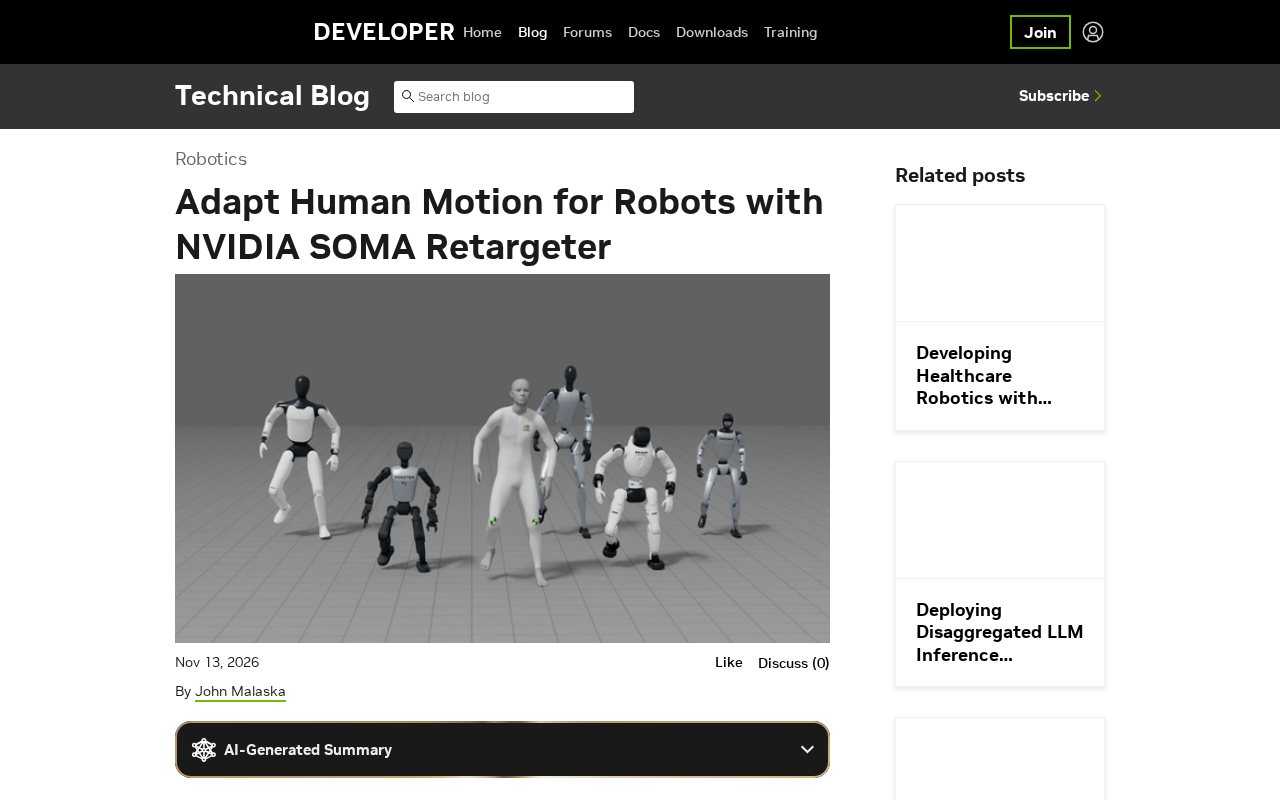
NVIDIA SOMA Retargeter converts human motion data into robot-executable joint trajectories, bridging the gap between data and the robot body.
NVIDIA's SOMA Retargeter is a developer tool that retargets human motion capture data into joint trajectories executable by humanoid robots. Human demonstrations carry coordination and timing information valuable for robot motion learning, but humans and robots differ in DoF, link lengths, and kinematic constraints, so direct use causes joint limit violations and instability. The tool standardizes retargeting, reducing engineering effort and making public human motion datasets easier to use.
From Human Demonstrations to Robot Motion: An Underrated Intermediate Step
The most intuitive way for humanoid robots to learn to move like humans is to "watch someone do it once." Human demonstrations naturally carry coordination and timing information—how the arms swing, how the center of mass shifts, how movements connect. But feeding human motion data directly to a robot is unrealistic: the two differ completely in joint degrees of freedom, link lengths, and kinematic constraints. NVIDIA's SOMA Retargeter is a tool aimed precisely at this step—it is responsible for "translating" human motion into joint trajectories the robot can execute.
According to the NVIDIA developer blog, capturing human motion provides roboticists with an excellent starting point for teaching humanoid robots how to move. This sentence points to the tool's core value: it is not a new motion capture solution, nor new robot hardware, but a conversion layer connecting "human motion data" and "the robot body."
What Problem Does the SOMA Retargeter Solve
Retargeting: A "Translator" for Motion Data
Retargeting is not a new concept in animation and robotics; its basic task is to preserve the semantics and style of a motion while adapting it to a target skeleton. For humanoid robots, the difficulty lies in the fact that the degree-of-freedom mapping is not a simple one-to-one correspondence. Human demonstration data usually comes from motion capture devices or video estimation and contains joint angle or position sequences on the human skeleton; the robot has its own set of joint chains, limits, and actuation methods. The role of the SOMA Retargeter is to establish a mapping between these two skeleton systems and output motion trajectories that the robot can track.
Degree-of-Freedom Mapping and Kinematic Constraints
The core difficulty of retargeting lies in the mismatch between the degree-of-freedom (DoF) systems of the two skeletons. The human skeleton usually contains dozens of degrees of freedom, and joints such as the shoulders and hips have multi-axis compound motion capabilities; the joint configurations of typical humanoid robots are often simplified, with some degrees of freedom merged or omitted. The retargeting algorithm needs to solve within an optimization framework: minimizing the position/orientation error between the robot's end effectors and the corresponding human body parts while satisfying the robot's joint limits, link lengths, and center-of-mass constraints. Common approaches include frame-by-frame inverse kinematics solving, trajectory-optimization-based temporal smoothing, and, in recent years, learning-based retargeting networks. The SOMA Retargeter encapsulates this solving pipeline as a tool: users only need to provide a human motion sequence and a robot model description to obtain trackable joint trajectories.
Why Human Data Cannot Be Used Directly
Human demonstrations capture coordination and timing—the parts that are hardest for a robot to obtain when learning a motion from scratch. But the range of motion of the human shoulder, leg proportions, and center-of-mass position differ markedly from those of a robot. Without retargeting, the robot will experience joint limit violations, pose distortion, or even instability when executing the motion. The SOMA Retargeter turns this adaptation process into a tool, letting researchers focus on motion selection and policy learning instead of repeatedly building conversion pipelines.
Center of Mass and Stability
Human demonstration data implicitly contains the human's own center-of-mass trajectory and support polygon relationships, while the robot's mass distribution, foot size, and joint actuation capabilities differ. Applying human joint angles directly will cause the robot's center of mass to deviate from the support region, leading to instability. The retargeting process usually needs to introduce center-of-mass constraints or zero-moment point (ZMP) feasibility checks to fine-tune the motion so that it is physically feasible on the robot body. This is one reason why retargeting cannot simply be equated with scaling joint angles.
Practical Impact on the Robot Learning Pipeline
From an engineering perspective, the SOMA Retargeter fills a gap on the data side. Previously, teams had to write their own scripts to map motion capture data joint by joint onto the robot model—a considerable amount of work that was hard to reuse. Once this step is standardized, human demonstrations can be converted more quickly into training data or reference trajectories for downstream tasks such as imitation learning and trajectory tracking.
In the blog, NVIDIA emphasizes that human demonstrations capture coordination and timing—exactly the information retargeting should preserve as much as possible. A tool-based retargeter shortens the "human demonstration → robot motion" chain and enables more developers without dedicated motion capture teams to use public human motion datasets.
Imitation Learning and Trajectory Tracking
The joint trajectories output by retargeting are usually used in two ways in the robot learning pipeline: first, as reference motions for imitation learning, training policy networks through behavior cloning or inverse reinforcement learning; second, as desired inputs for a trajectory tracking controller, with the low-level controller responsible for execution. In either case, the quality of retargeting directly affects the upper bound of downstream tasks—if the reference trajectory itself has joint limit violations or temporal discontinuities, policy learning will face distribution shift problems. Therefore, a standardized retargeting tool not only reduces engineering investment but also helps improve the physical consistency of training data.
Who Should Pay Attention to This Tool
The audience for the SOMA Retargeter is fairly clear: researchers working on imitation learning for humanoid robots, robotics companies that need to quickly validate motion feasibility, and research teams hoping to drive virtual humanoids with human motion. It is positioned as a developer tool rather than an out-of-the-box product, and the barrier to use lies in understanding robot kinematics and one's own model. For teams that already have human motion data but are struggling with cumbersome conversion pipelines, such tools can directly reduce upfront engineering investment.
It should be noted that retargeting is only the first step in motion transfer; whether the converted trajectory can be executed stably by the robot still depends on the controller and hardware capabilities. The SOMA Retargeter reduces friction in the data preparation step, rather than replacing downstream motion control work.
Summary
The value of the NVIDIA SOMA Retargeter lies not in proposing a new algorithmic paradigm, but in turning the conversion from human motion to robot motion into a reusable development component. It responds to a real need: motion learning for humanoid robots increasingly relies on human demonstration data, and the gap between data and the robot body requires dedicated tools to bridge. For teams focused on the humanoid robot development pipeline, this is a step worth adding to the toolbox.
One-line Summary
NVIDIA SOMA Retargeter converts human motion data into robot-executable joint trajectories, filling the conversion gap between data and the robot body.
Paragraph Summary
NVIDIA's SOMA Retargeter is a developer tool for retargeting human motion capture data into joint trajectories executable by humanoid robots. The article notes that human demonstrations carry coordination and timing information and are a valuable starting point for robot motion learning, but humans and robots differ significantly in degrees of freedom, link lengths, and kinematic constraints; applying human data directly leads to joint limit violations and instability. The SOMA Retargeter standardizes the retargeting pipeline, reducing the engineering investment of teams building their own conversion pipelines and making public human motion datasets easier to use. The tool is positioned as a development component rather than an out-of-the-box product; whether the retargeted trajectories can be executed stably still depends on the controller and hardware capabilities.
Related articles

Who Will Become the Next 'Face' of the AI Industry? A Vergecast Deep Dive
The Vergecast podcast discusses who will become the next face of the AI industry, ruling out Dario, Altman, Zuckerberg, Musk, Pichai, and Nadella, and arguing Jensen Huang remains the representative for now, though the industry urgently needs a new face from a model or product company.

Nvidia's Circular Financing: The Bubble Concerns Behind Chip-Collateralized Loans
The Vergecast podcast examines Nvidia's circular financing: customers borrow to buy chips, chips serve as collateral, but next-gen chips rapidly devalue that collateral—planting financial risk. Jensen Huang's forceful style masks bubble concerns.

PCMag Pay-to-Play Awards Controversy: The Gray Industry Chain Behind Tech Media Awards
PCMag awarded paint.net's developer a Readers' Choice Award but demanded $10,000 to link to or cite it. This article traces the incident and exposes the gray industry chain and traffic crisis behind pay-to-play tech media awards and paid coverage.