NVIDIA Synthetic 3D Medical Imaging: How AI-Generated Data Breaks the Training Bottleneck

NVIDIA uses synthetic 3D medical images to solve AI training data scarcity challenges
Medical imaging AI development is constrained by three major bottlenecks: data scarcity, privacy regulations, and annotation costs. NVIDIA proposes using diffusion models to synthesize realistic 3D medical images at scale, achieving technical breakthroughs in anatomical consistency, multi-modal support, and controllable generation. By adopting a "synthetic pre-training + real fine-tuning" paradigm, it enables high-performance clinical AI model training with minimal real data requirements.
The Data Bottleneck in Medical Imaging AI: Why Real Data Is Far from Enough
High-quality 3D medical imaging data is the cornerstone of modern radiology AI, yet acquiring this data faces formidable obstacles. Data scarcity, privacy regulations, and high annotation costs—these three challenges have long constrained the development of medical imaging AI models. NVIDIA's latest technical solution opens a completely new path for delivering pre-trained models by synthesizing realistic 3D medical images at scale.
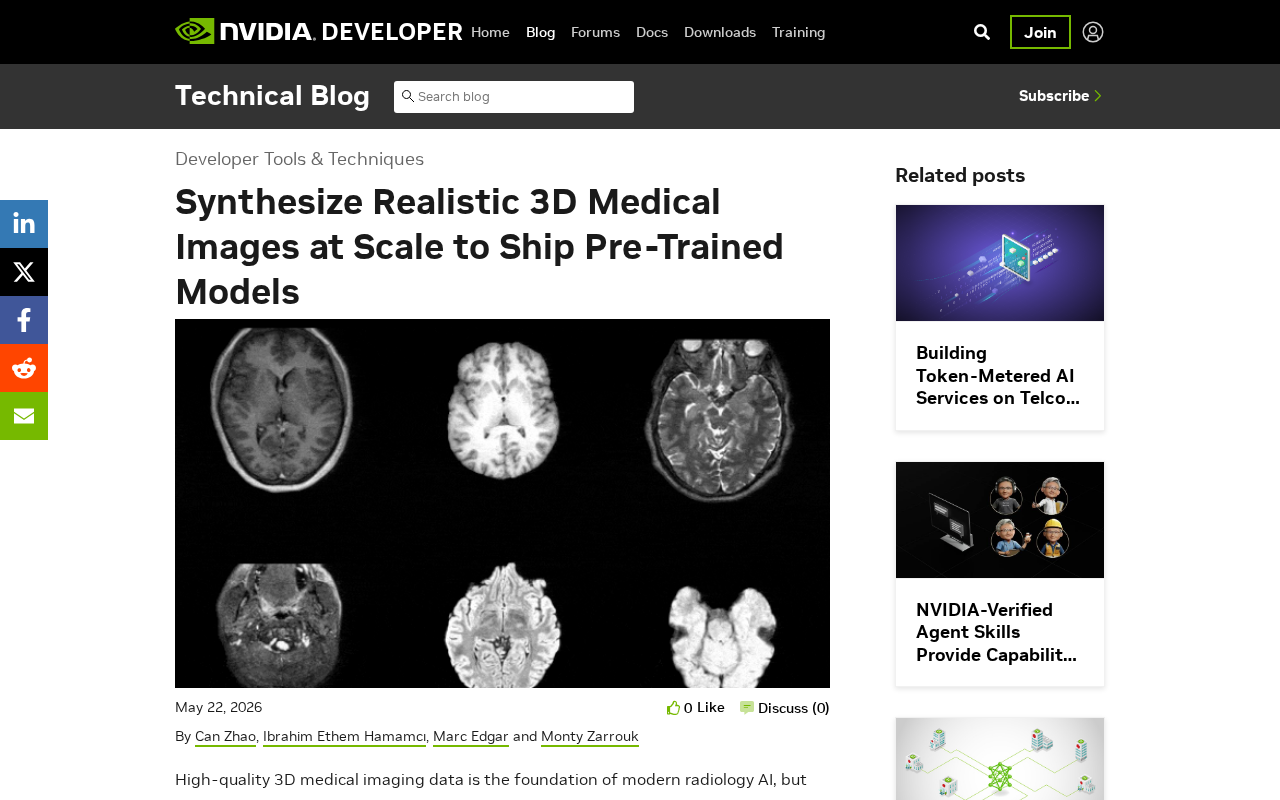
The core idea behind this approach is straightforward: since real data is difficult to obtain, use AI to generate sufficiently realistic synthetic data as a substitute. However, making synthetic data truly usable for training clinical-grade AI models presents technical challenges far more complex than one might imagine.
Why Medical Imaging Data Is So Scarce
Hard Constraints of Privacy and Compliance
Medical imaging data inherently carries patient privacy information and is subject to strict regulations such as HIPAA and GDPR. HIPAA (Health Insurance Portability and Accountability Act) is a U.S. federal law enacted in 1996 that establishes standards for the use and disclosure of Protected Health Information (PHI), with maximum penalties of up to $1.9 million per year for violations. GDPR (General Data Protection Regulation) is the EU's data protection regulation that took effect in 2018, classifying health data as "special category data" that requires stricter legal bases for processing, with fines up to 4% of global annual revenue for violations.
Notably, even when imaging data undergoes de-identification (such as removing patient names, birth dates, and other metadata from DICOM headers), research has shown that re-identification remains possible through facial reconstruction, skeletal features, and other methods. This keeps regulatory bodies and healthcare institutions highly vigilant about data sharing. Cross-institutional and cross-border data collaboration remains extremely difficult.
High Cost and Professional Barriers of 3D Image Annotation
Annotating 3D medical images (such as CT and MRI) requires experienced radiologists to label slice by slice, with a single high-quality 3D segmentation annotation often taking several hours. Understanding this challenge requires familiarity with the data structure of medical images: medical imaging universally uses the DICOM (Digital Imaging and Communications in Medicine) international standard for storage. A complete 3D CT scan typically contains hundreds to thousands of 2D slices, where pixel values represent the X-ray attenuation coefficient of the corresponding voxel (expressed in Hounsfield Units, HU). MRI uses different pulse sequences such as T1, T2, and FLAIR to reflect different physical properties of tissue, with the same anatomical region showing drastically different contrast under different sequences. Radiologists must understand these complex anatomical relationships in three-dimensional space to complete accurate annotations. This makes large-scale annotated dataset construction prohibitively expensive, severely limiting the data scale available for model training.
The Long-Tail Distribution Problem of Rare Cases
Imaging samples of rare diseases are naturally scarce, yet these long-tail cases are precisely what matters most for an AI model's generalization capability. Common cases dominate real datasets, and the insufficiency of rare cases directly impacts model reliability in clinical scenarios. Statistically, this extreme imbalance in data distribution causes models to overfit features of common cases during training, leading to significant performance degradation when facing rare but clinically equally important cases.
NVIDIA's Technical Pathway for Large-Scale Synthetic 3D Medical Imaging
From GANs to Diffusion Models: Rapid Iteration of Generation Technology
From early GANs to diffusion models, 3D medical image synthesis technology has undergone rapid iteration. Diffusion Models represent one of the most important breakthroughs in generative AI in recent years. Their core principle involves gradually adding noise to data (the forward process), then training a neural network to learn the reverse denoising process, thereby achieving high-quality content generation. Compared to earlier GANs (Generative Adversarial Networks), diffusion models offer more stable training, greater generation diversity, and are less prone to mode collapse.
In the medical imaging domain, diffusion models face unique challenges: the voxel resolution of 3D CT/MRI data far exceeds that of natural images, with memory and computational demands growing cubically. Additionally, the spatial coherence of anatomical structures requires models to maintain global consistency in three-dimensional space rather than generating slices independently. NVIDIA's solution effectively addresses these challenges through Latent Diffusion (latent space compression) and 3D attention mechanisms, enabling synthesis of 3D medical images that are highly realistic in terms of anatomical structure, tissue contrast, and pathological presentation.
Key technical breakthroughs manifest at three levels:
- Anatomical Consistency: Synthetic images maintain coherent anatomical structures in 3D space, rather than being simple stacks of 2D slices
- Multi-modal Support: Capable of generating images across different modalities such as CT and MRI while maintaining cross-modal anatomical correspondence—critical for downstream tasks that require multi-modal information fusion (e.g., tumor segmentation)
- Controllable Generation: Supports conditional generation, allowing specification of parameters such as pathology type, severity, and anatomical variations
Synthetic Pre-training + Real Fine-tuning: The Complete Workflow
The ultimate goal of synthetic data is to serve model training. The core paradigm here—Pre-training + Fine-tuning—originates from the successful practices of large language models like BERT and GPT in NLP: pre-training on large-scale general data to acquire powerful feature representation capabilities, then fine-tuning with small amounts of task-specific data to achieve high-performance downstream task adaptation at extremely low data cost. Research shows that even when a distribution gap exists between synthetic and real data, as long as the pre-trained model has learned sufficiently general anatomical feature representations, fine-tuning with a small amount of real data is enough to bridge this gap—a phenomenon known as Domain Adaptation.
NVIDIA's solution integrates synthetic data generation and pre-trained model delivery into a complete workflow:
- Large-scale Generation: Leveraging GPU clusters to batch-generate diverse 3D medical images with corresponding annotations
- Quality Filtering: Using automated quality assessment pipelines to filter out unqualified synthetic samples
- Pre-training: Training foundation models with synthetic data to establish powerful feature representation capabilities
- Fine-tuning Adaptation: Fine-tuning the pre-trained model with a small amount of real data to adapt to specific clinical tasks
This "synthetic pre-training + real fine-tuning" approach
Related articles
New Species Discovered in New York's C…
New Species Discovered in New York's Central Park? Inside the Urban Insect Hunting Project
Scientists set up insect traps in NYC's Central Park and Prospect Park to discover unknown species. With 90% of Earth's species still unnamed, urban biodiversity research is becoming a new trend in ecology.
The Full Story of the Higgs Boson Disc…
The Full Story of the Higgs Boson Discovery: An Insider's Account of the 'God Particle'
A Fermilab physicist's insider account of the Higgs boson discovery: the transatlantic race with CERN, behind-the-scenes details of the 2012 announcement, 14 years of verification, and the true origin of the 'God Particle' name.
 Research
SciMDR: How a 7B Small Model Rivals GPT-5 in Scientific Reasoning
Yale and other institutions introduce SciMDR, a two-stage data synthesis pipeline enabling a 7B model to match GPT-5 level performance in scientific literature comprehension.