Obidos Open Source: A Detailed Look at the Self-Hosted Enterprise-Grade Secure Secret Sharing Platform

Obidos open-sources its enterprise-grade self-hosted platform for secure secret storage and sharing.
Obidos, previously a commercial product since 2024, has officially gone open source. This self-hosted web-based security repository enables organizations to store and share confidential information — from passwords and 2FA codes to contracts and financial data — with fine-grained access control. It integrates with AD/LDAP, SMTP, SMS, and SNMP, and notably offers identical core functionality in both open-source and commercial editions.
Obidos: From Commercial Product to Open Source
Obidos, an enterprise-grade secure information storage tool, recently announced its official open-source release. This product has been sold commercially since 2024, and the development team has now decided to give back to the community by open-sourcing its core functionality. For small and medium businesses and technical teams who have long struggled with the challenge of "how to securely circulate sensitive information within an organization," this is an option worth exploring in depth.
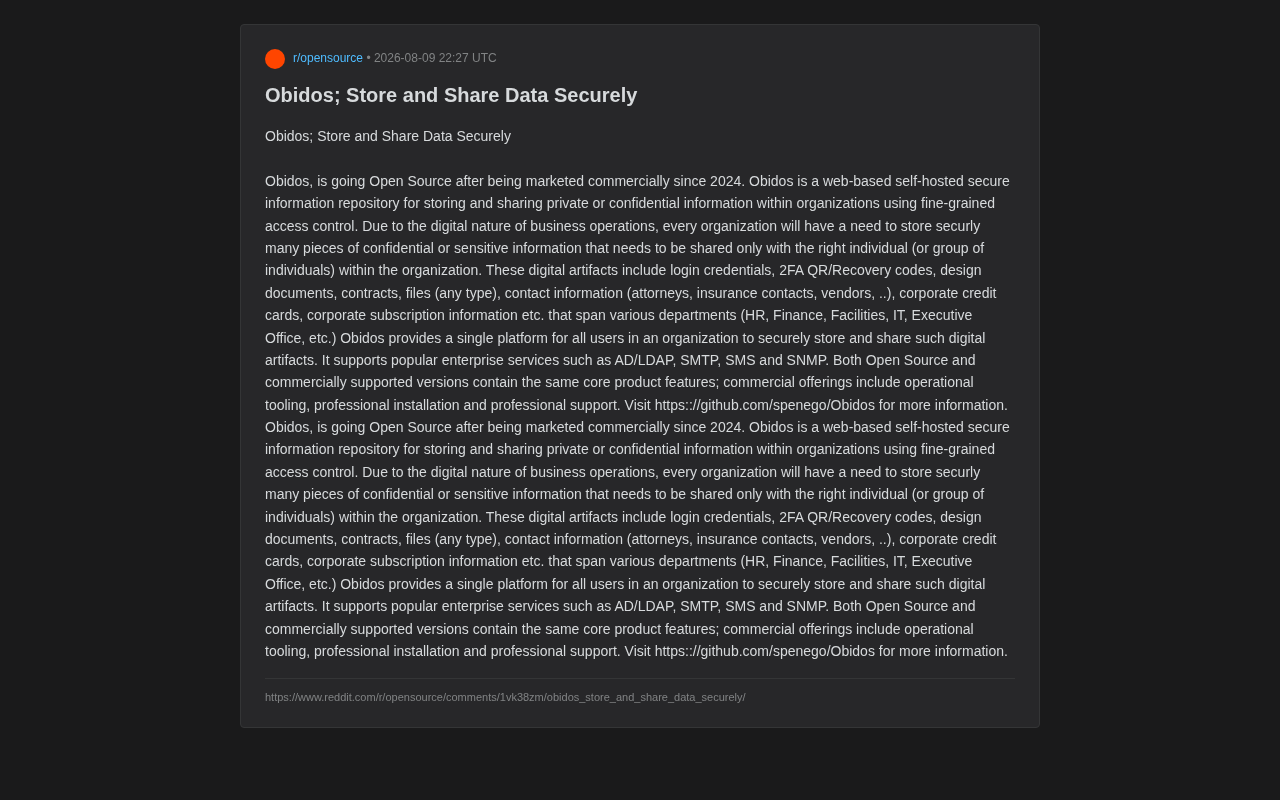
Obidos positions itself as a web-based, self-hosted secure information repository, focused on storing and sharing private or confidential information within an organization, using fine-grained access control to ensure information is only visible to authorized individuals or groups. Its GitHub repository is available at github.com/spenego/Obidos.
Self-hosted means the organization deploys the software on servers they own or lease, rather than relying on vendor-provided SaaS cloud services. The core advantage of this model is data sovereignty — all sensitive information remains stored within the organization's own infrastructure, never passing through third-party servers. For enterprises subject to regulations like GDPR, China's Multi-Level Protection Scheme 2.0, or HIPAA, self-hosting is often a necessary condition for meeting compliance requirements. The trade-off is that the organization must handle server maintenance, version upgrades, security patches, and other operational tasks.
Why Organizations Need a Dedicated Secret Repository
As enterprise operations become fully digitized, virtually every organization accumulates large amounts of sensitive information that needs secure storage and can only be shared with specific personnel. This information is scattered across different departments and systems, making management extremely difficult.
Typical Types of Confidential Information
According to the official description, Obidos covers a broad range of digital assets, including but not limited to:
- Login credentials: Account passwords for various systems and services;
- Two-step verification information: 2FA QR codes and recovery codes;
- Business documents: Design documents, contracts, and files of any type;
- Contact information: External resources such as lawyers, insurance contacts, and vendors;
- Financial and subscription information: Corporate credit cards, enterprise subscription services, etc.
These assets often span multiple departments including Human Resources (HR), Finance, Facilities, IT, and the Executive Office. In traditional approaches, teams might use spreadsheets, shared documents, or even instant messaging tools to transmit this information, creating significant security risks. Obidos aims to use a single platform to unify all these needs, enabling all users within an organization to securely store and share information in a controlled environment.
Core Capabilities: Fine-Grained Access Control and Enterprise Integration
Obidos's most critical capability is fine-grained access control. Unlike a simple binary "shared/not shared" logic, fine-grained control allows administrators to precisely define "who can see what," delegating access permissions down to the individual or specific group level. This is especially critical for handling information that crosses departmental and sensitivity-level boundaries — the finance team shouldn't see IT's system keys, and HR's contracts don't need to be exposed to the entire company.
From a technical implementation perspective, common models for fine-grained access control include RBAC (Role-Based Access Control), ABAC (Attribute-Based Access Control), and PBAC (Policy-Based Access Control). In RBAC, permissions are bound to roles, and users gain permissions by being assigned roles; ABAC goes further, dynamically determining access permissions based on multi-dimensional combinations of user attributes, resource attributes, and environmental conditions (such as time, IP address). The core value of fine-grained control lies in implementing the Principle of Least Privilege — each user receives only the minimum permissions necessary to perform their job, thereby significantly reducing the attack surface for information leakage.
Enterprise Service Integration
As a tool designed for internal organizational use, Obidos supports multiple mainstream enterprise services, lowering the barrier to deployment within existing IT environments:
- AD/LDAP: Integration with enterprise directory services for unified identity authentication. AD (Active Directory) is a directory service developed by Microsoft, widely deployed in Windows enterprise environments for centralized management of user accounts, computers, group policies, and other resources. LDAP (Lightweight Directory Access Protocol) is an open-standard directory access protocol, and AD itself is based on the LDAP protocol. When a security tool supports AD/LDAP integration, it means administrators don't need to create separate accounts for each user — the system can directly leverage the enterprise's existing identity authentication infrastructure for Single Sign-On (SSO), reducing both operational burden and the security risks from password fatigue caused by multiple independent account systems;
- SMTP: Email notifications and reminders;
- SMS: SMS channels for verification or alerts;
- SNMP: Network management protocol support for operational monitoring. SNMP (Simple Network Management Protocol) is the standard protocol for network device management, widely used for monitoring the operational status of routers, switches, servers, and other devices. SNMP support in Obidos means operations teams can incorporate it into existing network monitoring systems (such as Zabbix, Nagios, PRTG, etc.) to receive real-time alerts on system health status, resource utilization, anomalous access, and other metrics without needing to build a separate monitoring solution. This reflects the emphasis enterprise-grade products place on observability.
This set of integration capabilities demonstrates that Obidos is not a toy project but was designed from the outset to meet the demands of enterprise production environments. The self-hosted deployment model also means organizations can keep all data within infrastructure they control, avoiding entrusting confidential information to third-party cloud services.
Open Source vs. Commercial Edition
For teams evaluating this project, a key question is: Is the open-source version "watered down"?
The official answer is relatively clear — the open-source edition and the commercially supported edition contain the same core product functionality. There is no difference in product capabilities between the two. The commercial edition's added value is primarily at the "service" level:
- Operational tooling: Operations support capabilities for production environments;
- Professional installation: Deployment assistance from the official team;
- Professional support: Technical support and service guarantees.
This "open-source core + commercial services" model is quite mature in the open-source software world, commonly referred to as Open Core or Commercial Open Source. Representative examples include Red Hat for Linux, Canonical for Ubuntu, and GitLab's CE/EE dual-version strategy. The business logic is: open-source code gains user base and trust through community distribution, while enterprise customers are typically willing to pay for SLA guarantees, professional support, operational tooling, and other production-grade needs. The healthy operation of this model depends on the sincerity of the core functionality being open source — if the open-source version is excessively crippled, community trust will erode quickly. Obidos's choice of fully identical functionality is a positive signal.
Selection Reference: Obidos's Positioning and Competitive Comparison
From an industry perspective, Obidos's open-sourcing has several layers of significance worth noting.
First, demand for self-hosted password and secret management tools continues to grow. Although mature solutions like Bitwarden, Vaultwarden, and Passbolt already exist on the market, enterprises' demands for "data sovereignty" and "compliance controllability" ensure this space never lacks new entrants.
The major players in the current self-hosted password management space each have different focuses: Bitwarden is the benchmark for open-source password managers, offering both cloud-hosted and self-hosted modes; Vaultwarden is an unofficial Rust implementation of the Bitwarden server with extremely low resource consumption, suitable for individuals or small teams; Passbolt is designed specifically for team collaboration scenarios, emphasizing secure password sharing; and HashiCorp Vault targets DevOps scenarios, focusing on dynamic management of infrastructure secrets like API keys and database credentials. Obidos's differentiation lies in extending the management scope from passwords to unstructured confidential assets like contracts, files, and contacts, attempting to create a more comprehensive "organizational secrets hub" — positioning itself more as an organization-level vault.
Second, the timing of the transition from commercial to open source is noteworthy. Choosing to open source after more than a year of commercial operation typically means the product has been validated by actual customers and has relatively high maturity. This is a positive signal for users who have been on the fence.
It's important to note that as a security tool handling highly sensitive information, its security itself still requires community audit and verification. Open sourcing provides exactly this opportunity — once the code is public, security researchers can examine whether its encryption implementation and access control logic are truly reliable. For teams planning to adopt it, thorough security assessment and small-scale piloting before putting it into production is recommended.
Summary
Obidos provides a self-hosted, controllable, and functionally comprehensive open-source option for secure storage and sharing of confidential information within organizations. Its fine-grained access control, enterprise service integration, and "no-compromise open-source core" positioning give it differentiated competitiveness among similar tools. Interested teams can visit its GitHub repository for further evaluation of whether it fits their needs.
Related articles

GitHub Daily · October 22: Claude Code Tutorial Soars to 40K Stars
Claude Code tutorial project gains 428 stars in a day, topping GitHub Trending as AI coding tools shift toward ecosystem and onboarding methods.

Python 3.15 New Feature: Is the sentinel Type Better Than None?
Python 3.15 adds the sentinel type, using named unique sentinel objects to replace None and bare object(), resolving confusion among missing values, explicit emptiness, and invalid input while avoiding type hint failures.

Deep Learning's Three Architectures and the Universal Approximation Theorem: A Complete Guide to MLPs, CNNs, and Transformers
Explaining the inductive bias differences among MLP, CNN, and Transformer, the existence meaning of the Universal Approximation Theorem (UAT), and the role of Taylor expansion in approximation analysis, while clearing up common misconceptions.