Observability-Aligned Masked Pre-training: Improving VRU Motion Prediction Reliability
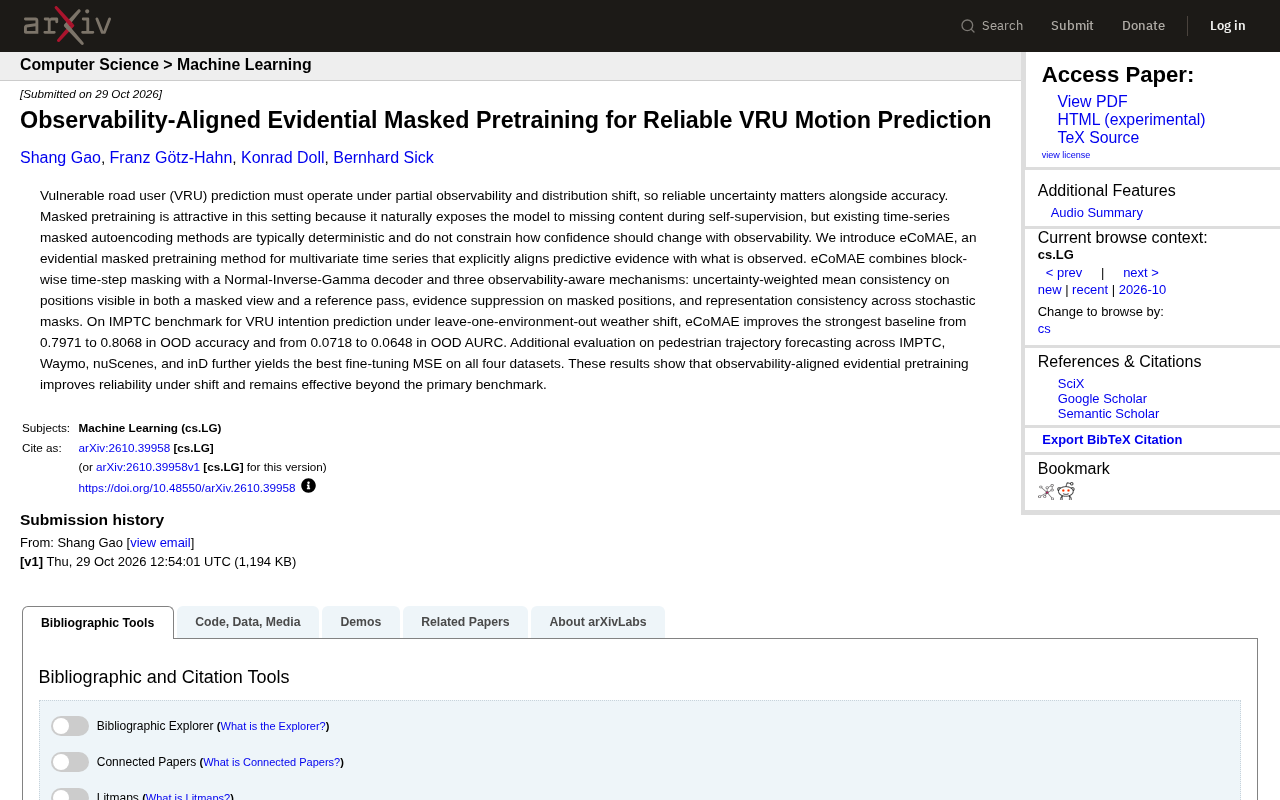
eCoMAE improves VRU prediction reliability under distribution shift via observability-aligned evidential masked pre-training.
The article introduces eCoMAE, a method proposed in an arXiv paper to address reliability issues in vulnerable road user (VRU) motion prediction caused by partial observability and distribution shift. While conventional masked pre-training can adapt to missing content, it cannot constrain model confidence with observability, making it prone to overconfidence about missing parts. eCoMAE combines block-wise temporal step masking with a Normal-Inverse-Gamma decoder and introduces three observability-aware mechanisms: uncertainty-weighted mean consistency, evidence suppression at masked positions, and representation consistency across random masks. Under the weather shift setting of the IMPTC benchmark, OOD accuracy improves from 0.7971 to 0.8068 and OOD AURC decreases from 0.0718 to 0.0648, while achieving the best fine-tuning MSE on trajectory prediction tasks across four datasets, demonstrating good generalization ability and potential for safety-critical applications.
In autonomous driving and intelligent transportation systems, motion prediction for vulnerable road users (VRUs, such as pedestrians and cyclists) is critical. However, perception systems in real-world scenarios often face partial observability and distribution shift, which means prediction models must not only achieve high accuracy but also provide reliable uncertainty estimates. A recent paper on arXiv proposes a new method called eCoMAE, which significantly improves the reliability of VRU motion prediction in out-of-distribution (OOD) scenarios through observability-aligned evidential masked pre-training.
Problem Background: The Uncertainty Challenge under Partial Observability
VRU prediction is inherently a task performed under partial observability. Sensor occlusion, limited field of view, and environmental changes (such as weather and lighting) all lead to incomplete input data. In addition, distribution shift between training and test sets (e.g., from sunny to rainy conditions) further exacerbates the prediction difficulty. Conventional masked pre-training methods (such as masked autoencoders) can adapt models to missing content through self-supervised learning, but existing methods are typically deterministic and cannot constrain how model confidence varies with observability. In other words, the model may be overconfident about missing parts, leading to unreliable predictions under distribution shift.
Evidential Deep Learning is a class of methods that explicitly models uncertainty estimation as parameters of an evidence distribution. Unlike approximate inference approaches such as Bayesian neural networks or Monte Carlo dropout, evidential deep learning lets the network directly output the hyperparameters of a prior distribution (e.g., Normal-Inverse-Gamma), thereby analytically expressing predictive uncertainty (aleatoric and epistemic). Its advantages are that uncertainty can be obtained in a single forward pass with low computational cost, and it can distinguish between two sources: "data noise" and "lack of knowledge." In partially observable scenarios, evidential deep learning allows the model to actively reduce evidence strength when observations are missing, keeping confidence consistent with the amount of observed information—this is precisely the theoretical basis for eCoMAE's suppression of overconfidence at masked positions.
eCoMAE's Core Design: Evidence Alignment and Observability Mechanisms
To address the above problems, the paper proposes eCoMAE, an evidential masked pre-training method for multivariate time series. Its core idea is to explicitly align predictive evidence with observed content. Specifically, eCoMAE combines block-wise temporal step masking with a Normal-Inverse-Gamma decoder and introduces three observability-aware mechanisms:
- Uncertainty-weighted mean consistency: At positions visible in both the masked view and the reference pass, constrain the consistency of predicted means and weight by uncertainty, making the model more consistent in trustworthy regions.
- Evidence suppression at masked positions: For masked positions, suppress evidence output to prevent the model from becoming overconfident about unobserved content.
- Representation consistency across random masks: Enhance the model's robustness to masking patterns through representation consistency constraints across multiple random mask views.
These mechanisms work together so that the model can output uncertainty estimates matching the observed information under partial observability, thereby improving reliability.
The Normal-Inverse-Gamma (NIG) distribution is a conjugate prior commonly used in evidential deep learning for regression tasks: the mean follows a normal distribution and the variance follows an inverse-gamma distribution, jointly characterized by four parameters (γ, ν, α, β). The network outputs these four parameters for each prediction position, from which the predictive mean, aleatoric uncertainty, and epistemic uncertainty can be obtained analytically. eCoMAE adopts an NIG decoder, enabling the model to output uncertainty matching the observed evidence for each time step; when a position is masked, the decoder can express "unknown" by suppressing evidence parameters (e.g., reducing ν and α) rather than giving a high-confidence guess. This parameterization provides a differentiable and constrainable mathematical interface for the observability-aware mechanisms.
Experimental Results: Simultaneous Improvements in OOD Accuracy and AURC
The paper conducts VRU intent prediction experiments on the IMPTC benchmark using a leave-one-environment-out weather shift setting. Results show that eCoMAE improves the strongest baseline's OOD accuracy from 0.7971 to 0.8068, while reducing OOD AURC (Area Under Risk-Coverage Curve) from 0.0718 to 0.0648. A lower AURC means the model is more conservative when rejecting predictions, thereby reducing high-risk errors. In addition, on the pedestrian trajectory forecasting task, eCoMAE achieves the best fine-tuning MSE on all four datasets—IMPTC, Waymo, nuScenes, and inD—indicating that the method is effective not only on the main benchmark but also has good generalization ability.
AURC (Area Under Risk-Coverage Curve) is a metric for measuring the quality of selective prediction: the model progressively accepts predictions from low to high uncertainty, plotting the curve of risk (error rate) against coverage. The smaller the area under the curve, the better the model is at ranking high-risk samples into the rejection region. Unlike looking only at average accuracy, AURC simultaneously penalizes "overconfident errors" and "unnecessary rejections," making it particularly suitable for safety-critical scenarios. eCoMAE reduces OOD AURC from 0.0718 to 0.0648, meaning lower risk at the same coverage or more samples covered at the same risk, indicating that its uncertainty ranking is more reliable—not just that mean accuracy has improved.
Multi-Source Cross-Validation and Industry Implications
According to analyses of related work by Bilibili uploaders and YouTube channels, the proposal of eCoMAE responds to the urgent need for uncertainty quantification in the autonomous driving field. Multiple independent sources point out that in safety-critical systems, pursuing average accuracy alone is insufficient—models must know what they "don't know." Through observability-aligned evidential pre-training, eCoMAE provides a feasible technical path toward this goal. However, some views hold that the method's effectiveness in more complex dynamic scenarios (such as dense crowd interactions) still needs further validation.
Overall, eCoMAE offers a new approach to improving the reliability of VRU motion prediction. Its core innovation lies in combining masked pre-training with evidential deep learning and explicitly modeling the impact of observability on uncertainty. In the future, this method is expected to be extended to a broader range of time-series prediction tasks, especially in application scenarios with distribution shift and safety requirements.
Leave-one-environment-out is an evaluation protocol for constructing distribution shift: each time, samples from one environment (e.g., a certain weather or lighting condition) are entirely held out as the test set, while the remaining environments are used for training, thereby simulating the model's performance on unseen domains. Compared with random splitting, this protocol can more realistically expose the model's reliance on domain-specific shortcuts. In VRU prediction, environmental factors such as weather, lighting, and sensor type are often the main sources of distribution shift, so the leave-one-environment-out setting has become a common benchmark for testing OOD reliability and is an important premise for the persuasiveness of eCoMAE's experimental conclusions.
Related articles

Google's Satellite AI Server Reaches Orbit: Gemma Model Generates First Reply in Space
Google's TPU-equipped satellite powers up in orbit, with the onboard Gemma 4 model generating the first reply from space. This article analyzes the technical path, real-world constraints, and implications for edge computing and satellite remote sensing.

AI Agents for Flight Booking Customer Support: Real Needs and Implementation Challenges
Starting from a real Reddit question, this article breaks down four needs for introducing AI Agents into flight booking call centers: basic Q&A, agent assist, call summarization, and quality inspection, and analyzes accuracy concerns and handoff boundary design.

Vercel Unifies Runtime Cache: Data Cache Merges into Runtime Cache
Vercel merges Data Cache into Runtime Cache, unifying storage quotas and billing for Next.js fetch cache, unstable_cache, getCache, and use cache: remote. Pro and Enterprise projects get more storage, and cache reads/writes are now billed at Runtime Cache pricing.