Office Snacks Reveal Corporate Health Culture: The Management Truth Hidden in Your Break Room
What's in your office break room reveals more about corporate culture than any mission statement.
Office break room snacks serve as an unintentional but revealing signal of corporate health culture. This article explores the cost logic behind cheap candy versus nutritious options, the physiological impact of sugar-laden snacks on productivity, and how organizational culture theory explains why these small details matter more than grand corporate slogans.
The Office Break Room: An Overlooked Signal of Corporate Culture
When discussing corporate culture and employee well-being, we tend to focus on macro topics like compensation, promotion pathways, and remote work policies. However, an observation from social media points to a more subtle yet more authentic criterion: what's actually placed in the office break room.
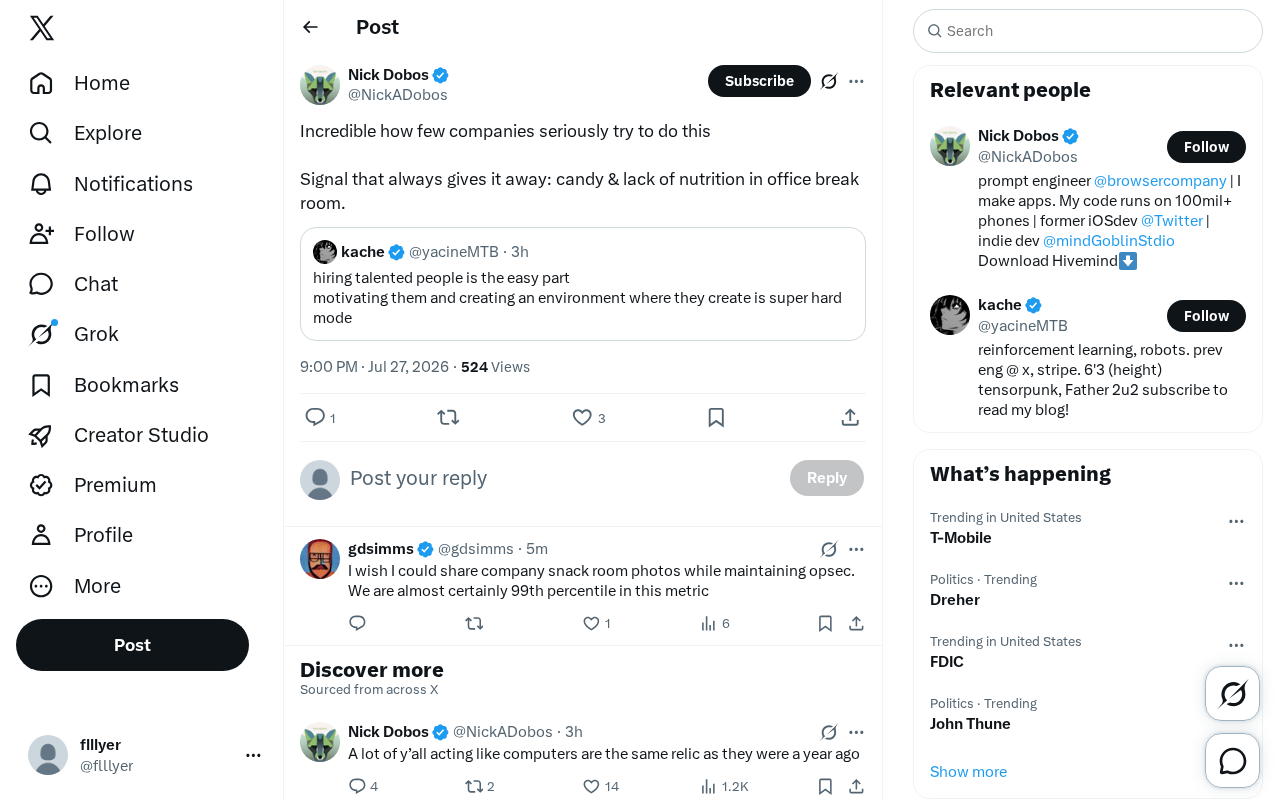
The observation is blunt: "It's surprising how few companies take this seriously. One signal that always reveals the truth — a break room filled with candy but lacking genuinely nutritious food." It seems like a throwaway comment, but it actually touches on a company's core attitude toward employees' long-term health.
The Cost Logic Behind Snack Choices
Why do so many companies stock their break rooms with candy, chips, and sugary drinks? The answer often lies in cost and convenience. Processed snacks have long shelf lives, low unit costs, require no refrigeration, and are simple to restock — making them the path of least resistance for administrative procurement. In contrast, providing fresh fruit, nuts, quality protein, or balanced meals means higher purchasing costs, shorter shelf lives, and more complex supply chain management.
From a procurement decision perspective, this also involves what behavioral economics calls the "default option effect" — when administrative departments face multiple supply options, the path of least resistance tends to win automatically. The processed food industry has spent decades optimizing its supply chain, compressing the costs of bulk ordering, long-distance shipping, and long-term storage to extremely low levels. This makes a case of candy with a six-month shelf life nearly "invisible" on financial statements. Meanwhile, the spoilage rate of fresh food (typically 15%-30%), cold chain requirements, and frequent restocking needs create visible, continuously approval-requiring line items in administrative budgets. It's this structural convenience gap — rather than deliberate neglect — that forms the underlying logic of most corporate break rooms.
The Misalignment Between Short-Term Stimulation and Long-Term Health
Sugar delivers instant energy and pleasure, giving employees a brief boost during afternoon slumps. But this "quick energy" often comes with rapid blood sugar spikes and crashes, ultimately worsening fatigue and impairing focus.
This phenomenon has a clear physiological basis. High glycemic index (GI) foods — such as white sugar and refined carbohydrates — rapidly convert to glucose that floods the bloodstream after entering the digestive system, triggering massive insulin secretion to maintain blood sugar homeostasis. This process causes blood sugar to spike rapidly within 30-60 minutes of consumption, then plummet below baseline within 90-120 minutes, creating the so-called "blood sugar roller coaster" effect. Simultaneously, sugar stimulates the brain's dopamine reward circuit, producing brief pleasure — but this pleasure has diminishing returns as the brain gradually develops tolerance, driving people to seek more sugar stimulation. This means a break room stocked with candy is, at the neuroscience level, actually cultivating an inefficient energy replenishment habit.
When a company only provides cheap candy, it inadvertently sends a message: we care about helping you "get through today," not "work healthily for the next ten years."
This is precisely the significance of "signals" — the form of benefits reveals a company's true positioning of employee value. In organizational behavior, "Signaling Theory" was originally proposed by economist Michael Spence in labor market research to explain how parties convey information that cannot be directly verified through observable behaviors in environments of information asymmetry. Applying this theory to corporate culture: when employees cannot directly verify a company's verbal promises of "valuing talent," they instinctively infer the organization's true attitude through observable behaviors — such as break room food offerings. Organizations that genuinely value talent treat employees' physical condition as a long-term investment, not an administrative expense to be arbitrarily squeezed.
Why Employee Health Benefits Deserve Serious Investment
From a more pragmatic perspective, employee nutrition directly impacts productivity. Extensive research demonstrates significant correlations between diet quality and cognitive performance, emotional stability, and absenteeism rates. A work environment offering balanced dietary options isn't merely a "perk" — it's substantive support for organizational effectiveness.
Joint research by the World Health Organization (WHO) and the International Labour Organization (ILO) has explicitly noted that workplace nutrition interventions can boost employee productivity by up to 20%. Another longitudinal study published in Population Health Management found that employees with unhealthy eating habits were 66% more likely to report productivity losses compared to those with healthy diets. From a return on investment (ROI) framework, Silicon Valley tech giants like Google and Meta have long treated high-quality employee dining as a strategic tool in talent competition — Google has publicly stated that one purpose of its free meal policy is to maximize "on-site creative time" by reducing time employees spend eating out and improving nutritional quality. These practices aren't pure generosity but precisely calculated human capital investments: when a highly-paid engineer's afternoon efficiency drops 30% due to poor diet, the hidden cost far exceeds the expense of providing a nutritious lunch.
The Gap Between "Having Snacks" and "Thoughtfully Providing Them"
You might not have noticed, but the key issue isn't "no snacks" — it's "lack of thoughtfulness." Putting out a basket of candy is essentially a zero-threshold operation, while thinking about how to make the break room genuinely serve employee health — such as introducing fresh produce, providing low-sugar options, and labeling nutritional information — demonstrates real corporate sincerity. This also explains why "few companies do it seriously": because seriousness itself requires additional thought and resources.
Small Signals Reflect Big Culture
These details carry diagnostic value precisely because they're unrelated to grand narratives. A company can fill its career page with slogans about "employees first," but break room shelves don't lie. When an organization handles even the most basic daily care in the cheapest possible way, how much credibility do its higher-level promises really carry?
This observation aligns with a classic theoretical framework in organizational culture research. MIT Sloan School of Management Professor Edgar Schein's "Three Levels of Organizational Culture" model divides culture into three progressive layers: the surface level is "Artifacts" — observable physical environments, behavioral patterns, and institutional arrangements; the middle layer is "Espoused Values" — ideals the organization publicly claims; the deepest layer is "Basic Assumptions" — deep beliefs members unconsciously follow. Break room food offerings fall squarely within the "Artifacts layer" — the most explicit, unadorned physical manifestation of organizational culture. Schein's theory suggests that when the artifacts layer is inconsistent with the espoused values layer (for example, a company claiming to be "people-oriented" while only providing cheap candy), what truly reflects the organization's deep assumptions is the former, not the latter. This is also why experienced organizational researchers always begin diagnosing corporate culture by observing the physical details of office spaces.
Practical Implications for Managers and Job Seekers
For corporate managers, this observation provides a low-cost starting point for self-examination: take a walk to your own break room and consider what the choices there actually reflect about your values. Improving employee nutrition doesn't necessarily require a massive budget — what matters is whether you're willing to treat it as something worth taking seriously.
For job seekers and current employees, this is also a practical observation lens. When evaluating whether a company truly puts people first, beyond reading the black-and-white benefits list, pay attention to those inadvertently revealed details — they're often closer to the truth than carefully packaged marketing.
It should be noted that snack variety can provide reference points, but assessing a company's culture still requires more comprehensive evidence. Nevertheless, this brief observation reminds us that the truth about corporate culture is often hidden in the most easily overlooked corners.
Key Takeaways
Related articles

The Truth Behind Codex 'Build a Website in 5 Minutes': AI Isn't Creating Sites—It's Helping You Copy Them
Exposing the truth behind viral Codex 5-minute website videos: creators aren't building original sites with AI—they're copying shared prompts or scraping others' work. Learn AI coding tools' real limits.

Getting Started with AI Agent Development: A Complete Guide from Concept to Practice
A comprehensive guide to AI Agent architecture and development, covering automated marketing, intelligent customer service, and investment analysis scenarios with single and multi-agent collaboration.

The Truth Behind Codex 'Build a Website in 5 Minutes': AI Isn't Creating Sites — It's Helping You Copy Them
Exposing the truth behind viral Codex 5-minute website videos: creators aren't building original sites with AI — they're copying shared prompts or scraping others' work.