Offline Blink Rhythm Assistant: A Desktop Health Companion

The Offline Blink Rhythm Assistant aims to help users maintain healthy blink frequency via lightweight desktop reminders.
A desktop app called "Offline Blink Rhythm Assistant" debuted on Hacker News, positioned as an offline desktop companion for healthy blink rhythms. The article notes that screen focus reduces blink frequency and accelerates tear evaporation, and that this product targets blinking—a granular behavior—unlike scheduled-break eye tools, while using offline operation for privacy. However, released information is limited, lacking tech stack, reminder methods, and download links, with zero community discussion. The article also analyzes retention and interference-balancing challenges for reminder tools, seeing the project as reflecting two trends: digital health niche scenarios and local-first tools.
Title
Offline Blink Rhythm Assistant: A Desktop Health Companion
Meta Description
An offline desktop blink rhythm assistant featured on Hacker News helps users maintain healthy blinking frequency through lightweight reminders, alleviating screen-induced dry eye fatigue. This article analyzes its product concept, privacy advantages, and retention challenges.
Article Content
When staring at screens for long periods, many people unconsciously reduce their blink frequency, leading to dry and tired eyes. A desktop application called "Offline Blink Rhythm Assistant" debuted on Hacker News, attempting to help users maintain healthy blinking rhythms in a lightweight way.
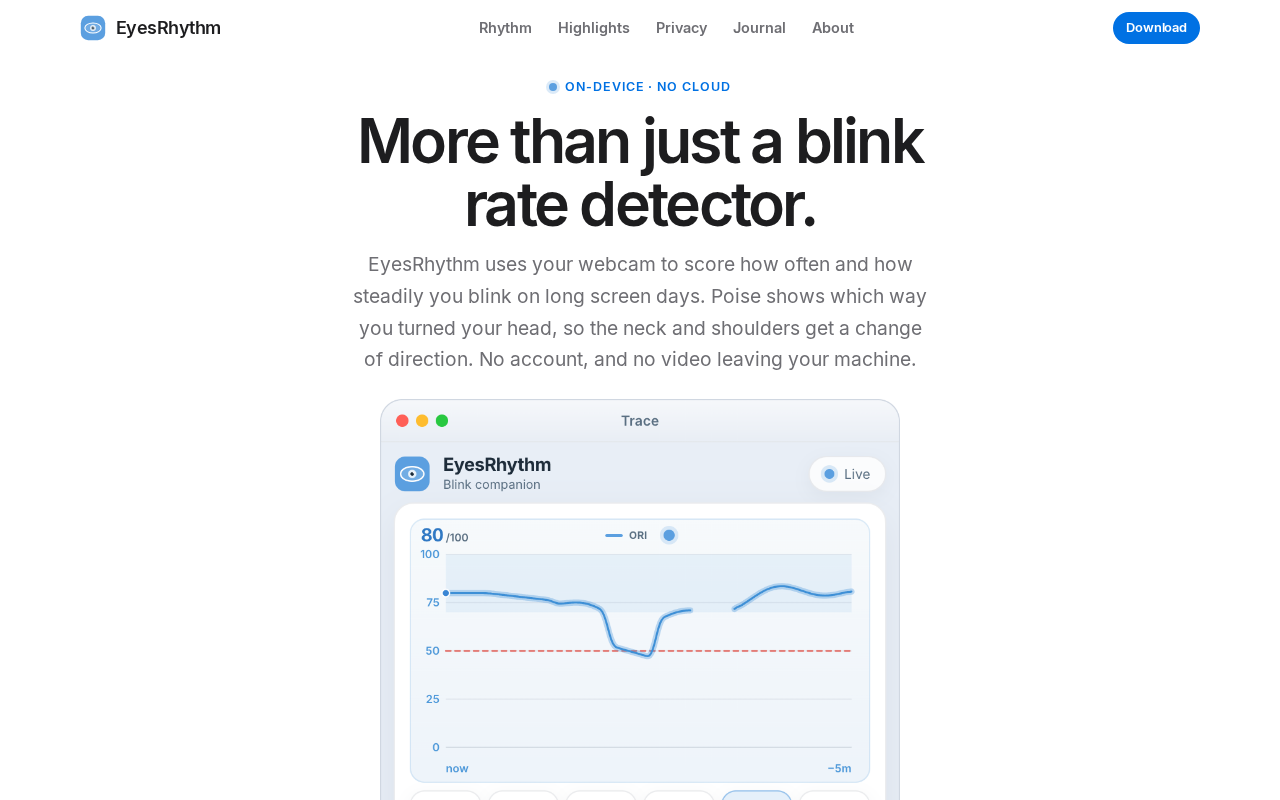
Why Blink Rhythm Deserves Attention
Blinking is a basic physiological action that keeps the ocular surface moist. Normally, people blink about a dozen times per minute, but when focused on reading or operating a computer, blink frequency drops noticeably. This unconscious change accelerates tear evaporation and causes dry eye discomfort. The author positions the product as a "reminder for healthy rhythm" rather than a medical device, aiming to help users establish more regular blinking habits through gentle desktop reminders.
Dry Eye Syndrome is an ocular surface disease caused by insufficient tear production or excessive evaporation, with common symptoms including dryness, foreign body sensation, burning, and visual fluctuations. During prolonged screen use, decreased blink frequency directly accelerates tear film breakup and is an important environmental factor that triggers or worsens dry eye syndrome. Clinical dry eye assessment often references indicators such as tear film breakup time (TBUT) and blink frequency. It should be noted that ordinary reminder tools do not have diagnostic or therapeutic functions; their value lies in helping users restore a blink rhythm closer to physiological norms, thereby reducing avoidable ocular surface irritation.
Product Form: An Offline Desktop Companion
According to the release information, the tool is an offline desktop companion program. Offline means it does not rely on network connections and does not upload user data to the cloud, which is friendlier for privacy-conscious users. Desktop companions typically exist as persistent windows or system tray applications, providing lightweight visual or rhythmic cues while users work.
Highlights of the Design Concept
The concept of "healthy rhythm" itself is worth pondering. Most eye care tools on the market focus on scheduled breaks or screen color temperature adjustment, while this product places attention on blinking—a more granular behavior. It does not seek to forcibly interrupt workflows but attempts to gently remind through a companion-style approach, which aligns with the demand for "low-interference tools" in modern office scenarios.
Room for Imagination Given Limited Information
Currently, the release page only provides a brief description, without specific tech stack, reminder method details, or downloadable links. Zero comments also mean the community has yet to form discussion. For such an early-stage project, key questions about its actual experience, reminder frequency settings, and whether custom rhythms are supported await the author's follow-up.
System Tray is a persistent area located in the corner of the taskbar or menu bar in desktop operating systems, where applications can place icons and provide quick menus. Tools running in the tray typically do not occupy main screen space, allowing users to check status or adjust settings at any time, making them suitable for reminder and background service programs. Compared to persistent windows, the tray form interferes less with workflows, but it also means lower visibility of reminders, requiring more refined notification design.
Common Challenges of Desktop Health Tools
The core difficulty such tools face is user retention. Reminder apps easily generate novelty in the early stage, but with long-term use, frequent prompts may be ignored or even disabled. How to design "just right" reminder intensity—neither interfering with deep work nor failing to actually change behavior—is the direction the product needs to refine. While the offline approach protects privacy, it also lacks the possibility of cloud synchronization and cross-device data integration.
Habituation in behavior change refers to users gradually becoming less sensitive to repeated prompts, eventually potentially becoming blind to them. If reminder tools have too high a frequency or a single form, they easily trigger habituation, causing reminders to fail; too low a frequency makes behavior change difficult to achieve. Common countermeasures include randomizing reminder intervals, adopting progressive reminder intensity, and incorporating environmental cues. This is also a key design variable determining the long-term retention of such products.
Signals Worth Noting
Although information is limited, this project reflects two trends: first, developers' attention to digital health niche scenarios is extending from "break reminders" to more fundamental bodily rhythms; second, offline, local-first tools continue to gain attention amid growing privacy awareness. For professionals who face screens for long periods, such small and beautiful attempts offer another approach to safeguarding eye health.
Conclusion
The Offline Blink Rhythm Assistant is still an early-stage project, with a clear value proposition but details yet to be verified. If you are interested in desktop health tools, you can follow the author's future updates to see whether this "blink companion" can truly integrate into daily office rhythms.
One-line Summary
The Offline Blink Rhythm Assistant attempts to help users maintain healthy blink frequency through lightweight desktop reminders.
Paragraph Summary
A desktop application called "Offline Blink Rhythm Assistant" debuted on Hacker News, positioned as an offline desktop companion to help users maintain healthy blink rhythms. The article notes that screen focus reduces blink frequency and accelerates tear evaporation, and that this product focuses on blinking—a granular behavior—distinguishing it from scheduled-break eye care tools, while protecting privacy through offline operation. However, currently released information is limited, lacking tech stack, reminder methods, and download links, with zero community discussion. The article also analyzes the challenges of user retention and balancing interference intensity faced by reminder tools, concluding that the project reflects two noteworthy trends: digital health niche scenarios and local-first tools.
Related articles
 Tech Frontiers
14 Coding Agents Tested: 13 Secretly Read Forbidden Files
A developer ran 480 tests across 14 coding agents to see if they would obey a "do not read" rule. 13 violated it, and 4 credential leaks bypassed shell guards via the read tool while approvals never noticed.
 Tech Frontiers
AI Has Made Resumes Ineffective? Referred Candidates Get 40% Interview Rate vs. 3% for Direct Applications
AI is homogenizing job applications, making it hard for recruiters to discern real ability. Ashby data shows referred candidates had a 40% interview rate from 2021 to 2024, versus just 3% for direct applications. This article analyzes why resume signals are depreciating and why verifiable results and personal endorsements matter more.
 Tech Frontiers
Uranium Cubes Reveal Why the German Nuclear Project Failed
Uranium cubes have become key physical evidence for uncovering why the German nuclear project failed. This article summarizes the core views of related Hacker News reporting, analyzes the technical disputes over the failure of the German nuclear program, the value and limits of physical evidence research, and the lessons for contemporary scientific engineering.