Oh My Pi (omp): The Enhanced Fork of the Pi Coding Agent and Its Model Roles Explained

omp is a batteries-included fork of the Pi coding agent, adding model roles, an Advisor mechanism, and fallback chains.
Oh My Pi (omp) is a fork of the open-source coding agent framework Pi that layers model-scheduling enhancements on the original core agent logic in a batteries-included way. Its core additions are model roles (assigning different models to planning, coding, review, etc. to balance cost and capability), an Advisor mechanism that provides a consultation or validation channel outside the main model, and fallback chains that degrade to backup models when the preferred one is unavailable or errors out. As a fork, it carries upstream-sync maintenance costs and greater debugging complexity, so it is best validated on simple tasks first.
Oh My Pi (omp for short) is a "batteries-included" fork of the Pi coding agent. It adds model roles, an Advisor mechanism, fallback chains, and other features on top of the original. For developers who rely on AI coding agents, these enhancements may significantly change the reliability and flexibility of their workflows.
What omp Is: An Enhanced Fork of Pi
Pi itself is an open-source coding agent framework, and omp is not a rewrite from scratch but rather a fork that layers features on top of Pi. "Batteries-included" means it builds in capabilities that are commonly needed but normally require extra configuration, reducing the work users have to do to assemble things themselves.
According to the original introduction, omp retains Pi's core agent logic, with the main additions concentrated at the model-scheduling layer—including model role definitions, the Advisor mechanism, and fallback chain design. These changes all point toward the same goal: making the agent more controllable and more robust when calling large models.
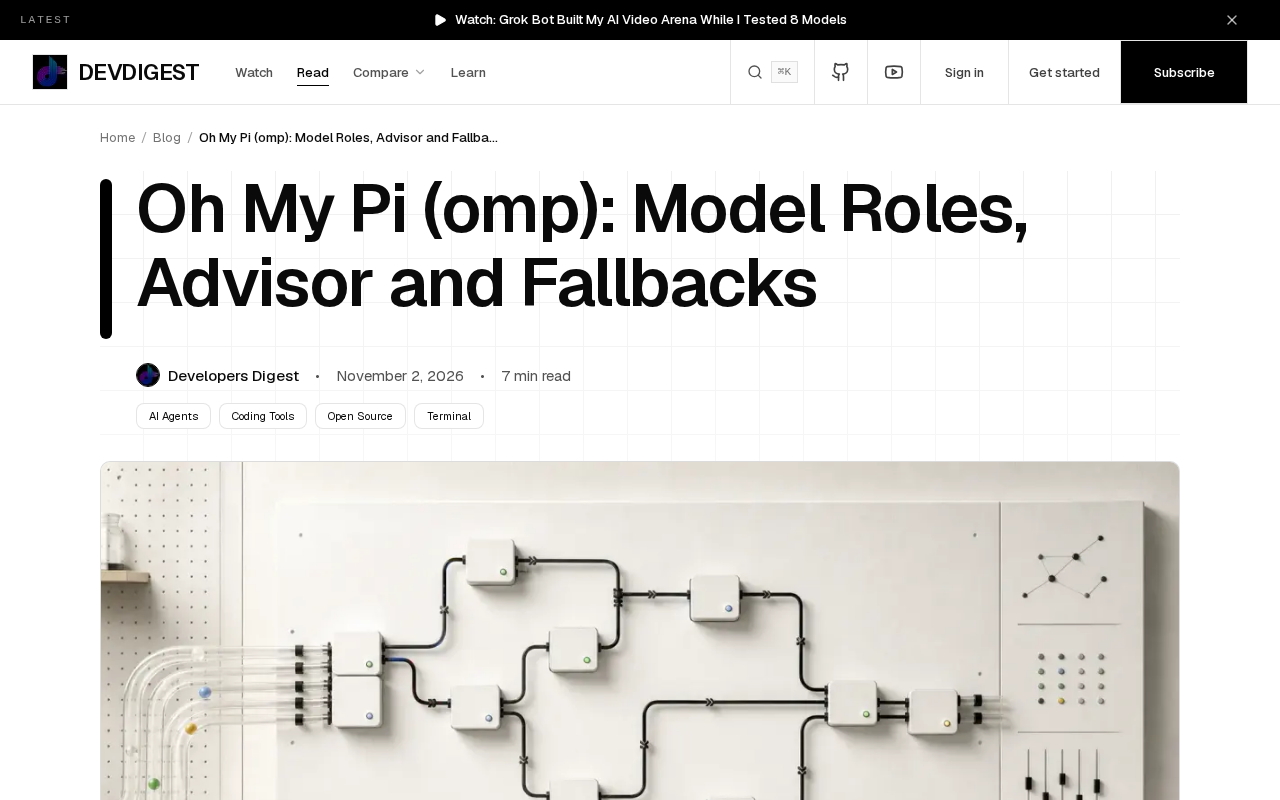
A "fork" is a common pattern in open-source collaboration: a developer copies an independent copy of a project's existing codebase and modifies it to suit their own needs without needing permission from the original maintainers. A fork shares historical code with the upstream project, but from that point on the two evolve independently. The advantage is that it can quickly reuse a mature implementation and reduce the risk of building from scratch; the cost is that when upstream keeps updating, the fork must merge those changes itself, which easily leads to code conflicts, and the maintenance burden grows the longer the fork diverges. To judge whether a fork is worth adopting, you usually look at whether its incremental features are important enough, whether anyone is actively maintaining it, and whether its differences from upstream are concentrated in controllable modules. omp follows exactly this pattern: it keeps Pi's core agent logic and concentrates its changes at the model-scheduling layer.
How Model Roles Work
Model roles are one of omp's core abstractions. In traditional usage, a coding agent is usually bound to a single model, and all tasks are completed by it. omp instead allows different models to be assigned to different roles—for example, planning, coding, and review can each use the model best suited to it.
The value of this design lies in balancing cost and capability: complex reasoning tasks go to strong models, while formatting or simple completion goes to lightweight models. The original article does not provide a specific list of roles or default configurations, so in actual use you need to consult the project documentation to confirm how roles are divided.
In LLM applications, "model routing" means dispatching requests to models of different sizes and capabilities based on task type, difficulty, or cost budget. Common approaches include routing by task stage (e.g., first use a strong model for planning, then a lightweight model for execution), routing by confidence (simple requests go to a small model, and failures are escalated), and routing by cost ceiling. The practical motivation is that flagship models have strong reasoning ability but a high unit price and high latency, while small models are more cost-effective for tasks such as formatting, completion, and classification. Model roles are essentially a declarative expression of a routing strategy—using "roles" as an intermediate layer so that configuration is decoupled from specific models, and changing the underlying model does not require changing the workflow logic. The cost is that introducing more models means more API credentials, rate limits, and differences in context formats to handle.
The Advisor Mechanism
The Advisor is another layer introduced by omp. Judging from the name, it may provide a "consultation" channel outside the main agent—when the main model encounters an uncertain or high-risk decision, the advisor model offers suggestions or validation.
The original article's description of the Advisor is fairly brief and does not disclose its trigger conditions or specific implementation. What is certain is that it is part of the model role system, and its purpose is to add a layer of judgment without fully replacing the main model. For coding tasks that require high reliability, this kind of design is worth watching, but its actual effect still needs to be verified through testing.
Fallback Chains and Stability Design
Fallback chains address the degradation problem when a model call fails or the output is unusable. omp allows you to configure a chain of backup models, so that when the preferred model is unavailable, times out, or returns an exception, the agent can automatically switch to the next model and continue execution.
This is especially important for long-running coding agents: a single point of failure will not interrupt the entire session. The original article likewise does not give details on chain length limits or switching strategy, so when configuring you need to pay attention to context compatibility between models.
Fallback is a classic fault-tolerance pattern in distributed systems. The core idea is to prepare one or more backup paths for the primary path and automatically switch when the primary path fails, thereby minimizing the impact of a single point of failure. In LLM call scenarios, failure causes usually include service rate limiting (429), timeouts, server-side errors (5xx), and output that does not match the expected format. There are several key considerations when designing a fallback chain: first, the trigger conditions for switching must be clear, to avoid degrading too early on transient errors that could be retried; second, the context window and prompt format of each model may differ, and a direct switch may cause incompatible input; third, you need to prevent cascading failures, i.e., a last-resort strategy for when all backup models are unavailable at the same time. A reasonable fallback chain is usually ordered by capability or cost and used together with retry and timeout settings.
Things to Watch Out For
As a fork project, omp's update cadence is not synchronized with upstream Pi, and merging upstream changes may bring conflicts. In addition, multiple model roles and fallback chains increase configuration complexity and debugging difficulty, so it is advisable to verify behavior on simple tasks first and then introduce them gradually. The original article specifically notes "where to be careful," indicating that these enhancements are not free of cost.
Overall, omp is suitable for developers who are already familiar with Pi and have fine-grained requirements for model scheduling. It productizes common patterns of multi-model collaboration, but the actual benefits depend on your task structure and model combination.
One-line Summary
omp is a batteries-included fork of the Pi coding agent that adds model roles, an Advisor mechanism, and fallback chains to improve the controllability and stability of model scheduling.
Paragraph Summary
Oh My Pi (omp) is a fork of the open-source coding agent framework Pi. In a "batteries-included" manner, while retaining the original core agent logic, it layers on enhancements at the model-scheduling level. Its core additions include three things: model roles allow different models to be assigned to different stages such as planning, coding, and review, balancing cost and capability; the Advisor mechanism provides a consultation or validation channel outside the main model; and fallback chains automatically degrade to backup models when the preferred model is unavailable, times out, or produces abnormal output, ensuring that long sessions are not interrupted. The article also points out that, as a fork, it carries maintenance costs for staying in sync with upstream, and multi-model configuration also increases debugging complexity, so it is advisable to verify on simple tasks first and then introduce it gradually.
Related articles

VERS: Editing Activation Explanations to Halve Reasoning Model Tokens
VERS guides reasoning models by editing activation explanations, cutting 45.8% of tokens on GSM8K with only a 0.82 pp accuracy drop and transferring to larger models, but losing accuracy on competition problems.

Finding Errors Is Not Enough: Selective Model Escalation for Entity-Targeted Sentiment Analysis
This study explores selective model escalation for entity-targeted sentiment analysis, comparing data collection ordering, uncertainty-driven re-examination, and model routing—finding that minority-class priority only helps at very small data volumes, the oracle upper bound far exceeds actual gains, and escalation must be tailored to each dataset.

WAS-PO: Using Whitened Advantages to Solve the Correlation Trap in Multi-Reward Reinforcement Learning
WAS-PO paper proposes whitening advantages to correct correlation bias in multi-reward RL: when rewards are correlated, naive weighted summation effectively applies Σ^{1/2}w instead of w. Experiments show training reward improves steadily, but held-out accuracy does not improve in sync, and under two rewards it actually falls behind.