Ollama v0.35.1 Released: Introducing the Clef Decision Model and Multimodal Capabilities

Ollama v0.35.1 adds Cloudflare's Clef decision models, CAPABILITY declarations, and expanded web search.
Ollama v0.35.1 introduces support for Cloudflare's open-source decision models Clef (27B) and Clef Flash (9B), accessible via the new `/v1/systemone` endpoint. These multimodal models return structured confidence scores for combined image and text inputs, ideal for content moderation and intent recognition. The update also adds explicit `CAPABILITY` declarations in Modelfile, helping clients accurately identify model types. Web search is now capped at 10 queries per response (up from 3), and both llama.cpp and MLX engines have been updated for broader architecture and Apple Silicon support.
The local LLM runtime tool Ollama has released version v0.35.1. The headline feature of this release is support for Cloudflare's new open-source Clef model family, along with several improvements to model capability declarations and web search. For developers who regularly deploy and run LLMs locally, these updates meaningfully expand Ollama's use cases.
Clef Decision Models: A New Multimodal Judgment Engine
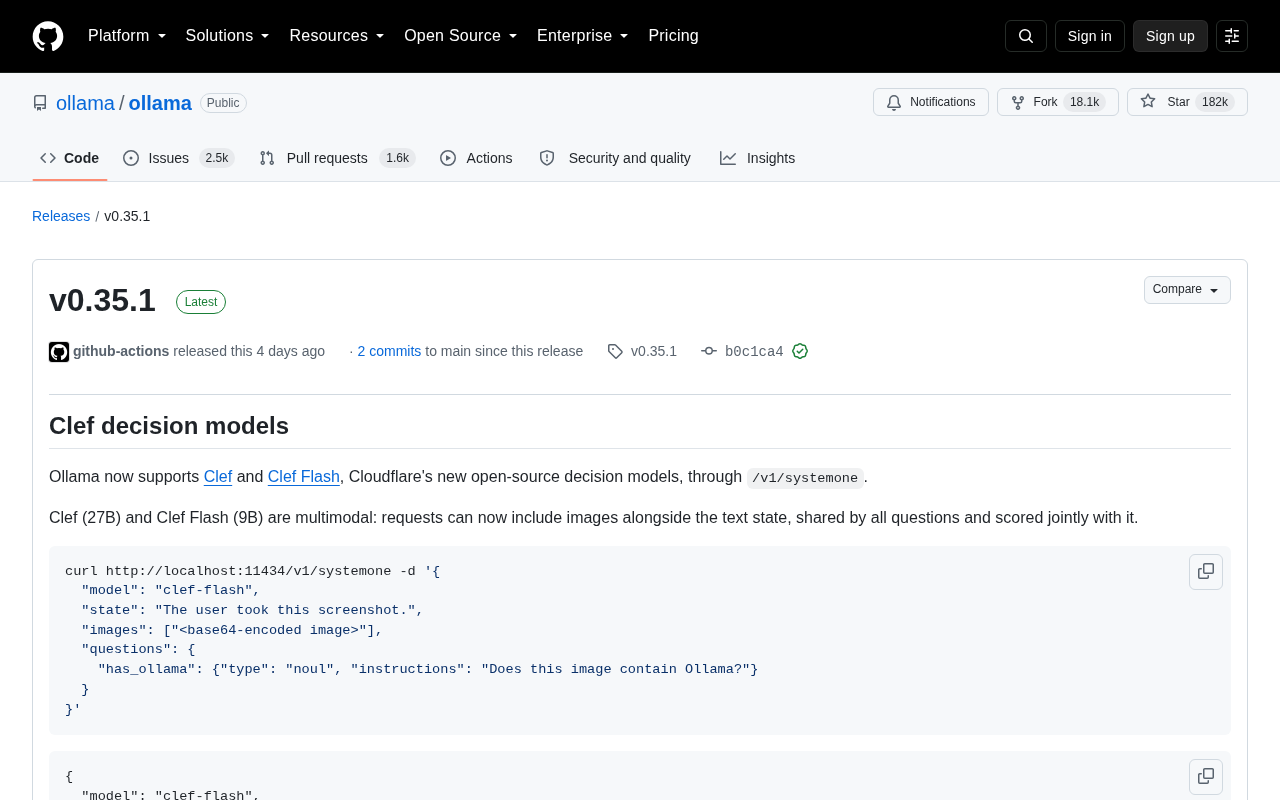
Ollama now supports Cloudflare's open-source decision models Clef and Clef Flash, accessible via the new /v1/systemone endpoint. Clef comes in at 27B parameters, while Clef Flash is 9B — both offer multimodal capabilities, meaning requests can include both images and text. Images are shared across all questions and scored jointly alongside the text.
Unlike traditional conversational models, Clef is designed to make decisions rather than generate text. It takes a state and a set of questions, then returns structured judgment scores for each question. In the official example, a developer can upload a screenshot and ask "Does this image contain Ollama?" — and the model returns a confidence score between 0 and 1:
curl http://localhost:11434/v1/systemone -d '{
  "model": "clef-flash",
  "state": "The user took this screenshot.",
  "images": ["<base64-encoded image>"],
  "questions": {
    "has_ollama": {"type": "noul", "instructions": "Does this image contain Ollama?"}
  }
}'
In the response, the noul value for has_ollama comes back as 0.958, indicating the model is highly confident that the image contains Ollama-related content. This kind of structured output is well-suited for automated judgment, content moderation, intent recognition, and similar tasks — outputs can feed directly into business logic without any secondary parsing of free-form text.
What is a Decision Model? A "Decision Model" is a specialized architecture distinct from generative language models. Its core purpose is to produce structured judgments for a given input rather than generate continuous natural language text. These models are designed more like classifiers or scorers — outputs are typically numeric confidence values, boolean decisions, or multi-label scores, making them a natural fit for direct integration with program logic.
noul(short for Normalized Output Unit Likelihood, or a Cloudflare-defined scoring type) is one such structured output type, with values ranging from 0 to 1 that can be used directly as thresholds in business rules — no regex parsing of free text or additional model calls needed to extract structure. This paradigm is already widely used in industrial settings such as content safety moderation, intent classification, and automated QA testing. Clef extends it into locally deployed, multimodal scenarios.
CAPABILITY Declarations: Making Model Abilities Explicit
This release introduces a CAPABILITY declaration mechanism in the Modelfile, allowing model creators to explicitly declare what capabilities a model supports. These declarations are preserved throughout the model lifecycle: when creating a model from GGUF or safetensors, through model inheritance, and when exporting a Modelfile.
This change may seem minor, but it addresses a long-standing pain point. In the past, clients often had no reliable way to determine whether a given model supported chat, tool calling, or reasoning (thinking) — leaving developers to guess or trial-and-error. With explicit declarations, clients can surface more accurate interfaces based on capability tags.
As a complement, ollama show and the model list now report only decision as the capability for decision models. This means models like Clef won't be mistakenly invoked by clients as general-purpose chat, tool-calling, or thinking models — preventing functional misuse.
Enhanced Web Search and Engine Updates
Beyond the decision model improvements, this release also raises the web search limit for models. Models using web search can now perform up to ten searches per response, up from the previous limit of three. For complex queries that require multiple retrieval rounds or cross-source information synthesis, this significantly improves the completeness and accuracy of responses.
On the engine side, Ollama has also updated both llama.cpp and MLX. The MLX update is particularly significant for local inference on Apple Silicon devices, while the continued llama.cpp updates ensure compatibility with the latest model architectures and quantization formats.
About llama.cpp and MLX llama.cpp is an open-source C/C++ inference framework led by Georgi Gerganov, designed for efficiently running large language models on CPUs and consumer-grade hardware. It supports the GGUF quantization format and is one of Ollama's core inference backends. MLX is Apple's machine learning framework built specifically for Apple Silicon (M-series chips), leveraging the Unified Memory Architecture for zero-copy data sharing between CPU and GPU — delivering noticeably better inference speed and energy efficiency on Mac devices compared to general-purpose alternatives. Updating both engines ensures Ollama stays current with upstream community support for new model architectures (such as Gemma 3, Qwen 3, etc.) and more aggressive quantization formats (such as Q2_K, IQ4_XS, etc.).
What This Means for Developers
The direction of the v0.35.1 update signals that Ollama is evolving from a simple "local model runner" into a more complete local AI infrastructure layer. The addition of the Clef decision model marks Ollama's expansion into structured judgment tasks beyond text generation, while the CAPABILITY declaration mechanism reflects a push toward ecosystem standardization.
For teams building local AI applications, decision models offer a lightweight, controllable, and privacy-friendly judgment tool — all inference runs locally, with no need to upload sensitive data (especially images) to the cloud. Combined with multimodal capabilities, these models hold significant potential for use cases like content recognition on edge devices and automated workflow decisions.
This is a feature-focused incremental release. Ollama users are encouraged to upgrade to explore the Clef model family and take advantage of the search and engine improvements.
Related articles

Should U.S. College Fraternities Be Banned? A Researcher's Incisive Observations
Why not just ban U.S. college fraternities? A researcher finds the key resistance comes from decision-makers' own fraternity identities and schools' "willful ignorance."

Microsoft Discovery: Accelerating Scientific Discovery with AI Agents
Microsoft's Discovery platform runs specialized AI agents to help researchers screen and prioritize the most promising compounds and experimental paths, reducing experiments and accelerating scientific discovery.

Cambridge Heavy Industries Secretly Develops Desktop-Scale Nuclear Fusion Device
Cambridge Heavy Industries is secretly developing a desktop-scale laser-driven nuclear fusion device, targeting the equipment supply market for fusion power plants. This article analyzes its miniaturization technology path, commercialization logic, and unique positioning in the fusion startup wave.