Ollama v0.40.0-rc4 Released: Key Changes in the MLX Upgrade

Ollama v0.40.0-rc4 upgrades Apple's MLX framework and reduces unit test memory usage.
Ollama has released v0.40.0-rc4, the fourth release candidate ahead of the v0.40.0 stable version. The primary change is a version bump to Apple's MLX machine learning framework, which is optimized for Apple Silicon's unified memory architecture — expected to bring inference performance gains and better model format compatibility for Mac users. The second change introduces finer-grained scopes in unit tests to reduce memory pressure during CI runs, a foundational engineering quality improvement. The release is GPG-signed and best suited for developers willing to test and provide feedback before the stable version ships.
Ollama Releases v0.40.0-rc4 Preview
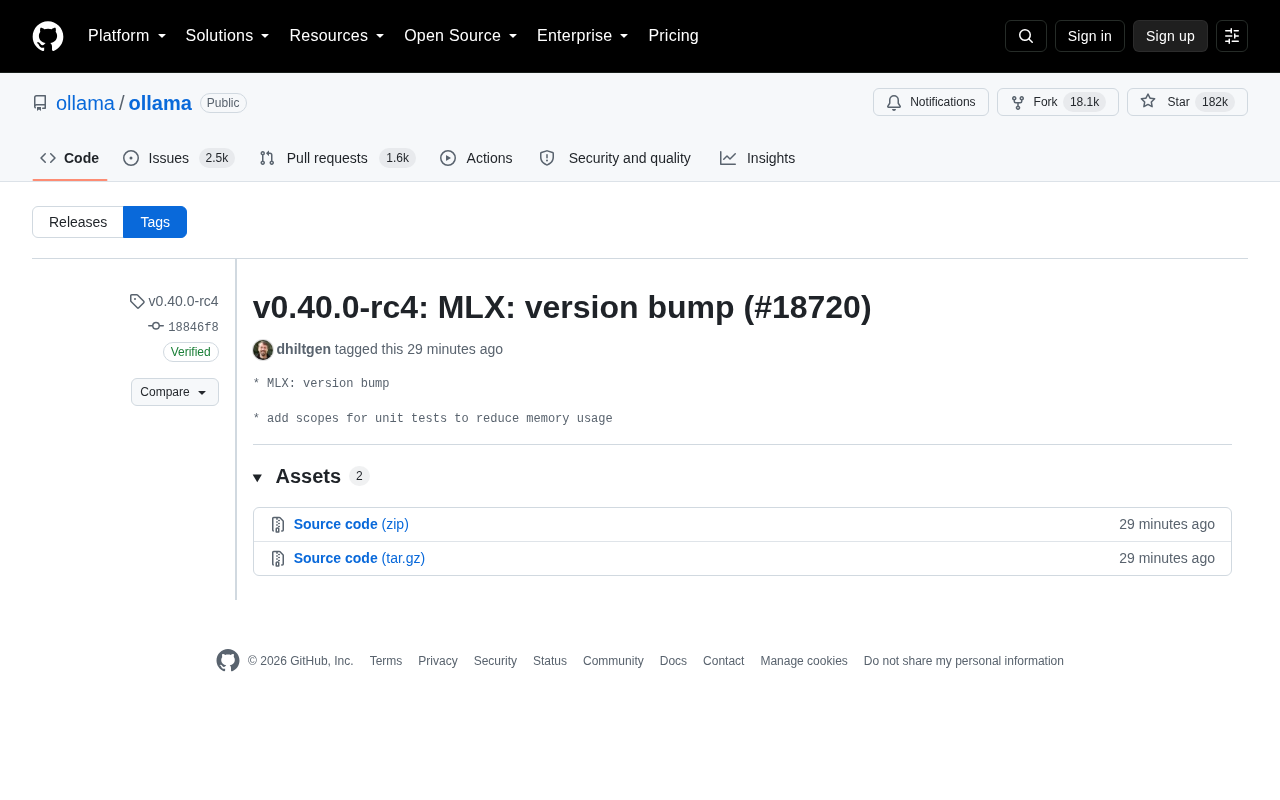
Ollama is one of the most popular frameworks for running large language models locally, having accumulated over 180,000 stars and 18,000 forks on GitHub — making it a critical piece of open-source AI infrastructure. The project recently released v0.40.0-rc4 (Release Candidate 4), tagged by maintainer dhiltgen. The release carries a verified GitHub signature (GPG key ID: B5690EEEBB952194), marking it as a candidate build ahead of the official stable release.
The naming tells the story: this is the fourth release candidate before the v0.40.0 major version goes stable, meaning feature development is essentially frozen and the focus has shifted to stability validation and polish. For developers who regularly deploy local models with Ollama, tracking rc releases is a good way to get ahead of breaking changes before the official version lands.
Core Changes in This Update
According to the release notes, v0.40.0-rc4 includes two main changes:
MLX Version Bump
The headline change is a MLX version bump. MLX is Apple's machine learning framework, purpose-built for Apple Silicon (M-series chips) to take full advantage of the unified memory architecture and GPU acceleration. Ollama's continued tracking of MLX upstream means that running local models on Mac hardware should see further improvements in performance and compatibility.
For users on MacBook, Mac Studio, and other Apple Silicon devices, updates to the MLX backend typically translate to faster inference or support for new model formats. Version bumps like this bring in upstream bug fixes and new features — necessary maintenance work to stay in sync with the broader ecosystem.
MLX was open-sourced by Apple in late 2023. Its design philosophy draws from NumPy, PyTorch, and JAX, but with a fundamental adaptation for Apple Silicon's Unified Memory architecture. Traditional ML frameworks require frequent data copies between CPU memory and GPU VRAM, whereas Apple Silicon's unified memory lets the CPU, GPU, and Neural Engine share the same physical memory pool. MLX exploits this with zero-copy cross-processor computation, significantly reducing inference latency. MLX also supports lazy evaluation of computation graphs, only triggering computation when results are actually needed — further improving memory efficiency during large model inference. For Ollama, staying current with MLX iterations means timely access to upstream support for new quantization formats (such as 4-bit and 8-bit) and compatibility with the latest M-series chip capabilities.
Unit Test Memory Optimization
The second change is "adding scopes to unit tests to reduce memory usage." This is an engineering quality improvement: by narrowing the scope of test fixtures, memory consumption during test runs is reduced. While this doesn't directly affect end-user experience, it has real benefits for CI pipeline efficiency and maintenance overhead — and reflects the project's growing engineering maturity.
The concept of "scopes" in testing comes from variable scope in programming languages. In testing frameworks (such as Go's testing package or Python's pytest), scope controls the lifecycle of test fixtures: function-level scope releases resources immediately after each test case, while module-level or global scope holds resources until the entire test suite finishes. Ollama's internals involve heavy model weight loading and GPU memory allocation. If fixture lifecycles are managed poorly, model contexts shared across multiple test cases can linger in memory, causing out-of-memory errors or dramatic slowdowns when running the full test suite in CI. By introducing finer-grained scopes to unit tests, each test case can promptly release its memory after execution, enabling stable full-suite test runs on resource-constrained CI runners and reducing the likelihood of memory-pressure-induced test failures.
What This Means for Developers
As a release candidate, v0.40.0-rc4 is best suited for developers who want to test early and provide feedback. Production environments should stick with the stable release and wait for v0.40.0 to officially land.
If you're on Apple Silicon, it's worth paying attention to any changes in local model inference performance after this MLX upgrade. Ollama has always been known for simplifying local model deployment — users can pull and run a wide range of open-source models with simple commands — and continuous backend optimization is what keeps that experience smooth.
How to Get It and Give Feedback
The release is available for download from the GitHub Releases page under Assets. Developers can grab the appropriate binary or source from the official repository, and are encouraged to file issues or submit PRs based on their testing experience. The value of a release candidate lies in broad community validation — the more users who test it, the more stable the official release will be.
Overall, v0.40.0-rc4 is a maintenance and engineering-focused iteration without any headline feature changes. That said, the continued MLX tracking is a meaningful improvement for Mac ecosystem users. Keep an eye on the full changelog when the stable version ships for the complete picture.
Related articles

AgentCore in Practice: Connecting Custom Tools and MCP Servers to Agents
DebuggerCafe tutorial shows how to connect custom tools and MCP servers to Amazon Bedrock AgentCore agents, covering tool contract design, MCP reuse, and production concerns.

816B Parameters Scores Only 39? The Real Cost-Effectiveness of the Open-Source LLM Parameter Race
Meta's 816B Muse Spark Open scores just 39 on Artificial Analysis, while 180B Qwen3.8-Flash-Next scores 40. This article analyzes 11 open-weight models' parameters vs. scores, exploring the real impact of activated parameters, quantized size, and deployment cost.

Aerial Manipulators: The Next Step for Drones from 'Seeing' to 'Changing'
Starting from a Reddit discussion, this article analyzes the technical challenges, potential applications, and deployment bottlenecks of aerial manipulators, exploring the key challenges for drones moving from environmental perception to physical manipulation.