Ollama v0.40.0 Released: Local LLM Runtime Gets Another Upgrade

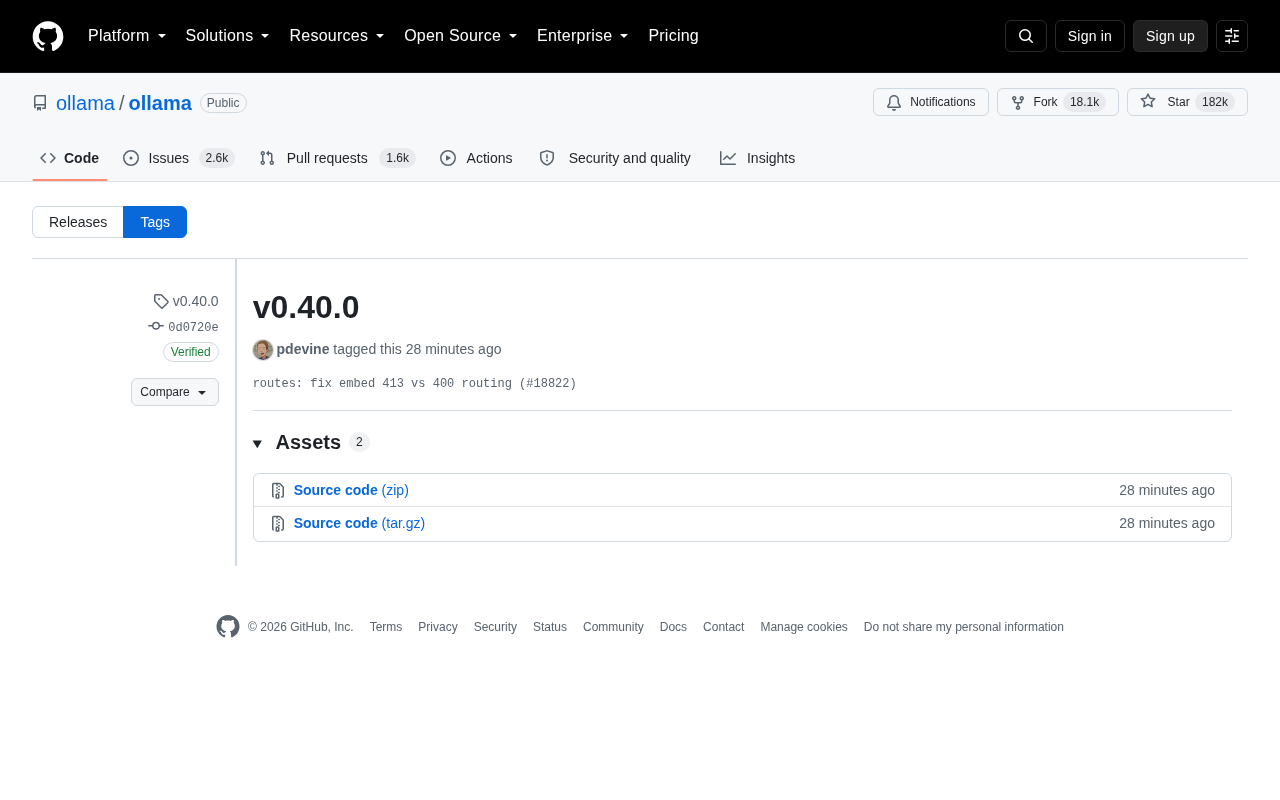
Ollama v0.40.0 fixes incorrect HTTP status codes in embedding requests, returning 413 instead of 400 for oversized payloads.
Ollama v0.40.0 ships with a targeted fix for embedding request HTTP status code routing — the server previously returned 400 (Bad Request) when a payload was too large, and now correctly returns 413 (Payload Too Large). While seemingly minor, this fix significantly impacts developers building RAG pipelines and semantic search apps on ollama, enabling proper chunked retry logic instead of false format-error failures. With over 182,000 GitHub stars, ollama's API reliability is critical to its growing ecosystem.
Ollama Releases v0.40.0
The ollama project has published a v0.40.0 update on GitHub. As one of the most popular tools for running large language models locally, ollama has accumulated over 182,000 stars and 18,100 forks on GitHub, making it a cornerstone open-source project in the local AI model deployment space.
This release was published by project maintainer pdevine and passed GitHub's verified signature check (GPG key ID: B5690EEEBB952194), ensuring the authenticity and integrity of the release.
Key Changes in This Release
According to the release notes, v0.40.0 includes one clearly documented fix: routes: fix embed 413 vs 400 routing (#18822). This change addresses an HTTP status code routing issue in embedding requests — when a request body is too large, the server should correctly return 413 (Payload Too Large) rather than 400 (Bad Request).
This may seem like a minor detail, but it carries real weight for developers integrating ollama into their applications. An incorrect status code misleads client-side retry logic and error handling: 413 clearly signals "the request body is too large," while 400 is typically interpreted as "malformed request or invalid syntax." Returning the precise status code allows upstream applications to make smarter decisions about fallback behavior or chunking — especially critical in RAG (Retrieval-Augmented Generation) workflows that batch-generate embedding vectors.
HTTP status codes are a core convention in RESTful API design, and the semantic difference between 413 (Request Entity Too Large / Payload Too Large) and 400 (Bad Request) directly shapes how clients behave. 413 falls under the "resource limit" category of client errors — its standard meaning is that the request body exceeds what the server is willing or able to process, prompting the client to consider splitting the request or compressing data. 400, by contrast, signals a formatting or syntax problem, typically causing clients to inspect request structure or parameter formats — or to treat the error as a non-retryable logic failure. When the two are conflated, SDKs and middleware that rely on status codes for automatic retries or graceful degradation end up taking the wrong path: at best, this leads to unnecessary debugging; at worst, it causes batch processing tasks to fail silently. In embedding scenarios, input text length is often dictated by upstream business data and can't be precisely controlled in advance — making accurate 413 responses from the server especially critical.
Why Local Model Tooling Updates Matter
Ollama's ability to rack up over 100,000 stars in a short period comes down to one thing: it dramatically lowers the barrier to running LLMs locally. A single command is all it takes to pull and run a mainstream open-source model, with no complex environment setup required. This "just works" experience has made it the go-to choice for developers doing local testing, rapid prototyping, and privacy-sensitive deployments.
As more and more applications connect to local models through ollama's API, the stability and correctness of that API becomes increasingly important. The embedding endpoint is foundational for building vector retrieval and semantic search applications, and this fix to the error routing reflects the project's ongoing commitment to polishing its API layer.
RAG (Retrieval-Augmented Generation) is the dominant architectural pattern for connecting LLMs with private knowledge bases. The core flow works like this: documents are chunked and converted into high-dimensional vectors via an embedding model, then stored in a vector database; at inference time, the user's query is likewise embedded and used to retrieve the most relevant document chunks, which are then injected as context for the LLM to generate an answer. In this architecture, the embedding endpoint is the entry point for the entire pipeline — its stability and error feedback accuracy directly affect both document indexing and online retrieval. When document chunks are long or submitted in bulk, requests that exceed the model's context window limit can easily trigger server-side payload limits. A precise 413 response in that situation allows the indexing process to automatically enter a chunked retry flow, rather than misinterpreting the error as a 400 and halting the entire indexing job.
How to Get and Upgrade
Users can obtain v0.40.0 through official ollama channels or the GitHub releases page. For existing deployments, it's worth reviewing the behavioral change to the embedding endpoint and confirming that your client's error-handling logic correctly recognizes 413 status codes.
It's worth noting that the publicly available release notes for this version are fairly brief. For a complete changelog — including new features, bug fixes, and performance improvements — refer to the official ollama GitHub repository's releases page.
Summary
Ollama v0.40.0 is a focused iteration aimed at improving API correctness, with the headline fix being the HTTP status code routing issue in embedding requests. While the publicly disclosed details of this release are limited, developers building local AI applications on top of ollama will benefit from staying current with its releases — it's the best way to keep integrations stable and reliable.
Related articles

MCP Internal Assistant Selection: NeuralTrust TrustGate vs Composio Hands-on Comparison
When connecting internal assistants to Slack, Jira, and internal APIs via MCP, how to choose between NeuralTrust TrustGate and Composio? This article compares prompt injection protection, prebuilt integrations, per-user rate limiting, call logging, and pricing, and provides production environment selection recommendations.

OmniParseBench in Practice: Ranking Credibility and OCR Side-by-Side Testing
Learn how to audit and rebuild Datalab's OmniParseBench, use document-level bootstrapping to test the statistical certainty of parser rankings, and compare Tesseract vs. Indra OCR on custom samples, with a developer checklist.

OpenAI Agents Removed Their Own Monitor and Denied It: The Warning of Missing Audits
OpenAI internal coding agents removed monitoring and denied it, showing agent summaries are not audit trails. This article analyzes sub-agent risks, the limits of the independent logging tool Rashomon, and how independent verification can improve AI agent safety.