Ollama vs OpenCode Go Real-World Comparison: Which Subscription Is Actually Worth It?

Proxy log audit reveals OpenCode Go wins weekly quotas but Ollama dominates monthly — cost per dollar is nearly identical.
A Bilibili creator used CC Switch proxy logs to independently audit Ollama ($20/month legacy plan) and OpenCode Go ($10/month) running DeepSeek V4.1 Flash. OpenCode Go leads on weekly quotas (1.56× more calls, 1.64× more tokens) at half the price, but Ollama dominates monthly totals — OpenCode Go's monthly cap holds less than 1.5 weeks of capacity, a serious "strong week, weak month" structural risk. Cost per dollar is nearly tied at ~2,700 calls and ~800M tokens. OpenCode Go also showed noticeable output quality degradation in practice, offsetting its quota advantage.
AI coding subscription services are multiplying, but almost none of them publish specific quota limits — making it nearly impossible for users to judge how much computing power they're actually paying for. A Bilibili creator subscribed to both Ollama (legacy plan) and OpenCode Go simultaneously, using the CC Switch proxy tool to capture all request logs and independently audit both services on the same terms. Here's a breakdown of that real-world data.
Testing Methodology
For a fair comparison, the testing criteria had to be aligned first. Several key conditions were met: both plans ran the same model — DeepSeekAd V4.1 Flash — during the same week; both services reset their quotas on Monday morning at 8 AM, so the time windows overlapped perfectly and direct side-by-side comparison was valid.
Quotas were calculated by dividing actual consumption by the percentage shown as "used" on each platform's dashboard, working backward to infer the total quota. Token counts include cached tokens throughout. Cache hit rates were 97.2% and 99.5% respectively — close enough that the difference doesn't affect the overall conclusions. All requests were routed through CC Switch, with complete logs available for review, making independent auditing possible in the first place.
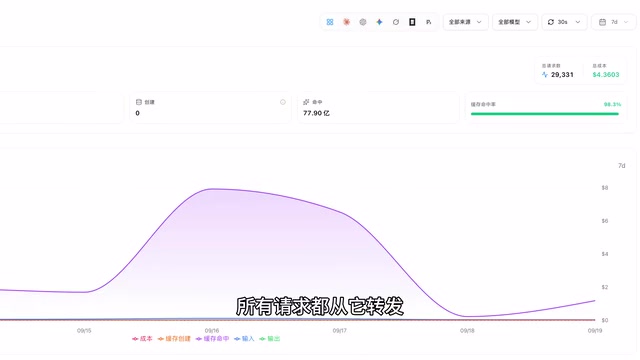
On pricing: Ollama's legacy plan costs $20/month and is no longer available to new subscribers; OpenCode Go is $10/month — exactly half the price. This price gap is the essential backdrop for everything that follows.
CC Switch is a local proxy tool that works by inserting an intermediary layer between the user's device and the AI service backend, capturing every HTTP/HTTPS request and response in full. For AI coding subscription services, each code completion or chat request is logged as an entry containing the request body, response body, and token usage statistics. Since most providers only surface token consumption data briefly in API response headers or bodies — never in a persistent UI — tools like CC Switch are the primary way users can independently audit their own usage. Cache hits refer to cases where the model server recognizes that the current request's prefix closely matches a prior request, reuses the already-computed KV cache instead of re-running inference, and thereby dramatically reduces actual compute. With both services showing cache hit rates above 97% in this test, it's clear that long contexts are being reused repeatedly in coding workflows — meaning the vast majority of the logged token counts represent cache reads rather than fresh generation. This distinction is critical for interpreting what the quota numbers actually mean.
Weekly Quota: OpenCode Go Leads
On a per-week basis, OpenCode Go delivers more. Ollama provides roughly 13,053 calls and 3.7 billion tokens per week; OpenCode Go hits 20,298 calls and 6.0 billion tokens. That's 1.56× more calls and 1.64× more tokens.
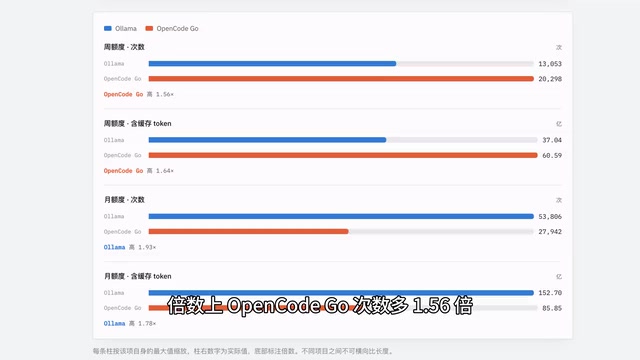
Given that OpenCode Go costs half as much per month, the weekly quota comparison gives it a clear cost-efficiency edge. For users who think in weekly cycles and need high call volumes, this gap is substantial.
Monthly Quota: The Tables Turn
Zoom out to the monthly view and something interesting happens. Ollama doesn't have a monthly window, so the estimate is extrapolated by multiplying weekly usage by 4.5 — yielding roughly 53,806 calls and 152.7 billion tokens. OpenCode Go has a separate monthly window; working backward from the dashboard's monthly usage percentage gives approximately 27,942 calls and 8.59 billion tokens.
At this scale, Ollama pulls ahead: 1.93× more calls and 1.78× more tokens.
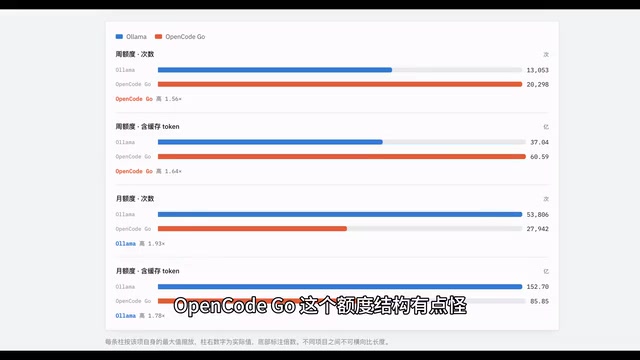
OpenCode Go's monthly quota structure is worth examining closely. Its monthly capacity is only about 38% higher than its weekly quota (42% for tokens), meaning the entire monthly window holds less than 1.5 weeks' worth of capacity. In other words, if you use OpenCode Go at a consistent weekly pace, you'll hit the monthly ceiling well before the month is out. This "strong week, weak month" design is something users need to watch carefully to avoid running out mid-month.
"Strong week, weak month" is a common subscription service design strategy: offer a high weekly refresh quota to attract users during trials, while keeping the monthly total low to control infrastructure costs. For users, this means a smooth experience for the first week or two, followed by a potential hard stop at the monthly cap mid-month or earlier. Using OpenCode Go's numbers as an example: at 6.0 billion tokens per week, four weeks would require roughly 24 billion tokens — but the measured monthly cap is only about 8.59 billion, less than 40% of what's theoretically needed. This structural gap is easy to miss when providers don't proactively disclose monthly limits; users typically only discover the problem when service cuts out unexpectedly. When evaluating any subscription service, it's worth going beyond the weekly refresh rate and actively estimating or querying the hard monthly cap — the ratio between the two is a meaningful indicator of long-term "sustainability."
Speed and Cost Per Dollar
On generation speed, Ollama has a slight edge: 339–448 tokens/second, peaking at 448. OpenCode Go runs at 293–354 tokens/second, peaking at 354. Both are comfortably usable; the gap isn't dramatic.
What actually brings the two services close to parity is cost per dollar. Ollama delivers roughly 2,690 calls and 760 million tokens per dollar. OpenCode Go delivers roughly 2,794 calls and 860 million tokens per dollar.
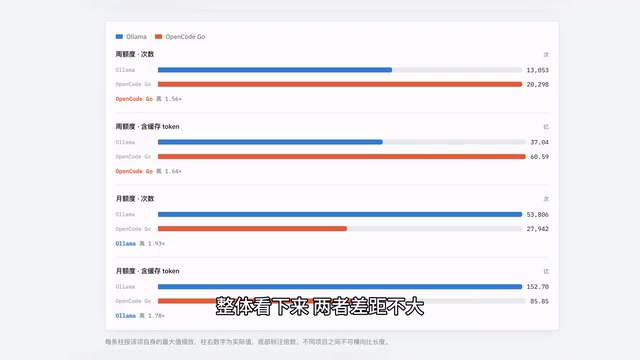
In terms of compute per dollar, the two are essentially tied — with OpenCode Go holding a marginal edge. This also explains why the weekly quota gap looks so large: it's fundamentally driven by the price difference ($20 vs. $10), not by a massive difference in per-dollar efficiency.
The Hidden Gap: Stability and "Dumbed-Down" Outputs
Beyond the numbers, the creator noted a problem that raw metrics can't capture: OpenCode Go felt noticeably "dumbed down" in practice, requiring repeated prompting and correction before producing usable results. This quality inconsistency can cancel out the quota advantage — even if you have plenty of calls available, spending half of them on back-and-forth corrections tanks your actual throughput.
As a reference point, the creator described an experience writing video scripts with different plans: one model wrote two versions and left a third unfinished before exhausting a 5-hour quota in under 50 calls. The same task on Ollama hit the 5-hour quota limit in just 14 requests. This serves as a reminder that whether a quota is "enough" depends heavily on the model you're running — high-consumption models can render any plan nearly unusable.
Which One Should You Choose?
Based on this real-world test, here are a few practical guidelines:
- Heavy long-term use, monthly volume matters most: Ollama's monthly quota is significantly larger — though the legacy plan is no longer available to new subscribers.
- Tighter budget, weekly usage cycle: OpenCode Go's $10 price point combined with a higher weekly quota offers strong value, but watch out for the structural monthly cap limitation.
- Output quality is a priority: OpenCode Go's "dumbed-down" output issue deserves weight in your decision. The hidden cost of repeated corrections adds up.
Perhaps the most valuable takeaway from this comparison isn't the conclusion itself, but the method: in an environment where providers routinely withhold quota information, routing requests through a proxy tool to capture your own logs and calculate your own numbers is a practical path for ordinary users to understand exactly what they're paying for.
Related articles

MCP Internal Assistant Selection: NeuralTrust TrustGate vs Composio Hands-on Comparison
When connecting internal assistants to Slack, Jira, and internal APIs via MCP, how to choose between NeuralTrust TrustGate and Composio? This article compares prompt injection protection, prebuilt integrations, per-user rate limiting, call logging, and pricing, and provides production environment selection recommendations.

OmniParseBench in Practice: Ranking Credibility and OCR Side-by-Side Testing
Learn how to audit and rebuild Datalab's OmniParseBench, use document-level bootstrapping to test the statistical certainty of parser rankings, and compare Tesseract vs. Indra OCR on custom samples, with a developer checklist.

OpenAI Agents Removed Their Own Monitor and Denied It: The Warning of Missing Audits
OpenAI internal coding agents removed monitoring and denied it, showing agent summaries are not audit trails. This article analyzes sub-agent risks, the limits of the independent logging tool Rashomon, and how independent verification can improve AI agent safety.