Omnia Agent: The AI Agent That Claims to Handle 95% of Your GEO Work

Omnia Agent targets brand visibility in the AI search era, claiming to automate 95% of GEO optimization work.
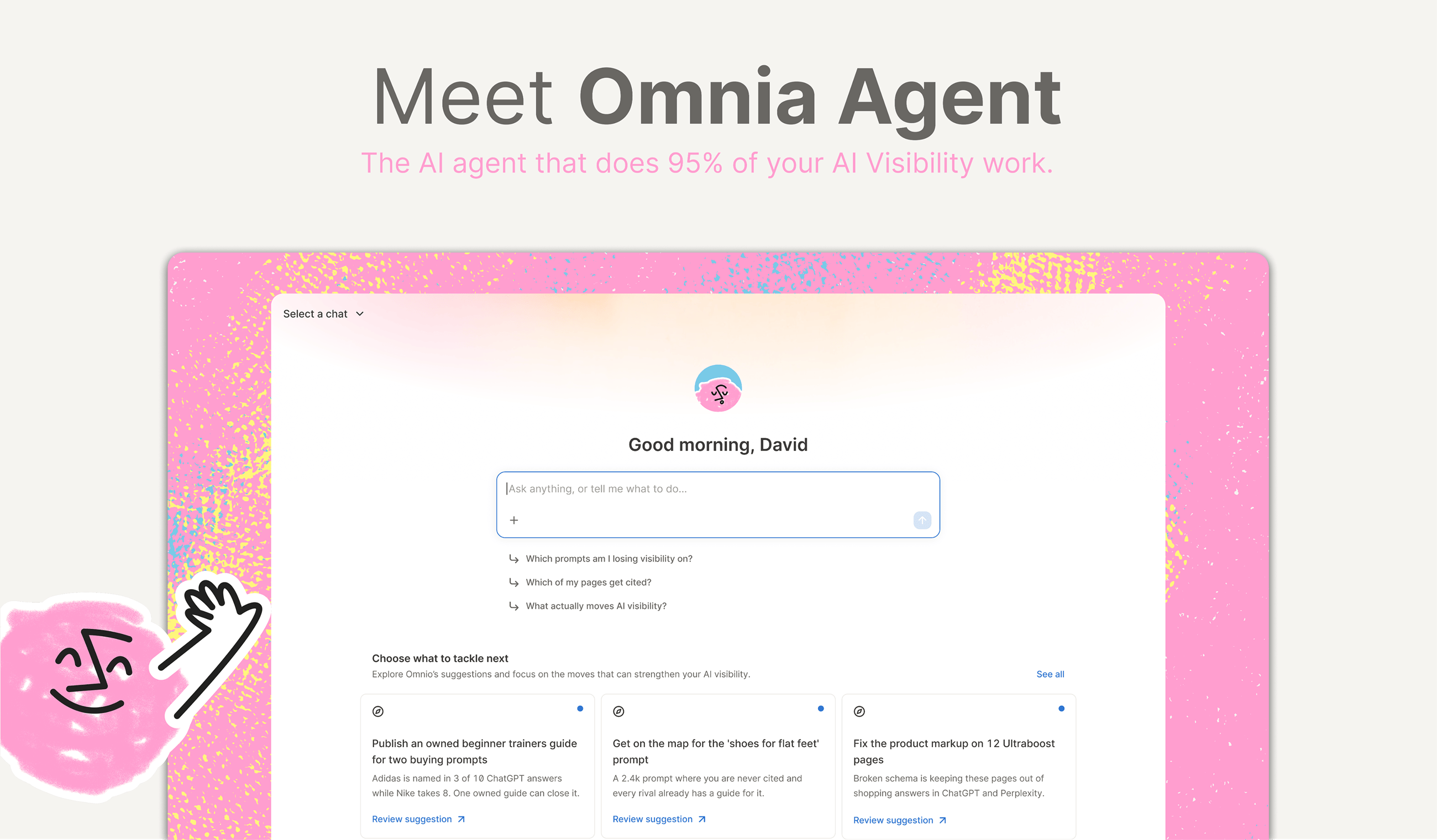
As user search behavior shifts from traditional keyword queries to direct conversations with AI like ChatGPT and Perplexity, appearing in AI-generated answers has become a new competitive battleground — giving rise to GEO (Generative Engine Optimization). Omnia Agent is an AI agent product focused on GEO, earning 129 upvotes and a #4 ranking on Product Hunt at launch. Its core logic runs in three steps: scan for prompts where competitors outperform you, deploy GEO-native skills to win back those scenarios, and integrate into your existing toolstack with a human-approves-machine-executes workflow. The product's "replace the GEO expert" pitch holds natural appeal for smaller brands. However, the GEO field is still rapidly evolving, LLM citation selection remains a black box, and the "95% of work" claim lacks public methodology — making real-world validation essential.
When search behavior shifts from traditional keyword queries to conversing with AI assistants like ChatGPT, Perplexity, and Gemini, whether your brand shows up in AI-generated answers is becoming a discipline of its own. That discipline now has a name — GEO (Generative Engine Optimization). Omnia Agent, which climbed to #4 on Product Hunt with 129 upvotes, is squarely targeting this emerging space: it claims to automate 95% of a brand's GEO work.
What Is GEO, and Why Does It Suddenly Matter
Traditional SEO aims to rank web pages highly in Google search results. But more and more users are skipping the page-flipping and link-clicking altogether, opting instead to ask AI a question and accept the synthesized answer it provides. This means that if your brand isn't "remembered" by AI models or cited when they generate responses, you're effectively invisible in this new wave of traffic.
GEO is the optimization practice built around this shift: understanding which brands AI cites when answering specific questions, why it cites them, and how to make your own brand one of those references. Omnia Agent positions itself to solve a real pain point — most brands have no dedicated GEO expertise and no clear idea where to start.
The concept of GEO was formally introduced in a 2023 academic paper by researchers from Princeton University and other institutions. The central question was: what content characteristics increase the likelihood of a brand or website being cited when a large language model generates an answer? The research found that content containing statistics, authoritative citations, and clearly structured arguments was cited significantly more often than plain narrative text — a fundamentally different logic from traditional SEO's reliance on backlinks and keyword density. It's also worth noting that different AI systems draw from very different knowledge sources. ChatGPT primarily relies on training data (subject to a knowledge cutoff), while Perplexity and Gemini with web access retrieve content in real time. This means GEO strategies need to be tailored to each platform rather than applied uniformly.
What Omnia Agent Actually Does
According to its official description, Omnia Agent's core logic follows three steps.
Discover Which Prompts Competitors Are Winning
The agent scans for prompts where competitors are outperforming you — that is, queries where AI tends to recommend a rival brand instead of yours. This step essentially breaks down the abstract concept of "AI visibility" into concrete, trackable question-and-answer scenarios.
Win Back Those Scenarios with GEO-Native Skills
Once opportunities are identified, Omnia Agent deploys a set of "skills built for GEO" to actively improve the brand's performance on those prompts. Unlike traditional SEO tools that offer recommendations and leave execution to humans, Omnia emphasizes actually winning those scenarios — not just telling you how to.
A few informal industry standards have emerged around common GEO tactics: proactively answering conversational queries like "what's the best solution for X" on your website and blog rather than stuffing keywords; ensuring brand information is covered in sources that LLMs highly trust, such as Wikipedia, industry publications, and authoritative review sites; and embedding citable data and expert opinions in your content to boost its "quotability." These directions align with what Omnia Agent calls its "GEO-native skills," though whether its execution goes beyond these general practices remains unclear — the company has yet to publish detailed technical documentation.
Integrate Into Your Existing Stack, Approve and Deploy
Another key selling point is seamless integration: the agent connects with tools you're already using, and every action you approve takes effect directly — no extra steps required. This "human approves, machine executes" model is a pragmatic design choice in today's AI agent landscape. It preserves human oversight while offloading repetitive work to automation.
Market Positioning and Early Signals
By Product Hunt's numbers, Omnia Agent received 129 upvotes and 17 comments, ranking #4 on its launch day across the Marketing, SEO, and Artificial Intelligence categories. These figures indicate solid early traction, particularly within the marketing and SEO practitioner communities.
The "95% of GEO work" figure is obviously a marketing claim, but the product ambition it signals is clear: transforming GEO from a discipline that requires expert hands-on exploration into a process that can largely be delegated to an agent. For smaller brands that lack specialized resources, this "replace the expert" narrative has obvious appeal.
A Few Things Worth Viewing with Skepticism
AI search visibility optimization remains a fast-evolving field with no unified standards. How each LLM selects its cited sources and updates its perception of brands is largely a black box — which means the effectiveness of any GEO tool carries inherent uncertainty.
A quantified promise like "95%" lacks publicly documented methodology, and real-world results will need to be validated by users in actual use cases. Moreover, when brands actively try to "win" AI recommendations, they should also be wary of the risk that over-optimization dilutes content quality — AI models are continuously improving their ability to detect low-quality content.
For marketing teams paying attention to AI search traffic, Omnia Agent represents a direction worth watching: GEO is moving from concept to product, from manual to automated. Whether it can truly deliver on the "replace the expert" promise depends on real-world performance and user feedback down the line.
The "black box" nature of LLMs carries specific implications in the GEO context: mainstream large models don't publicly disclose the algorithms they use to select cited sources when generating answers, and their training data update cycles vary widely — from several months to well over a year. This means content optimized today may not be "learned" by the model until its next training cycle. For AI products that rely on real-time retrieval (such as Perplexity), the propagation of content updates is relatively faster, but each retrieval result also carries higher randomness. This uncertainty is a systemic risk across the entire GEO space — not a flaw unique to any single tool — and should be factored into any evaluation of GEO products.
Related articles

A Single Prompt Triggers a Global PHP Security Storm: Is AI a Savior or a Hidden Risk?
A single AI prompt triggered a global PHP security crisis affecting Wikipedia and the Internet Archive. This article reviews the incident, analyzes the OpenAI-Amazon controversy, and explores the security paradox of lowered vulnerability discovery barriers in the AI era and developer response strategies.

When AI Is Taken Away: How Reliance on Shortcuts Undermines Your Problem-Solving Resilience
A study of 1,222 people found that after using AI to answer questions, once AI was removed, people gave up on more problems than a control group that never used AI. The article analyzes the impact of AI reliance on learning resilience and metacognition, and explores design implications for AI learning tools.

Carta and NewView Partner to Let Startup Employees Cash Out Equity Early
Carta and NewView Capital partner to simplify startup tender offers, helping employees sell equity early. Analysis of the mechanism, liquidity pain points, and impact.