One-Day Security Conference Social Guide: Building Real Connections in a Single Day

One-day security cons have no evening socializing — all relationship-building must happen during the day.
Based on Simply Cyber host Jerry's insights, this article breaks down how one-day security conferences (like local B-Sides) differ from multi-day events and how to adapt. With no evening bars, parties, or 'day two hallway reunions,' all socializing must happen during daylight. The article covers pre-conference prep (finding buddies on Discord, trimming the agenda, convincing your employer to pay), what to bring (stickers as icebreakers, a shareable project, a personal website link instead of paper resumes), day-of tactics (arriving early to chat with neighbors, approaching speakers, treating lunch as the best social window, using lock picking villages as natural settings), the practical value of photos, and post-conference follow-up with just one person — plus a bonus tip on volunteering for free admission.
The Unique Challenge of One-Day Conferences: No Evening Social Window
Many people who attend security conferences have a fixed routine — listen to talks during the day, then hit bars or parties at night to network. But one-day conferences (like local B-Sides events) completely break that rhythm. According to Jerry, host of the YouTube channel Simply Cyber, the doors at a one-day con close at 5 PM and everyone goes home. There might be an occasional happy hour, but if you didn't make any connections during the day, chances are you won't go.
This means: all socializing must happen while the sun is up. Jerry repeatedly emphasizes this core difference in his video — relationships at multi-day conferences tend to form after the talks end. You run into the same person in the hallway on day two and pick up yesterday's conversation. One-day cons don't have that "day two," no hotel bar, no sponsor parties. You get one shot.
Another often-overlooked advantage is the physical toll. Walking around Las Vegas for three straight days means your feet will "file a complaint with your body," while six to eight hours of standing at a one-day con is entirely manageable. But the trade-off is: you have to actively engage within a limited window rather than passively waiting for socializing to happen.
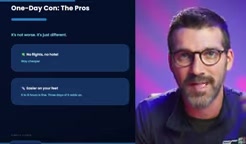
Before You Go: Find Your Crew, Pick the Right Talks
Team Up in Advance to Avoid a Cold Start
Jerry's first piece of advice is very specific: figure out who else is attending before you go. Post a message in a Discord server (like Simply Cyber's own server) asking "anyone going to this con?" Ask classmates at school, ask colleagues on your security team at work. The benefit is that you don't show up cold — you arrive with a small group. That person might know others, and after introductions, your network starts snowballing.
For readers unfamiliar with the security community ecosystem, here's some background on Discord servers. Discord started as a voice chat tool for gamers and has since become the primary online gathering place for tech communities worldwide. Nearly every security conference, open-source project, and podcast channel has its own Discord server, where members communicate via text or voice in topic-based channels. Simply Cyber is a cybersecurity content channel founded by Gerald Auger, and its Discord server brings together a large number of practitioners and learners, with daily topics covering career transitions, certification prep, tool sharing, and more. So posting a "anyone going to X con?" message in these servers before the event often quickly connects you with fellow attendees — these people usually already have some online interaction history, making the cold-start cost of meeting in person extremely low. Beyond Discord, Mastodon, Bluesky, Reddit's r/netsec, and local B-Sides' own Slack or Discord are also common channels for finding conference buddies. The key is to act one to two weeks ahead — waiting until right before departure is usually too late.
Agenda Filtering: Don't Overcommit
Every conference has an agenda. Jerry's advice is to circle one or two "must-see" talks and mark the rest as "go if you have time." He doesn't recommend trying to sprint through every talk — the rhythm of "this one just ended, rush to the next to grab a seat" leaves no breathing room and no opportunity for meaningful conversations.
He also shares a tip for getting your employer to foot the bill: find a talk directly relevant to your work, then tell your boss that this talk is closely tied to current business needs and that you can bring the information back to train the team. One-day cons typically cost only a few hundred dollars, a very low bar for most companies to approve.
What to Bring: Stickers Beat Resumes
Stickers Are the Ultimate Icebreaker
This tip comes from community member Mara Levy, whom Jerry specifically thanks in the video. In the security world, stickers are a cultural phenomenon. Bring your own stickers, hand one to someone, and you've completed a zero-pressure self-introduction. Even if the other person isn't interested, the worst outcome is they politely take it and toss it later — but most of the time, they'll glance at it and ask "what's this?" or "who are you?" and the conversation starts naturally.

Bring a Project You Can Share
One level deeper than stickers: do you have something you can show? A blog, a home lab, a GitHub repo, a small AI project — anything you can say "I'm working on this, you should check it out." Jerry emphasizes that this is about "delivering value," not just exchanging business cards.
Don't Bring Paper Resumes
This advice runs counter to many people's instincts. Jerry says plainly: "I've never found bringing a resume to a con to be a practical thing to do." Imagine someone hands you a piece of paper and now you have to carry this unwanted sheet around all day. Plus, nobody actually reads your resume on-site. What's genuinely valuable is: prepare a simple personal website link (like yourname.com/resume) pointing to a resume file on Google Drive. The URL is easy to remember, easy to share verbally, and doesn't change when you update your resume.
B-Sides (pronounced "B-sides") is a unique community security conference brand that originated in Boston in 2007 and now has independent chapters in dozens of cities worldwide, including Charleston, Atlanta, Montreal, San Diego, and Chicago mentioned in this article. Its positioning is a "local edition" or "underground edition" of major conferences like DEF CON: single-day events, low ticket prices (often tens of dollars or even free), organized by local volunteers, with speakers who are mostly frontline practitioners and enthusiasts rather than commercial lecturers. This de-commercialized atmosphere makes B-Sides socializing more egalitarian and open, and makes it easier to engage speakers up close. For those just entering the field or considering a career change, B-Sides has a far lower barrier than large commercial conferences, making it an ideal testing ground for practicing conference social skills. The reason Jerry specifically recommends starting with local B-Sides is precisely its low-pressure, familiar-circle nature — same-city attendees will keep running into each other at local security meetups, making relationships easier to sustain.
On the Day: Start Socializing from the Moment You Sit Down
Arrive Early — the First Line Is Simple
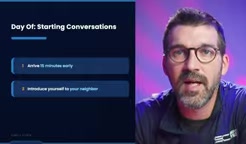
Jerry suggests arriving 15 minutes early to park calmly, pick up your badge, and settle in. Don't rush in sweating.
His "signature move" is to turn to the person next to him before the first keynote starts and say: "Hey, I'm Jerry, you are?" That's it. He admits this might feel awkward for introverts, but two seconds later the other person will start talking. Because everyone in the room voluntarily registered, looked at the agenda, and came specifically to hear the same talk — you already have something in common. Even if the other person doesn't want to chat ("Oh, I'm Kyle" and that's it), you've lost nothing. Just turn to the person on the other side and try again.
Find Speakers After Their Talks
If a talk really resonated with you, walk up to the front afterward and say "I really enjoyed your talk, I'm Jerry." Jerry uses a baseball analogy: don't try to hit a home run every time — you just need to get to first base. Occasionally you'll hit a double or even a home run, but consistently hitting "singles" is the foundation of building relationships.
Lunch Is the Best Social Window of the Day
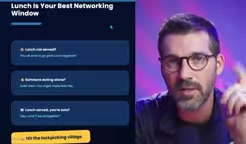
Lunchtime is what Jerry calls "the best social window of the whole day." If the conference doesn't provide lunch, proactively ask someone you've chatted with "want to grab lunch?" — they're hungry too and will likely say yes. If you see someone standing alone, inviting them could change their entire day. If lunch is provided, carry your tray and ask the person ahead of or behind you "mind if I join you?" — 99% of the time they'll say yes.
Jerry also offers an "advanced move": if you already have two people heading to lunch and spot a fourth person along the way, say "the three of us are going to lunch, want to join?" — you become the person who makes socializing happen.
Check Out the Lock Picking Village
Most security conferences have a Lock Picking Village. Jerry suggests giving it a try, not just because it's fun, but because it's a natural social setting — you're holding lock picks, someone next to you is fiddling with the same lock, and a casual "this is pretty cool, right?" opens a conversation. You don't need to talk cybersecurity with everyone. Talking about something else is actually more natural.
The Lock Picking Village (often abbreviated LPV) is a long-standing cultural corner of security conferences. Its origins trace back to early DEF CON, when physical security enthusiasts spontaneously gathered with lock picks to practice. Today, nearly every conference of any size has a lock picking village, usually run by organizations like TOOOL (The Open Organisation Of Lockpickers), with tables covered in practice locks, transparent locks, and various tools. Beginners can learn basic techniques like single-pick and raking under volunteer guidance. For security professionals, lock picking is an intuitive way to understand physical security boundaries; for socializing, it's a "shared-task" scenario — two people staring at the same lock naturally have something to talk about without forcing conversation. This is the deeper reason Jerry recommends it: compared to awkwardly striking up conversations in hallways, having tools in hand and a goal on the table makes conversation flow much more naturally. Many long-term security community friendships were first forged at the lock picking table.
Why Photos Matter More Than You Think
Jerry says this is a tip he's "never seen anyone talk about in a video." The core logic is simple: photos serve two purposes. First, they enrich the experience — you'll actually remember it later. Second, they give you material for a post-conference LinkedIn post.
A more practical trick: instead of collecting a stack of business cards, just take photos. Your phone is always on you, and all contact info is centralized in one place. Jerry admits he's countless times brought business cards home only to forget to organize them, or found them crushed or lost.
And that post-conference LinkedIn post shows what event you attended, what you're interested in, and that you actively participated — it can itself spark new conversations.
Post-Conference Follow-Up: Pick Just One Person
The conference ends at five or six, but the relationship doesn't have to. Jerry's advice: don't try to contact everyone you met — that'll just overwhelm you into doing nothing. Pick just one person you connected with best, send a LinkedIn connection request or message: "Thanks for chatting about XYZ, you mentioned that resource — can you send the link?" Follow-up collaborations and deeper conversations grow from there.
Bonus: How to Attend for Free
Jerry's final tip is volunteer. Most conferences let volunteers attend for free, but you must sign up well in advance — you can't just show up on the day and ask. The value of volunteering isn't just saving money — you spend the whole day working alongside organizers and other volunteers, which is itself an embedded social opportunity. The trade-off is you might not get to see every talk you wanted, but Jerry thinks it's absolutely worth it.
He especially recommends starting with local B-Sides — Charleston, Atlanta, Augusta, Montreal, San Diego, Chicago, and more all have them. Prices are usually very affordable, and they're perfect as an entry point to one-day conferences.
Related articles

iPhone Duo Hands-On: Is the $2,000 Small-Screen Foldable Worth It?
YouTube's Allison shares her iPhone Duo hands-on: dual-screen multitasking doubles efficiency, great video viewing, nice matte finish—but thick body, small outer screen, and a $2,000 luxury price.

Sentry's Ad Cracks Up Developers: Can On-call Actually Be Fun?
Sentry's ad short film taps into developers' on-call anxiety, using humorous dialogue to showcase its observability platform—errors, logs, traces, metrics, replays, and releases in one place.

LLM App Getting Worse With Every Change? Build an Effective Evaluation System in Three Steps
How do you know if your LLM app is getting better or worse? A Reddit-based guide to test sets, automated regression evaluation, LLM-as-judge scoring, and structured agent tracing.