One Month Into My Internship Without Writing a Single Line of Code: A Practical Guide to AI Agent Coding

AI coding has entered the agent era, shifting developers from writing code to reviewing it.
In 2025, AI-assisted programming has entered the Agent era. AI is no longer a simple Q&A assistant but an autonomous agent capable of planning tasks, writing code, and operating file systems. Developers only need to describe requirements in natural language, and AI handles the rest. This article covers mainstream tools like CodeBuddy and OpenCode, demonstrates a complete project workflow using OpenCode with DeepSeek, and emphasizes that beginners still need solid programming fundamentals first.
AI Coding Has Entered the Agent Era
If your current approach to using AI for coding is still stuck at the "copy code → send to ChatGPT → paste it back" stage, you're already several versions behind.
A Bilibili content creator named Fish shared his real experience: Over a month into his internship, he hasn't manually written a single line of code—everything was done by AI agents. This isn't an exaggeration; it's the reality of AI-assisted programming in 2025. Based on his sharing, this article will walk beginners through the core concepts, tool selection, and getting-started workflow for AI agent coding.
The Current State of AI: Far Beyond What You Might Imagine
AI capabilities have undergone a qualitative leap in 2025. GPT-generated images have reached a level that's nearly indistinguishable from reality, and video AI (such as Jimeng) delivers stunning results. In the coding domain, the transformation AI brings is even more profound—it's no longer just a "Q&A assistant" but has evolved into an Agent capable of independently completing development tasks.
An AI Agent is a core concept in artificial intelligence, referring to an intelligent system capable of perceiving its environment, making autonomous decisions, and taking actions to achieve goals. Unlike traditional AI conversational models, agents possess three key capabilities: task planning (breaking complex goals into executable steps), tool invocation (operating file systems, executing commands, calling APIs, etc.), and memory and context management (maintaining understanding of project state across multiple interactions). In coding scenarios, this means agents can not only generate code snippets but also understand the entire project's directory structure, dependencies, and coding style, making coherent and consistent development decisions.
The core philosophy of AI agent coding is: You only need to clearly describe your requirements, and the AI will automatically plan, write, and generate complete functional code. The developer's role shifts from "the person who writes code" to "the person who reviews code." This transformation means the core of programming ability is no longer typing speed or syntax memorization, but the ability to express requirements and review code.
Looking back at the evolution of AI-assisted programming, this shift didn't happen overnight. AI-assisted programming has gone through three distinct phases: The first phase was the "code completion" era (2021-2022), represented by GitHub Copilot, where AI predicted and completed code in real-time within the editor—essentially an advanced autocomplete tool. The second phase was the "conversational programming" era (2023-2024), where developers copied code snippets into chat interfaces like ChatGPT, received modification suggestions, and manually pasted them back into the project—more efficient but with a fragmented workflow. The third phase is the current "agent coding" era (2025 onwards), where AI is embedded directly in the development environment, autonomously reading project files, creating new files, executing terminal commands, running tests, and forming a complete automated development loop. The fundamental difference between these three phases lies in the progressive increase of AI's autonomy and control over the development environment.
Overview of Mainstream AI Agent Coding Tools
There are numerous AI coding agents on the market today, which can be broadly divided into two categories:
Ready-to-Use: CodeBuddy and Similar Tools
Represented by Tencent's CodeBuddy, these tools work immediately after download and installation, requiring no additional configuration—ideal for zero-experience users to get started quickly.
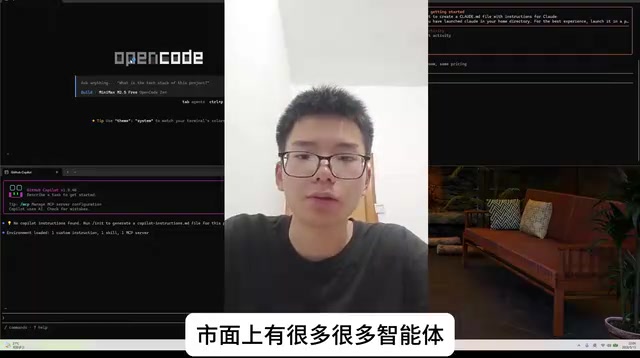
Command-Line Configurable: OpenCode, Claude Code, etc.
Including OpenCode, Claude Code, GitHub Copilot CLI, and others, these typically require a few command-line inputs for installation and configuration. They offer greater flexibility, support custom models and plugin extensions, and are suited for developers with some technical background.
Each tool has its own characteristics and use cases. Below, we'll focus on demonstrating the complete workflow of the open-source tool OpenCode.
Hands-On Demo: Starting from Scratch with OpenCode
Step 1: Installation and Launch
Installing OpenCode is straightforward—usually requiring just 2-3 commands. After installation, launch it by pressing Bin + R and typing opencode.
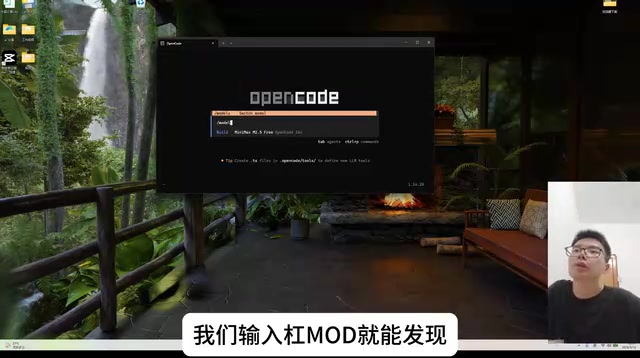
Once launched, OpenCode provides several free models to choose from. Enter the /models command to see a list of models marked as "Free," such as DeepSeekAd V4.
DeepSeek is a large language model series developed by China's DeepSeek company, which gained global attention in early 2025 due to the exceptional reasoning capabilities of its DeepSeek-R1 model. DeepSeek's core competitive advantage lies in its exceptional cost-performance ratio—its training costs are a fraction of international models with comparable performance, and its API pricing is far lower than products from OpenAI and Anthropic. The DeepSeek V3/V4 series employs a Mixture of Experts (MoE) architecture and excels at code generation, mathematical reasoning, and other tasks, making it particularly suitable for Chinese-language development scenarios. For developers in China, DeepSeek is not only budget-friendly but also avoids network latency and compliance issues that may arise when accessing overseas APIs.
Step 2: Configuring a Paid DeepSeek Model (Optional)
While free models are usable, they're typically beta versions with potentially limited speed and quality. For a better AI programming experience, you can purchase your own API Key. Using DeepSeek as an example:
- Go to the DeepSeek website and register an account
- Top up with a custom amount (minimum 1 yuan)
- Create a dedicated API Key and copy it
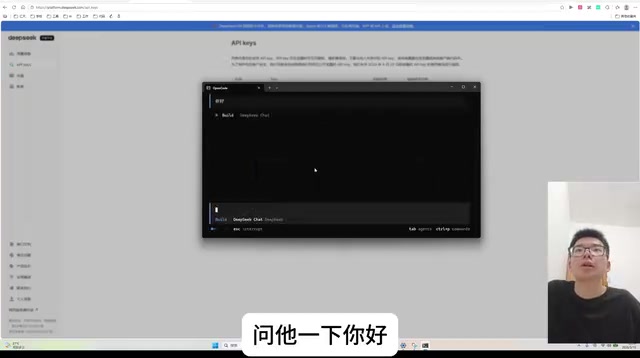
- Return to OpenCode, enter
/connect, find DeepSeek, and paste the Key
Here's an explanation of how API Keys work. An API Key (Application Programming Interface Key) is an authentication mechanism used by cloud service providers to verify user identity and meter usage. When you purchase services from AI model providers like DeepSeek, you don't receive a software installation package—you get a unique key string. Every time your tool (like OpenCode) sends a request to the AI model, it includes this Key, which allows the service provider to identify you and deduct the corresponding fee from your balance. Fees are typically calculated per Token (the smallest unit of text processing, roughly equivalent to 0.75 English words or 0.5 Chinese characters), which is why you can start with just 1 yuan—daily coding tasks don't consume many tokens.
Once configured, you can select a DeepSeek model for conversations and coding.
Step 3: Letting the AI Agent Directly Modify Your Project
This is the most impressive part of agent coding. The video demonstrated a real scenario:
- The creator had an existing AI introduction page project
- He sent a screenshot of the entire project to the agent, requesting it to create a new HTML page with a similar style
- The agent automatically began planning, proactively asking questions to clarify requirements
- After confirming requirements, the agent automatically wrote the code
- The final generated page closely matched the style of the original project
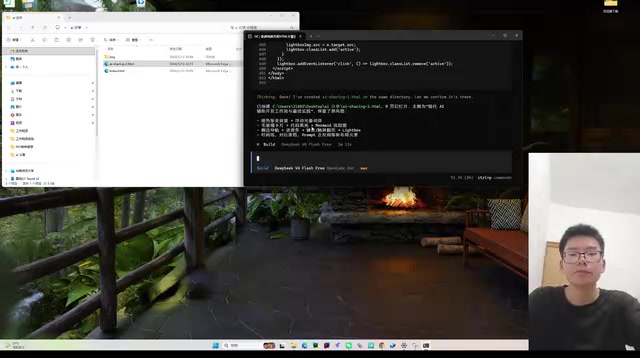
Throughout the entire process, the developer didn't write a single line of code—just "conversed" with the AI. This is fundamentally different from traditional "copy-paste" AI programming—the agent can understand project context, autonomously plan tasks, and directly operate the file system.
Advanced Directions: Beyond the Basics
What was demonstrated above is just the most basic usage of AI agent coding. To further improve efficiency, there are several important directions worth exploring:
Switching to More Powerful AI Models
Different models vary significantly in code generation quality. Domestic models (like DeepSeek) offer excellent value for money, suitable for daily development and learning; while international models like Claude and GPT-4 typically excel at complex logic and code quality, making them better suited for handling difficult tasks at work.
Extending Agent Capabilities Through Plugins
By adding MCP plugins, custom Skills, configuring workflows, and more, you can give your agent additional capabilities such as automatically reading databases, calling APIs, running tests, etc. Each extension can significantly boost development efficiency.
MCP (Model Context Protocol) is an open standard proposed by Anthropic in late 2024, designed to provide AI models with a unified way to connect to external data sources and tools. Think of MCP as the "USB port" for AI agents—through a standardized protocol, agents can plug-and-play with database queries, web browsing, file operations, API calls, and other external capabilities without writing custom integration code for each tool. This architecture dramatically expands the agent's capability boundaries, evolving it from a simple code generator into a versatile assistant capable of deep interaction with real development environments.
Developing a Sensible Usage Strategy
A pragmatic recommendation:
- Learning phase: Start with free or affordable domestic models to familiarize yourself with the entire AI agent coding workflow
- Interview phase: Ensure you understand the complete workflow and principles of agent coding
- Work phase: Invest in more powerful paid models to maximize output efficiency
Advice for Beginners
Here's a critically important reminder: If you're still learning basic syntax and your foundations aren't solid, you should write code by hand first.
This isn't denying the value of AI programming tools—it's a simple truth: you must understand code before you can reasonably express requirements to AI, and before you can judge whether AI-generated code is correct. The essence of agent coding is "human-machine collaboration," not "complete replacement." Without a solid foundation, you won't even be able to spot the AI's mistakes, let alone use it efficiently.
Build a strong foundation first, then use tools to soar. This is the correct growth path for programmers in the AI era.
Conclusion
AI agent coding is redefining how software development works. From "handwriting code" to "copy-paste AI assistance" to today's "conversational agent coding," each iteration dramatically lowers the barrier to development and boosts productivity.
For developers, embracing this change isn't optional—it's mandatory. The key is: understand the principles, master the tools, and keep learning. Whether you're a complete beginner or an experienced developer, now is the best time to start experimenting with AI agent coding.
Related articles
 Tutorials
ChatGPT Plus Subscription Guide: Are GPT-5.5, image-2, and Codex Worth the Upgrade?
A detailed look at ChatGPT Plus features — GPT-5.5, image-2, and Codex — with a Plus vs Pro comparison and a complete step-by-step subscription guide for users outside the US.
 Tutorials
Harness AI Engineering in Practice: Using Claude Code to Master Enterprise-Level E-Commerce Development
Deep dive into Harness AI Engineering: master enterprise e-commerce development with Claude Code using the Rules, Skills, Wiki, and Changes framework.
 Tutorials
Cursor + Codex Dual-IDE Collaboration: A Practical Methodology for Open-Source Project Customization
A complete methodology for open-source project customization based on real-world experience, detailing the Cursor+Codex dual-IDE workflow, seven-stage process, MVP validation, and AI source code reading techniques.