One Prior, Two Dynamics: How Video Diffusion Transformers Learn Latent Actions

O²LaF initializes inverse and forward dynamics models from the same pretrained video DiT, sharing a world model prior to learn transferable latent actions.
The paper proposes the O²LaF framework with the core principle "one prior, two dynamics": initialize an inverse dynamics model (a feedforward transition encoder with learnable action queries that infers actions from adjacent frames) and a forward dynamics model (an action-conditioned causal video generator that predicts visual consequences) from the same pretrained video DiT, optimized end-to-end through a compact bottleneck with controlled information access to prevent leakage. Sharing a prior lets both tasks reuse the physical world change laws internalized by the video generator. Experiments achieve a new SOTA in few-shot action probing on navigation and robotic manipulation, with stronger zero-shot cross-environment and cross-embodiment transfer; the framework extends to predictive representation priors like V-JEPA2, pointing toward a broader paradigm.
Video records how the world changes, yet tells us almost nothing about what actions caused those changes. Latent Action Learning attempts to recover this supervisory signal from visual transitions, but most existing methods need to learn the underlying dynamics from scratch. A new paper proposes a different approach: can a pretrained video generator provide a prior for both inverse dynamics and forward dynamics simultaneously?
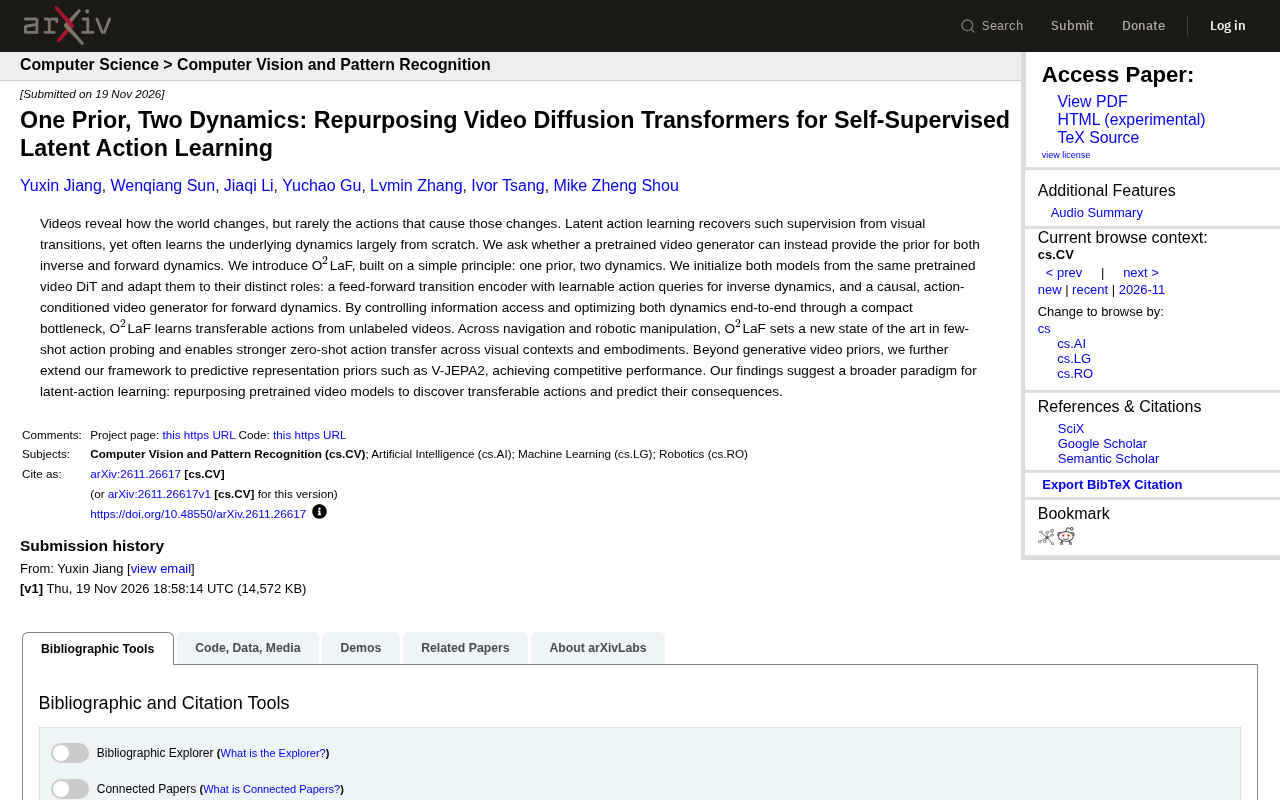
Core Idea: One Prior, Two Dynamics
The O²LaF framework proposed in the paper is built on a simple principle—one prior, two dynamics. It initializes two models from the same pretrained video DiT (Diffusion Transformer), then lets each take on a different role:
- Inverse dynamics model: a feedforward transition encoder with learnable action queries, responsible for inferring actions from adjacent frames;
- Forward dynamics model: a causal, action-conditioned video generator, responsible for predicting the visual consequences of actions.
Both models are optimized end-to-end through a compact bottleneck, with controlled information access to prevent information leakage. In this way, O²LaF can learn transferable action representations from unlabeled video.
Why sharing a prior matters
Traditional latent action learning trains the inverse and forward models separately, so dynamics knowledge cannot be shared. The key insight of O²LaF is that video generators have already internalized rich priors about the laws of physical world change during pretraining—priors that are equally valuable for "inferring actions" and "predicting consequences." Sharing the same DiT initialization is equivalent to letting both tasks stand on the shoulders of the same world model, rather than each groping from scratch.
Latent Action Learning is a representation learning paradigm that requires no action labels. Its basic assumption is that visual changes between adjacent frames in a video are driven by some low-dimensional "latent action," and the model can infer this latent variable from inter-frame differences, then condition on it to predict subsequent frames. Unlike directly supervised action learning, latent actions have no semantic labels and need to be shaped through the joint constraint of inverse dynamics (inferring actions from frame changes) and forward dynamics (predicting frame changes from actions). The value of this approach lies in its ability to leverage massive amounts of unlabeled video, but the difficulty is that the latent action space tends to collapse or become entangled with visual noise, so techniques such as bottleneck design and asymmetric information access are often needed to ensure the action encoding truly captures transferable control information.
DiT (Diffusion Transformer) is a backbone architecture for diffusion models that replaces the traditional U-Net with a Transformer as the denoising network, typically combined with patchify to split video or images into patches processed as token sequences. Compared with U-Net, DiT has advantages in scalability and long-range modeling, making it the mainstream choice for current video generation models. When pretrained video DiTs learn the denoising objective on massive video, they implicitly internalize physical laws such as object motion, occlusion, and lighting changes, which makes their intermediate representations a reusable "world model prior." O²LaF exploits exactly this: it initializes the inverse encoder and forward generator with the same DiT weights, letting both tasks share this prior about the laws of visual change, rather than each learning dynamics from random initialization.
Experimental Results: Few-Shot Probing and Zero-Shot Transfer
The paper evaluates O²LaF on two types of tasks: navigation and robotic manipulation. The results show:
- On few-shot action probing, O²LaF achieves a new state of the art;
- On zero-shot action transfer across visual environments and across embodiments, it performs more strongly.
This means the learned latent actions not only fit the training distribution but also possess a degree of generalization ability—which is especially critical for robot learning, because real-world visual environments and hardware platforms vary enormously, and the cost of recollecting labeled data is extremely high.
Beyond generative priors
The paper further extends the framework to predictive representation priors such as V-JEPA2 and achieves competitive performance. This shows that O²LaF's "one prior, two dynamics" idea is not bound to video diffusion models but can be generalized to other types of pretrained representations.
V-JEPA2 is the second-generation version of Meta's Video Joint-Embedding Predictive Architecture (JEPA). Unlike generative models that reconstruct pixels, JEPA predicts features of masked or future regions in an abstract representation space, avoiding the modeling of pixel-level details, and is therefore more computationally efficient with representations that are more semantic. After pretraining on large-scale video, V-JEPA2's representations perform outstandingly on tasks such as action recognition and robot planning. O²LaF uses it as an alternative to "predictive representation priors," showing that the core of sharing a prior does not lie in whether the prior comes from diffusion generation or feature prediction, but in that the pretrained model has already encoded structured knowledge about how the visual world evolves, which can be reused by both inverse and forward dynamics.
Broader Paradigmatic Significance
The authors summarize this finding as a broader paradigm for latent action learning: reuse pretrained video models to discover transferable actions and predict their consequences. Behind this is a trend worth noting—pretrained video generation models are moving from "generating content" toward "understanding physical interaction," becoming general-purpose foundational components for embodied intelligence and robot learning.
Of course, this direction still faces challenges: the forward dynamics model needs to generate sufficiently realistic future frames, which is computationally expensive; and how the capacity of the action bottleneck scales with task complexity also requires further study. But the benefits brought by sharing a prior have already shown clear potential.
Key Takeaways
- O²LaF initializes both inverse and forward dynamics models from the same pretrained video DiT, achieving "one prior, two dynamics."
- On navigation and robotic manipulation tasks, few-shot action probing reaches a new SOTA, and zero-shot action transfer is stronger.
- The framework can be extended to predictive representation priors such as V-JEPA2, showing the generality of the idea.
- This work points toward a broader paradigm: reusing pretrained video models to learn transferable latent action representations.
One-line Summary
O²LaF initializes inverse and forward dynamics models from the same pretrained video DiT, sharing a world model prior to learn transferable latent actions.
Paragraph Summary
The paper proposes the O²LaF framework, whose core principle is "one prior, two dynamics": initialize an inverse dynamics model (a feedforward transition encoder with learnable action queries that infers actions from adjacent frames) and a forward dynamics model (an action-conditioned causal video generator that predicts the visual consequences of actions) from the same pretrained video DiT, with both optimized end-to-end through a compact bottleneck and with controlled information access to prevent leakage. Compared with traditional latent action learning trained separately, sharing a prior lets both tasks reuse the laws of physical world change internalized by the video generator. Experiments achieve a new SOTA in few-shot action probing on navigation and robotic manipulation tasks, and demonstrate stronger zero-shot action transfer across visual environments and across embodiments; the framework can also be extended to predictive representation priors such as V-JEPA2, pointing toward a broader paradigm of reusing pretrained video models to learn transferable latent action representations.
Related articles

S&P Weighs Downgrading Nvidia's Credit Rating: Governance and Key Man Risk in Focus
S&P is considering downgrading Nvidia's credit rating to AA-, citing corporate governance and key man risk rather than financial performance. We analyze the drivers, potential impact, and the broader trend of governance scrutiny for large tech companies in the AI era.

Generating a 3D Stacking Game from a Few Prompts: Hands-on with the Playground Experimental Platform
Playground lets users generate the 3D stacking game One More Pie from a few text prompts. This article examines the capabilities and limits of prompt-based web game generation.
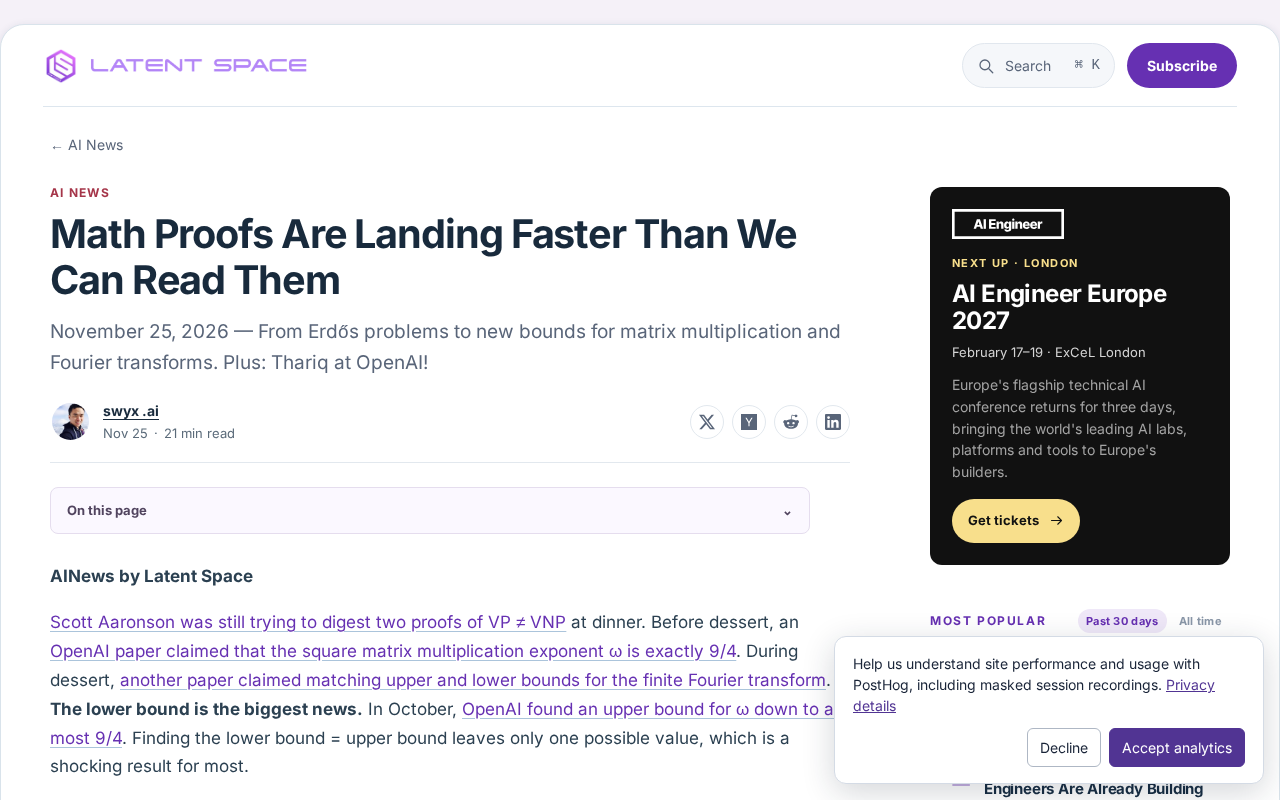
AI Math Proofs Are Exploding: Humans Can't Read Fast Enough
AI math proof output now outpaces human reading speed. AINews roundup covers Erdős problems, new matrix multiplication bounds, and Fourier transform bounds—verification is the new bottleneck.