One Prompt Exhausts Pro Quota? Fable 51.8 Sparks Outrage
One prompt triggers 50x multi-agent mode, exhausting Pro quota and fueling billing transparency controversy.
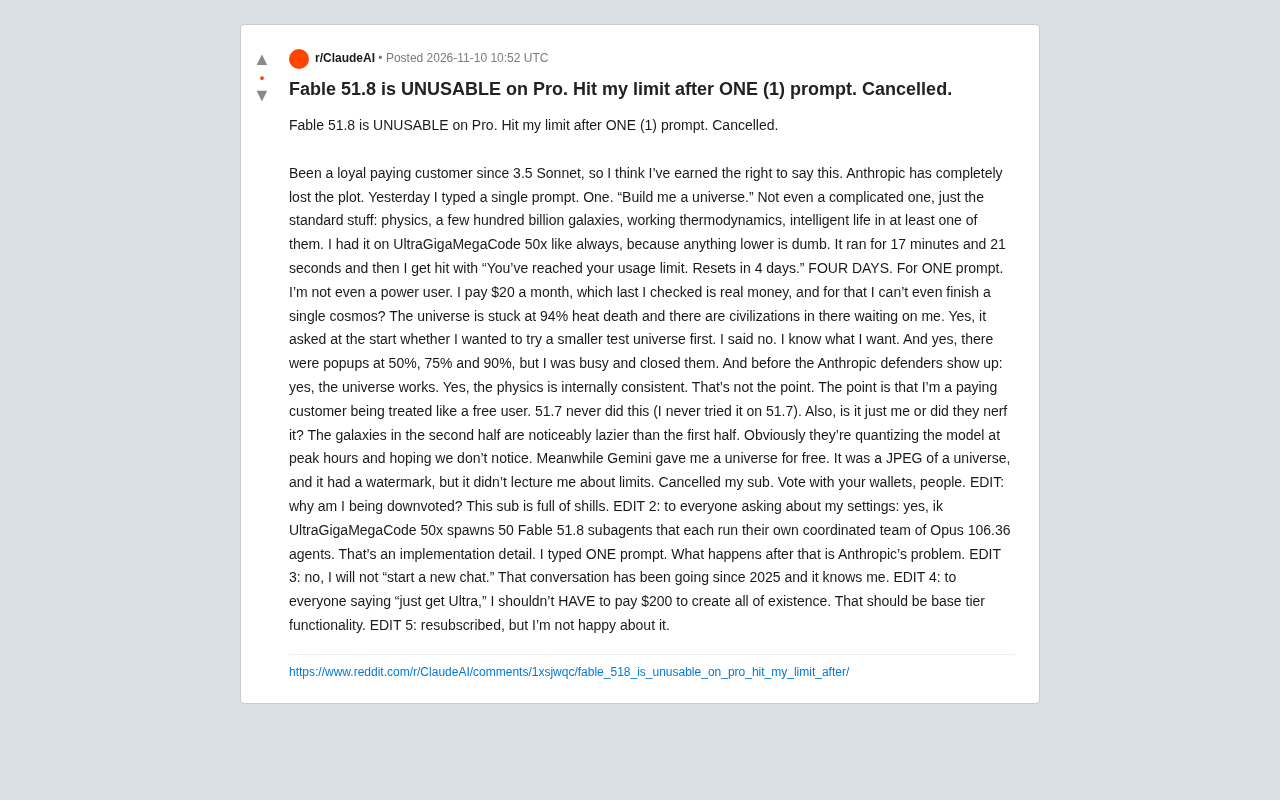
A Reddit paying user says that in Fable 51.8's UltraGigaMegaCode 50x mode, a single "build a universe" prompt ran for 17 minutes before hitting the Pro plan limit, requiring a 4-day reset. The controversy centers on how this mode spawns 50 sub-agents plus Opus collaboration teams, making the UI's "one input" severely disproportionate to actual resource consumption. The author also speculates about model quantization during peak hours and contrasts this with Gemini providing a free watermarked universe image, questioning whether the basic tier should support high-end features. Though the post is partly parody, it reflects real pain points in multi-agent products around quota metering, breakpoint warnings, and expectation management.
One Prompt, Four-Day Cooldown: The Fable 51.8 Quota Controversy
A Reddit user who claims to have been a paying subscriber since the Claude 3.5 Sonnet era posted a bluntly titled thread—"Fable 51.8 is unusable on Pro, one prompt hits the limit, subscription cancelled." The scenario he describes carries a dark humor: he typed "build me a universe," requiring physical laws, hundreds of billions of galaxies, runnable thermodynamics, and at least one intelligent civilization.
According to his account, the model ran for 17 minutes and 21 seconds in UltraGigaMegaCode 50x mode before popping up "usage limit reached, resets in 4 days." He repeatedly stressed that he only pays $20 a month, isn't a heavy user, yet was treated like a free-tier user. The post quickly drew replies and pushed the technical detail of "whether a high-end mode counts as a single prompt" into the spotlight.
Behind 50x Mode: One Prompt, Fifty Sub-agents
The crux of the controversy lies in the post's EDIT 2. The author admits that UltraGigaMegaCode 50x spawns 50 Fable 51.8 sub-agents, each of which runs its own collaborating team of Opus 106.36. His stance is clear: "That's an implementation detail. I typed one prompt. What happens after that is Anthropic's problem."
This claim sparked an obvious split in the tech community. One side argues that "one input" in the UI doesn't equal "one call" in billing terms—multi-agent orchestration naturally amplifies resource consumption. The other side points out that if the product makes 50x an almost default option without giving intuitive warnings about quota consumption, the cognitive gap of "I only asked one thing" is almost inevitable. The post mentions that prompts popped up at the 50%, 75%, and 90% marks during the run, but the author dismissed them all because he was "busy."
Multi-agent orchestration refers to an architectural pattern in which a primary model (or orchestrator) decomposes a user task into multiple subtasks, dispatches them to several sub-agents for parallel or sequential execution, and then aggregates the results. Unlike a single forward inference pass, one user request may trigger dozens of model calls, tool calls, and intermediate reasoning steps, with actual token and compute consumption far exceeding the "one input" shown in the UI. This is precisely the technical root of the gap between "one prompt" and "one billed call": quota metering typically accumulates based on actual backend calls, while user perception stops at the character count in the input box.
Model quantization refers to representing model weights or activations at lower precision (such as FP8, INT8, or even lower) to reduce memory footprint and inference cost, at the price of possible subtle degradation in output quality. Providers often enable dynamic quantization for some requests during peak hours to scale throughput, but typically don't disclose this in the UI. Therefore, subjective impressions like "the galaxies in the second half are lazier" would require controlled experiments holding prompts, random seeds, and time windows constant—a single generation's before-and-after differences cannot rule out sampling randomness.
Quantization Rumors and "Lazier Galaxies in the Second Half"
The author also raises an unverified speculation: the model may be quantized during peak hours, citing that "the galaxies built in the second half are noticeably lazier than those in the first half." Some replies echoed this claim, while others demanded comparative evidence.
According to the post itself, the universe actually runs—physics are internally consistent—and the problem lies in resource allocation rather than output quality. This combination of "the result is fine, but the process is infuriating" is exactly where subscription-based AI products most easily accumulate dissatisfaction: users can't perceive the backend orchestration complexity, only the quota bar suddenly hitting bottom.
Contrast with a Free Competitor and "Shouldn't Have to Pay for Existence"
The post's virality stems largely from one comparison: the author says Gemini gave him a universe for free—just a watermarked JPEG, but "at least it didn't lecture me about quotas." This metaphor was widely shared and became an entry point for discussing the reasonableness of subscription tiers.
His statement in EDIT 4 is even more direct: one shouldn't have to pay $200 to "create all of existence"—that should be a basic-tier feature. This touches the structural contradiction of tiered subscriptions: when a high-end mode is packaged as part of basic operations, users' expectations of "what the basic tier should provide" get raised.
Tiered subscription is a common pricing structure for AI products: the basic tier offers limited quota and standard models, while higher tiers unlock stronger models, higher concurrency, or special modes. Its structural contradiction lies in the fact that when a high-consumption feature is presented in the UI as indistinguishable from ordinary conversation, users assume it belongs to "basic capabilities," and once quota drains quickly, they feel deceived. A sensible approach is to label estimated consumption multipliers at the entry point, provide a real-time quota bar and a mid-run pause option, and turn backend complexity into perceivable cost signals.
One Absurd Post, Several Real Problems
It should be noted that the post carries obvious exaggeration and parody—lines like "the universe is stuck at 94% in a heat-death state" and "there are civilizations waiting for me inside" read more like jokes. The post also contains plenty of sarcastic edits: complaining about downvotes, refusing to "start a new conversation" because "that conversation started in 2025, it knows me," and finally adding "resubscribed, but I'm not happy about it."
But stripping away the jesting shell, the problems it points to are not fictitious: whether quota metering under multi-agent modes is transparent, whether breakpoint warnings are prominent enough, and whether peak-hour throttling should come with clearer explanations. For teams building AI coding and application products, this is a worthwhile sample of user sentiment—when "one prompt" fractures into dozens of concurrent agents in the backend, the product needs to keep pace in billing, notifications, and expectation management, or users will only remember that glaring "resets in 4 days."
Related articles

Inside Honey Trap Training: Emotional Dissociation and Anchoring Techniques
How are spies trained for honey trap missions? A trainee reveals emotional dissociation, perfume and keyword anchoring, and target photo binding—psychological techniques that condition reflexes for intelligence work.

Frontier AI Risk Management: Full-Pipeline Practices from Training to Deployment
OpenAI outlines a frontier AI risk management framework: from training-stage model alignment to deployment-stage sandboxing and blocking safeguards, plus post-deployment monitoring—a layered risk control system across the model lifecycle.
DaisyRose-27B: 1,200-Task RL Boosts Qwen3.8 from 5.6% to 12% on Terminal-Bench 4.1
DaisyRose-27B uses RL training on 1,200 tasks to boost Qwen3.8's Terminal-Bench 4.1 score from 5.6% to 12%, showing lightweight RL can more than double terminal task performance.