One Sentence to a Full Business? A Critical Analysis of Leapd AI Startup Tool

Leapd claims one sentence generates a full business in an hour — slashing startup validation time and cost.
Leapd is an AI startup tool that promises to turn a single plain-language description into a working business — complete with a custom website, business email, and multi-channel marketing setup (email, Meta ads, LinkedIn, and GEO/SEO) — in under an hour. Its companion product, Build Radar, catalogs 5,000+ business ideas with verified revenue, moat analysis, and replicability scores. While the "one-hour business" claim is largely marketing language and success still depends on real market demand and sustained execution, the broader trend is significant: AI is compressing what once required months and tens of thousands of dollars into a near-zero-cost, rapid experimentation loop.
From One Sentence to a Working Business
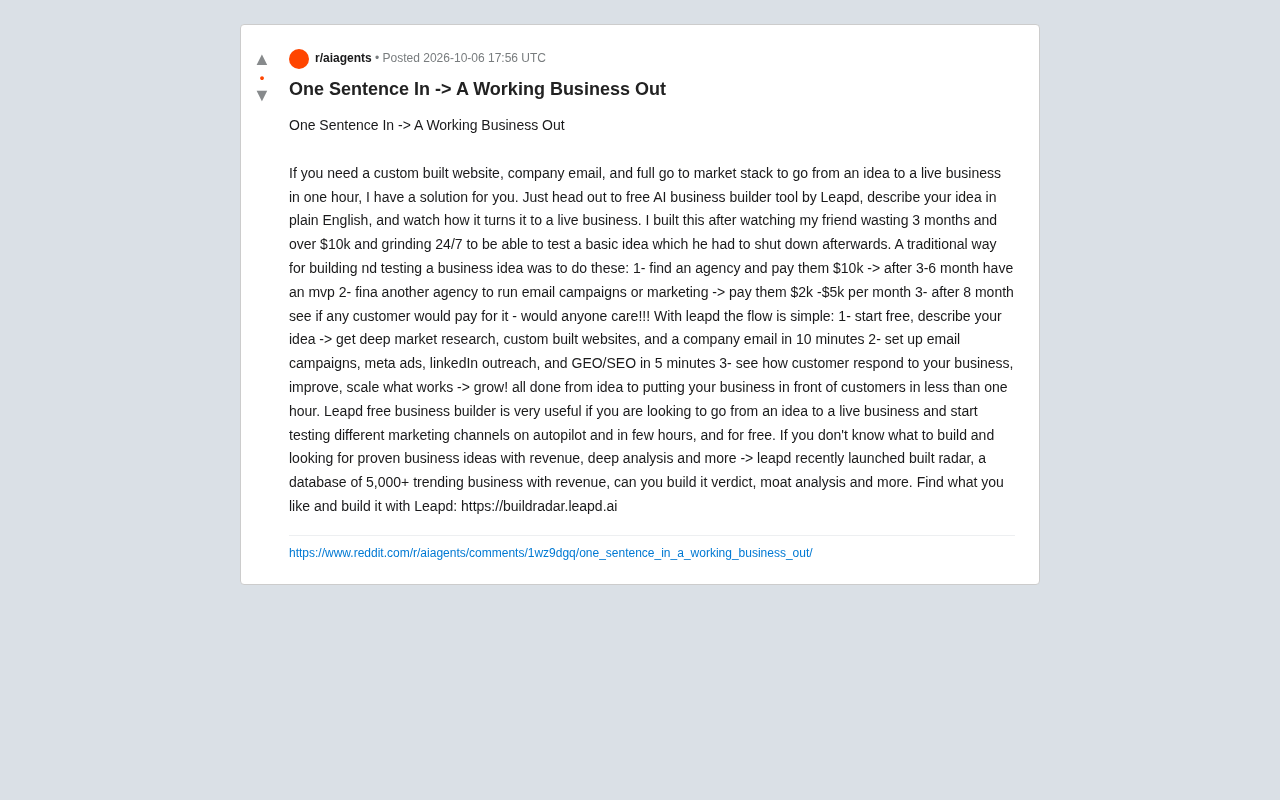
An AI tool called Leapd has been generating buzz on Reddit with a bold tagline: "One Sentence In → A Working Business Out." According to its developer, users simply describe their startup idea in plain language and receive a custom website, business email, and a complete marketing stack within an hour — turning a concept into an operational business.
The tool was born from a real pain point. In the Reddit post, the developer describes a friend who spent three months and over $10,000 working around the clock to validate a basic business idea — only to shut the project down. This experience is all too common among early-stage founders, and it's exactly the gap AI tools are trying to fill.
The High Cost of Traditional Validation
The developer breaks down the traditional startup validation process into three steps, with costs attached to each:
- Outsource development: Pay around $10,000, wait 3–6 months for an MVP (minimum viable product)
- Outsource marketing: Pay another $2,000–$5,000 per month for email campaigns or ad spend
- Wait for market feedback: About 8 months before knowing whether anyone will actually pay
The core problem: validating whether an idea is worth pursuing often requires nearly a year and tens of thousands of dollars. For bootstrapped founders with limited resources, that cost of experimentation is nearly unbearable. The real danger isn't failure itself — it's that failure arrives too late and costs too much.
Leapd's Alternative Approach
According to its official description, Leapd compresses the process into three steps:
Step 1: Start free — describe your idea in plain language. Get in-depth market research, a custom website, and a business email in 10 minutes.
Step 2: Set up email marketing, Meta ads, LinkedIn outreach, and GEO/SEO in 5 minutes.
Step 3: Watch customer responses, refine what works, and scale.
The entire process is said to take under an hour — from idea to putting your business in front of customers. Compared to a multi-month traditional pipeline, this "autopilot" approach to multi-channel testing is genuinely appealing, especially for early founders who need to validate multiple directions quickly.
GEO (Generative Engine Optimization) is an emerging concept that arose alongside the rise of LLM-powered search. Unlike traditional SEO — which targets web search engines like Google — GEO focuses on making content more likely to be cited and recommended by AI search engines like ChatGPT, Perplexity, and Claude. The core logic: when users ask AI a question, the AI synthesizes answers from training data or real-time retrieval, and content that is clearly structured, authoritative, and semantically relevant is more likely to be cited. For early-stage founders, seeing GEO listed alongside SEO signals that Leapd is attempting to cover both traditional search traffic and AI-native search traffic simultaneously — reflecting a broader trend of marketing toolkits rapidly adapting to AI-native acquisition channels.
The Build Radar Database
Beyond the business-building tool, Leapd has also launched Build Radar — a database of over 5,000 trending business ideas with verified revenue. Each entry includes in-depth analysis covering:
- Revenue figures
- A "can you build it" verdict
- Moat analysis
This feature targets a different type of user: someone with entrepreneurial drive but no clear direction. Rather than brainstorming from scratch, they can pick from models that have already been validated with real income and work to replicate or improve on them. This "reverse-engineer from success" approach fundamentally reduces uncertainty at the ideation stage.
Moat analysis draws from Warren Buffett's concept of the "economic moat" — the core barriers that protect a business from competitive erosion and sustain long-term advantage. Common moat types include network effects (the product becomes more valuable as more users join), switching costs (high cost for users to migrate), economies of scale, brand premium, and proprietary data or technology. In the context of Build Radar, moat analysis helps users assess whether a given business model is easily replicable. If an idea has almost no moat, competitors can quickly follow, and first-mover advantage evaporates fast. Conversely, a model with meaningful moats can still yield differentiation even for late entrants. This is a critical filter for founders choosing which model to copy from the database.
A Measured Take: Opportunity and Caveats
This content is fundamentally a product promotion posted by its developer on Reddit, so any claimed results should be verified through personal experimentation before drawing conclusions. The "launch a business in one hour" framing is largely marketing language — AI can rapidly generate websites, email accounts, and marketing materials, but whether a "working business" actually works ultimately depends on market demand, product refinement, and sustained operations. No tool can replace those fundamentals.
That said, the trend this tool represents is worth paying attention to: AI is compressing what used to require an outsourced team, months of work, and significant budget — the "idea validation" phase — into a near-zero-cost process completable in a matter of hours. It doesn't change whether a startup will succeed, but it fundamentally changes the speed and cost of experimentation. For founders who iterate fast, a lower validation threshold means more directions can be tested in less time — and that is a structural efficiency gain in its own right.
Readers curious about the tool can explore Leapd's free business-building tool or the Build Radar database at buildradar.leapd.ai to judge its real-world value for their own needs.
Related articles

Should U.S. College Fraternities Be Banned? A Researcher's Incisive Observations
Why not just ban U.S. college fraternities? A researcher finds the key resistance comes from decision-makers' own fraternity identities and schools' "willful ignorance."

Microsoft Discovery: Accelerating Scientific Discovery with AI Agents
Microsoft's Discovery platform runs specialized AI agents to help researchers screen and prioritize the most promising compounds and experimental paths, reducing experiments and accelerating scientific discovery.

Cambridge Heavy Industries Secretly Develops Desktop-Scale Nuclear Fusion Device
Cambridge Heavy Industries is secretly developing a desktop-scale laser-driven nuclear fusion device, targeting the equipment supply market for fusion power plants. This article analyzes its miniaturization technology path, commercialization logic, and unique positioning in the fusion startup wave.