"One, Two, Three" Classic Dialogue: Who Is Choo-Choo?

A telephone dialogue in a Wilder comedy dissolves class and generational authority through an absurd engagement and a spelling game.
This article closely reads a telephone conversation in a Berlin hotel from Billy Wilder's Cold War comedy *One, Two, Three*, analyzing how everyday banter carries multiple conflicts of class, generation, and mistaken identity. The girl packages family intervention as political deportation, explains her engagement through a telephone booth record challenge, calls her father a snob by spelling S-N-O-B, and undermines elder authority with self-mockery about four engagements at seventeen. Wilder completes character building and thematic suggestion in a very short space, giving the dialogue independent comic vitality.
One Scene of Dialogue, Half a Comedy
In Billy Wilder's Cold War comedy One, Two, Three, this telephone conversation in a Berlin hotel may look like mere banter, but it actually condenses the film's entire satire of class, generational conflict, and mistaken identity. A young girl just "deported" from the United States to Berlin explains to her friend in rapid-fire slang why she got engaged to her fiancé Choo-Choo Babcock—a record challenge in a telephone booth becomes the starting point of her fourth engagement.
The opening line "Scarlett's checked in" borrows the imagery of Gone with the Wind, immediately anchoring the character as a Southern belle from a distinguished family. But she immediately undercuts that respectability with "Don't bother. Let them worry"—she didn't come to Berlin willingly; she was "deported" by her family to break up the relationship. This exaggerated rhetoric, which packages family intervention as political deportation, is typical of Wilder's satire: using serious Cold War vocabulary to depict an adolescent engagement farce.
The Record in the Telephone Booth: How Absurdity Becomes a Reason for Engagement
"Choo-Choo Babcock. I met him in a telephone booth." This self-introduction-style recollection compresses the origin of an intimate relationship into an extreme challenge in a public space. The scene she describes is this: a group of people squeeze into a telephone booth trying to break the record, and she and Choo-Choo happen to be crushed at the bottom. By the time the crowd disperses, the two are already "engaged."
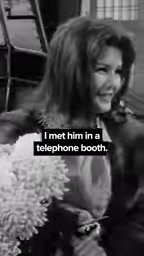
The comic logic here lies in the complete disorder of cause and effect. Engagement is supposed to be a solemn social contract, but it is treated as a physical byproduct of a crowded space. The telephone booth, a communication node seen everywhere on the streets of Cold War Berlin, is rewritten here as a temporary stage for youthful adventure. The dialogue doesn't specify the exact number of the record, but with the self-affirmation "that's a record, all right," it pushes the absurdity to its peak—the only justification she gives for an engagement is that it also broke some kind of record.

More importantly, this recollection reflects the film's mockery of the very idea of a "record." In an era when Cold War propaganda machines were obsessed with counting missiles and satellite weights, a record for the number of people in a telephone booth seems both childish and honest. Wilder uses this to suggest that the absurdity of personal life often reveals the true texture of an era better than grand narratives.
Telephone booth stuffing was a youth subculture popular on American college campuses in the 1920s and 1930s. Participants crammed as many people as possible into a standard telephone booth to set a new record. The craze drew international attention again in 1959 when South African students set a record with 25 people, becoming a curious spectacle reported by Western media during the Cold War. Wilder wrote this real youth cultural phenomenon into the script, giving the girl's absurd memory a concrete historical anchor and reinforcing the film's satire of "record worship"—beyond the grand statistics of the arms race, there was also a popular frenzy for records in the form of bodily crowding.
Spelling Out Father: The Class Undercurrent Behind S-N-O-B
The second turning point in the conversation comes from her father's attitude. "Daddy didn't approve. Because Choo-Choo's folks are from the wrong side of the tracks." Immediately afterward, she says "S-N-O-B," spelling it out letter by letter, turning her judgment of her father into a small linguistic performance.

"Wrong side of the tracks" is a typical phrase of American Southern class discourse, referring to the working class on the other side of the railway. The girl's response is not to defend the family's respectability, but to directly label her father a snob. This frankness is the core charm of the character: she understands how class prejudice operates, but refuses to play along. Spelling out "snob" instead of saying the word directly feels both like a childish venting of anger and like a mocking imitation of the hypocritical rules of the adult world.
The film plants a deeper thread here: the father solves a family problem through political means, sending his daughter to Berlin, which precisely exposes the anxiety of so-called high society when faced with class mobility. Choo-Choo's surname, Babcock, has a clearly common touch, forming a sharp contrast with the plantation myth the girl's family tries to maintain. The dialogue doesn't unfold the outcome of this conflict, but with one line, "Let them worry," it returns the initiative to the girl herself.
"Wrong side of the tracks" literally means "the wrong side of the railway" and originates from town planning during American industrialization: railway lines often separated residential areas by class, with the working class mostly living on one side of the tracks, creating a spatialized class division. The idiom later became a recurring class metaphor in American Southern literature, meaning humble origins and a lack of upper-class refinement. The girl's use of this phrase shows both that she is familiar with how Southern class discourse operates and that Choo-Choo's common origins constitute an insurmountable obstacle in her family's eyes, providing a social-psychological footnote for her father's use of "deportation" to interfere with the marriage.
Seventeen and Four Engagements: The Comic Expression of Generational Conflict
The conversation ends with the two questions about age and the number of engagements. "Seventeen isn't that a little young to be engaged?" This question should come from an elder, but it is raised by the interlocutor. The girl's answer is casual: "I've been engaged four times. All the women in our family are sort of hot-blooded."
The information density here is extremely high. Seventeen years old, four engagements, and a family tradition of "hot-blooded" women—these three elements combine into an engagement record utterly disproportionate to her age. The dialogue doesn't explain how the first three engagements ended, but with the vague qualifier "sort of," it describes the family temperament as an almost hereditary impulse. Wilder displays here his usual strategy for handling generational conflict: instead of debating head-on, he lets the younger generation dissolve the moral authority of their elders through self-mockery and exaggeration.
You may not have noticed that this conversation always takes place across the two ends of a telephone line, and the person the girl confides in never appears. This one-way transmission of information reinforces the character's sense of isolation—she is far from home, exiled by her family, and the only thing she can do is rebuild her sense of existence through language. The telephone booth is both the place where she met Choo-Choo and the channel through which she announces this relationship to the outside world; the spatial imagery completes a closed loop here.
"Hot-blooded" in English usually refers to a temperament that is passionate and prone to impulsive action, and it is often used to describe the temperament in stereotypes of Latinos or Southerners. By attributing the multiple engagements of the family's women to a "hot-blooded" tradition, the girl is actually using pseudo-physiological discourse to provide a family-lineage defense for transgressive behavior. This rhetorical strategy is common in comedy: using an almost genetic-determinist explanation to dissolve personal responsibility while suggesting that the moral self-discipline of so-called distinguished families is merely a fragile shell. Wilder uses this to transform generational conflict from a moral debate into an absurd topic of inherited temperament, leaving the authority of the elders hollowed out amid laughter.
Dialogue as a Slice of the Era
The reason this passage of dialogue in One, Two, Three withstands repeated scrutiny is that it compresses multiple conflicts into the rhythm of everyday conversation. Class prejudice is spelled out in four letters, engagement is reduced to a byproduct of a telephone booth, and family politics is compared to diplomatic deportation. Wilder doesn't let the characters make any grand speeches, yet every bit of banter points to the loosening of postwar social structures.
From the perspective of screenwriting technique, this dialogue demonstrates how to accomplish character building, relationship exposition, and thematic suggestion in an extremely short space. The girl's speaking pace, word choice, and跳跃 logic are themselves a character file: she is well educated but deliberately uses slang and spelling games to undercut seriousness; she understands her situation but chooses humor to maintain distance. This linguistic strategy is highly consistent with the film's overall satirical tone and allows this passage of dialogue to retain an independent comic vitality even outside the plot.
One-line Summary
A telephone dialogue in a Wilder comedy dissolves class and generational authority through an absurd engagement and a spelling game.
Paragraph Summary
This article closely reads a telephone conversation in a Berlin hotel from Billy Wilder's Cold War comedy One, Two, Three, analyzing how it carries multiple conflicts of class, generation, and mistaken identity through everyday banter. The girl packages family intervention as political deportation, explains the origin of her engagement through a telephone booth record challenge, directly calls her father a snob by spelling S-N-O-B, and undermines the moral authority of her elders with self-mockery about being engaged four times at seventeen. The article points out that Wilder, through disordered causality, appropriation of class idioms, and one-way telephone confession, completes character building and thematic suggestion in a very short space, allowing the dialogue to retain independent comic vitality even outside the plot.
Related articles

Java4Shell Vulnerability Analysis: Has Java's Memory Safety Myth Been Shattered?
Computerphile breaks down the Java4Shell vulnerability: OpenJDK's native Base64 decoder mishandles AVX-512 mask calculation, causing out-of-bounds writes and RCE. Covers root cause, Base64 padding mechanics, AI-assisted discovery debate, and fixes.

Controversial US Surveillance Law Section 702 Nears Expiration: Congress Races to Renew
FISA Section 702 surveillance authority is nearing expiration. Congress is urgently pushing reauthorization, possibly attaching it to the NDAA. This article analyzes the controversies, legislative strategy, and future outlook.

iFood Manages 15,000 Repositories with Coding Agents: An Architectural Lesson at 4 Cents per Run
How iFood scaled coding agents to 15,000 repositories with its Remote Agents Platform: REST API-driven, GPT-5.6 Luna selection, structured output acceptance, $0.04 per run, security fixes doubled.