Only 4.5M Parameters: TTS Model Runs 70x Real-Time on CPU, Trained for $10
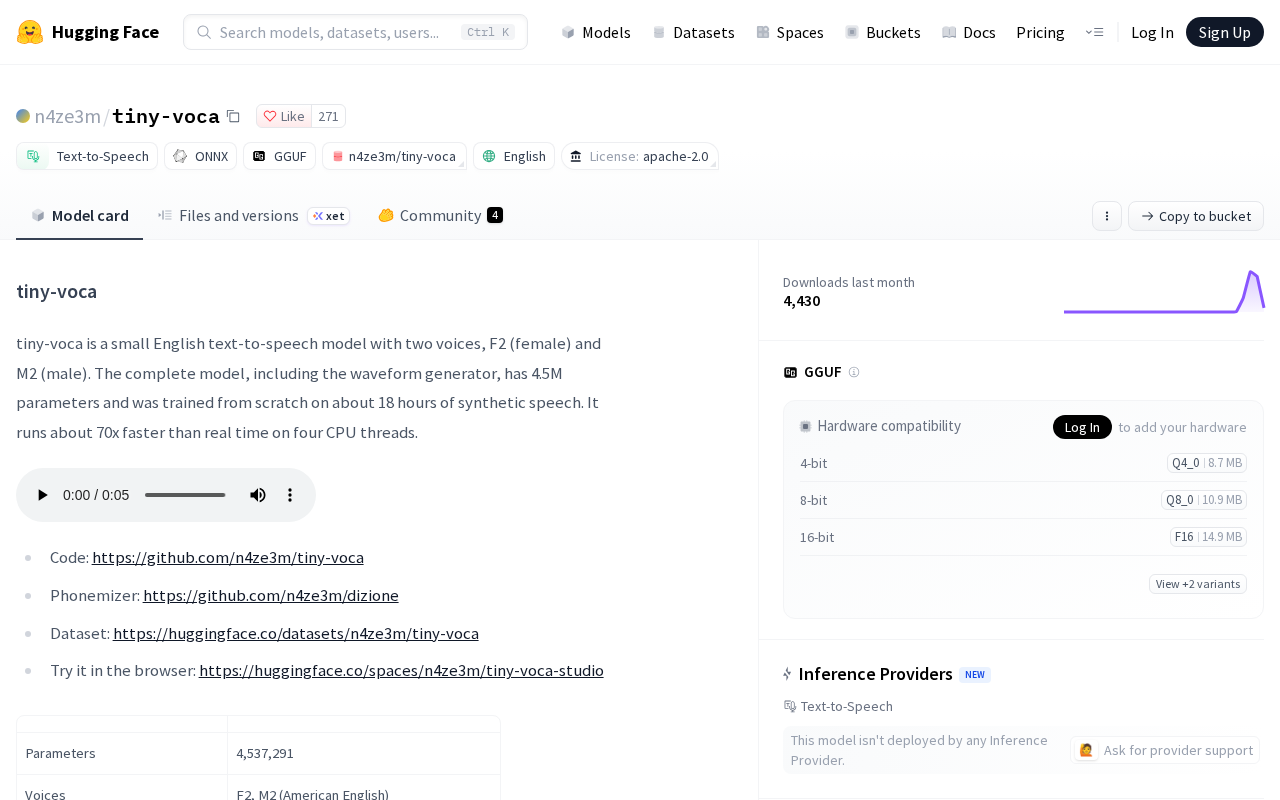
A 4.5M-parameter TTS model achieves 70x real-time inference on CPU with only $10 training cost.
This article covers a TTS model with only 4.5M parameters that achieves 70x real-time inference on CPU and costs just $10 to train, far below the compute and data barriers of mainstream TTS models like Tacotron 2 (~28M parameters). It discusses implications for edge computing and low-cost AI deployment, noting that embedded devices, mobile devices, and real-time interactive scenarios could benefit, and that individual developers and small teams could customize speech models. It also points out missing information such as speech quality comparisons and multilingual/emotional control support, and speculates the model may use a lightweight FastSpeech-like architecture or knowledge distillation. Compared with end-to-end solutions like VITS, it offers better efficiency but may compromise audio quality, requiring objective evaluation and awaiting open-source details.
A Big Breakthrough for Small Models: 4.5M-Parameter TTS Model Achieves 70x Real-Time Inference on CPU
At a time when deep learning models keep growing in scale, a TTS (text-to-speech) model with only 4.5M parameters has achieved 70x real-time operation on a CPU—and it was trained for just $10. This result, shared on Hacker News, has sparked discussion about edge computing and low-cost AI deployment.
Model Specs and Performance
According to the original share, the TTS model has only 4.5M parameters—far smaller than mainstream TTS models (such as Tacotron 2, which has about 28M parameters). More importantly, it can run at 70x real-time speed on a CPU, meaning it takes only about 1/70 of a second to generate 1 second of audio. This makes it possible to deploy high-quality speech synthesis on low-power devices.
Real-time factor (RTF) is a key metric for measuring the efficiency of a speech synthesis system, defined as the ratio of the computation time required to generate audio to the audio duration. An RTF below 1 means the system can generate speech faster than real time; an RTF of 1/70 means generating 1 second of audio takes only about 14 milliseconds. This metric is strongly tied to the hardware platform: the same model may reach hundreds of times real time on a GPU, while on a CPU it often drops sharply. Therefore, "70x real-time on CPU" emphasizes that real-time interactive requirements can be met without a dedicated accelerator, which is especially important for embedded and mobile deployment. Note that RTF usually does not include the overhead of the vocoder; actual end-to-end latency still needs to be assessed together with vocoder efficiency.
Training Cost and Efficiency
A training cost of only $10 is an impressive figure. Typically, training a TTS model requires substantial GPU compute and data, making it expensive. This model greatly lowers the barrier through a minimalist architecture and an efficient training strategy. Although the specific training details have not been disclosed, it is reasonable to infer that it uses a lightweight network design and optimization algorithms.
Knowledge distillation is a common means of enabling a small model to approach the performance of a large one: first train a "teacher model" with a large parameter count and high audio quality, then have the 4.5M-parameter "student model" imitate the teacher's output distribution (such as mel spectrograms), so that only the student model is deployed at inference time. Another approach is to use a lightweight backbone network (such as a convolution-based or streamlined Transformer structure) together with parameter quantization and pruning to further compress model size. A training cost of $10 usually means training on a single GPU or a few GPUs for several hours to tens of hours, with a limited amount of training data. Such low-cost training often relies on a pretrained acoustic model or transfer learning rather than starting from scratch, so its reproducibility and audio-quality ceiling still need to be judged in light of the specific training configuration.
Potential Applications and Impact
This result could promote the adoption of TTS technology in embedded devices, mobile devices, and real-time interactive scenarios. Low-cost training also enables individual developers and small teams to customize speech models. However, it is not yet clear how the speech quality compares with mainstream models, or whether multilingual support and emotional control are available.
Technical Details and Discussion
Since the original post has 0 comments, there is no in-depth discussion. But it is foreseeable that the community will pay attention to whether the model is open-sourced, its speech naturalness, and its performance on different hardware.
Architecture Speculation
Based on the parameter scale, the model may use a lightweight architecture similar to FastSpeech, or it may use knowledge distillation. But the specific implementation will have to wait for the author to disclose it.
Comparison with Existing Solutions
Compared with end-to-end TTS models such as VITS, this model has a significant efficiency advantage, but its audio quality may involve some compromise. Objective evaluation will be needed in the future.
VITS is an end-to-end TTS model that integrates text encoding, duration prediction, acoustic modeling, and the vocoder into a single network. It is known for generating highly natural speech, but its parameter count is usually in the tens of millions or more, and inference is computationally demanding. The FastSpeech series, by contrast, uses a non-autoregressive architecture and generates mel spectrograms in parallel through a duration predictor, making inference much faster than autoregressive models such as Tacotron 2. However, it usually requires a separate vocoder (such as HiFi-GAN) to convert spectrograms into waveforms, so end-to-end latency depends on vocoder efficiency. Therefore, a model with 4.5M parameters and 70x real-time performance on CPU very likely borrows FastSpeech's non-autoregressive idea in its architecture, or uses an extremely lightweight vocoder. Its audio quality involves a trade-off relative to end-to-end solutions such as VITS and needs to be objectively compared through subjective evaluations such as MOS (mean opinion score).
Conclusion
This share demonstrates the enormous potential of small models on specific tasks and offers a new approach to low-cost AI deployment. We look forward to the release of more technical details and open-source code.
One-line Summary
A 4.5M-parameter TTS model achieves 70x real-time inference on CPU, with a training cost of only $10.
Paragraph Summary
This article introduces a TTS model with only 4.5M parameters that achieves 70x real-time inference on CPU and was trained for just $10—far below the compute and data barriers of mainstream TTS models (such as Tacotron 2 with about 28M parameters). It analyzes the significance of this result for edge computing and low-cost AI deployment: it makes speech synthesis possible in embedded devices, mobile devices, and real-time interactive scenarios, and also enables individual developers and small teams to customize speech models. At the same time, the article notes that key information is still lacking, such as speech quality comparisons and support for multilingual and emotional control, and speculates that the model may use a lightweight FastSpeech-like architecture or knowledge distillation. Compared with end-to-end solutions such as VITS, this model has an efficiency advantage but may compromise on audio quality; objective evaluation and open-source details are still needed in the future.
Related articles

Jensen Huang Returns to Nvidia: The Power Game Behind an "Aggro Reset"
Nvidia's board reappointed Jensen Huang as CEO less than two weeks after his scandal-driven resignation. This analysis explores the board's decision-making, Trump's political intervention, media power failure, and market reaction behind the dramatic return.

Why Voice AI Can't Understand Kenyans' Everyday Conversations
Swahili speech recognition hits 3.24% error on read text, but everyday Kenyan speech mixes English, Sheng slang, and accents—leaving mainstream voice AI struggling.

Data Centers Build Their Own Natural Gas Plants: AI Compute's Breakout Around a Decade-Long Grid Wait
Grid interconnection approvals can take a decade, so xAI and others are building off-grid natural gas plants to power AI clusters. This article analyzes the drivers, costs, and impact of behind-the-meter generation on AI infrastructure.