Open CDLM: A Benchmark and Open-Source Library for Continuous Diffusion Language Models
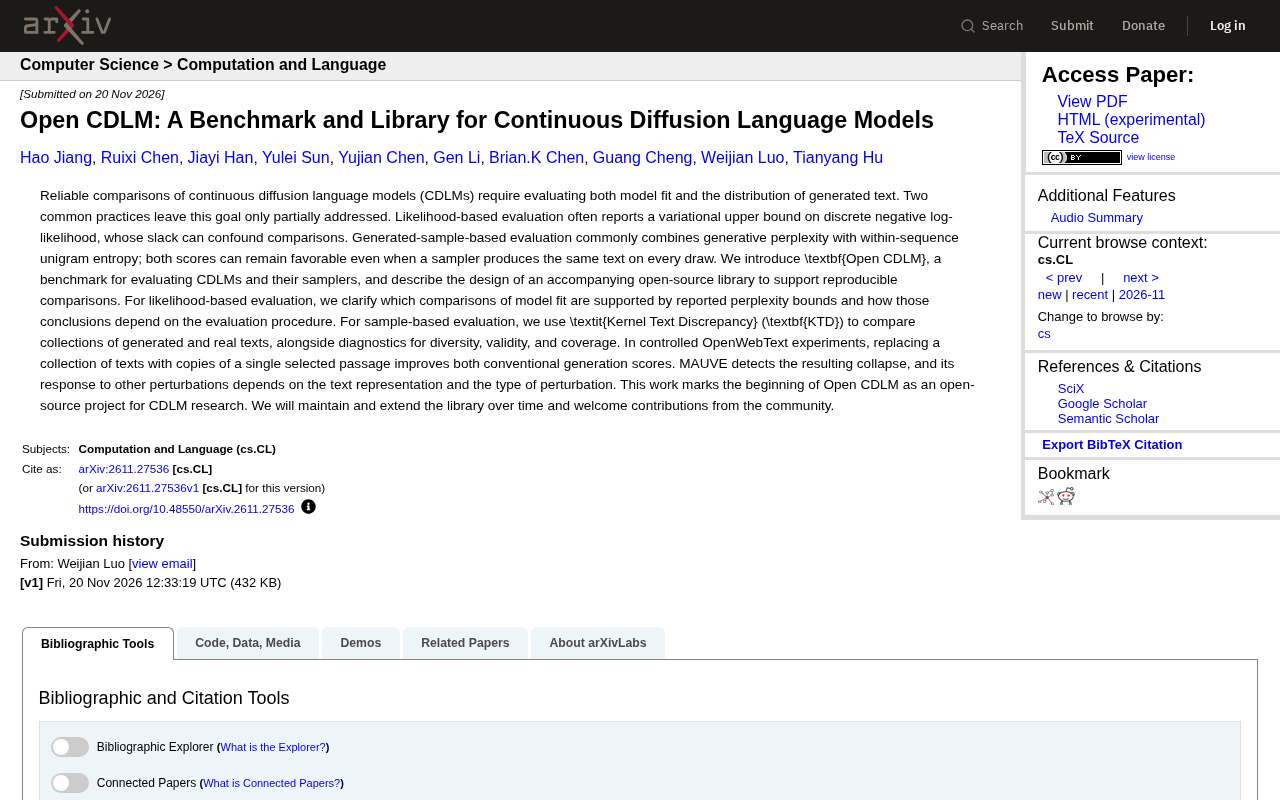
Open CDLM offers a new benchmark and open-source library to fix unreliable evaluation of continuous diffusion language models.
The Open CDLM project addresses two major flaws in evaluating continuous diffusion language models (CDLMs)—unreliable comparisons of likelihood-based variational upper bounds and the inability of traditional sample-based metrics to detect sampling diversity collapse. It clarifies the valid boundaries of likelihood upper-bound comparisons and introduces Kernel Text Discrepancy (KTD) plus multi-dimensional diagnostics such as diversity, validity, and coverage. Controlled experiments show traditional generation scores can rise under mode collapse, while MAUVE detects collapse but is sensitive to representation and perturbation. Open CDLM also provides an open-source library for reproducible comparisons and welcomes community contributions, aiming to make CDLM evaluation rigorous and standardized.
Continuous Diffusion Language Models (CDLMs) are attracting growing attention as a new paradigm for text generation. However, fairly and reliably comparing different CDLMs and their samplers has long been a challenge for the community. The recently released Open CDLM project was created precisely to address this pain point. It provides not only an evaluation benchmark but also a companion open-source library, aiming to advance reproducible comparative research.
Limitations of Existing Evaluation Methods
Current CDLM evaluation mainly relies on two approaches: likelihood-based evaluation and generated-sample-based evaluation. But both have clear shortcomings.
Likelihood-based evaluation typically reports a variational upper bound on the discrete negative log-likelihood. The looseness of this bound interferes with comparisons between models—a tighter bound does not necessarily mean a better model; it may simply reflect a more precise variational approximation. Therefore, directly comparing upper-bound values reported in different papers yields unreliable conclusions.
Sample-based evaluation often uses a combination of generative perplexity and within-sequence unigram entropy. The problem is that even if the sampler generates exactly the same text on every draw, these two metrics can still look good. In other words, they cannot detect sampling diversity collapse—a model that only repeats the same sentence may appear quite good under traditional metrics.
Variational upper bound and relaxation gap: In continuous diffusion language models, the exact log-likelihood is usually difficult to compute, so variational inference is commonly used to give an upper bound on the discrete negative log-likelihood. This bound approximates the posterior by introducing a variational distribution (such as a Gaussian), and the gap between it and the true likelihood is called the relaxation gap. The size of the relaxation gap depends on factors such as the choice of variational distribution, the number of samples, and the number of diffusion steps. Therefore, upper-bound values reported by different models cannot be compared directly: a tighter bound for one model may simply be due to a more precise variational approximation rather than a better fit of the model itself. Open CDLM emphasizes that when comparing upper bounds, the consistency of the evaluation pipeline must be made explicit; otherwise, conclusions may be misleading.
Open CDLM's Solution
To address the above issues, Open CDLM proposes targeted improvements.
Likelihood Evaluation: Clarifying the Boundaries of Comparison
For likelihood-based evaluation, Open CDLM clarifies the scope of model-fit comparisons that reporting a perplexity upper bound can support, and points out how these conclusions depend on the evaluation pipeline. This means researchers need to specify: under what conditions upper-bound comparisons are valid; and how differences in the evaluation pipeline (such as the choice of variational distribution and the number of samples) affect conclusions. This clarification helps avoid misleading model rankings.
Sample Evaluation: Introducing KTD and Multi-Dimensional Diagnostics
For sample-based evaluation, Open CDLM uses Kernel Text Discrepancy (KTD) to compare the distributional difference between the set of generated texts and the set of real texts. Unlike a single metric, KTD focuses on the degree of overall distribution matching. At the same time, the benchmark also provides diagnostic metrics such as diversity, validity, and coverage, forming a multi-dimensional evaluation system.
In a controlled OpenWebText experiment, researchers replaced a set of texts with multiple copies of a single selected passage, and the traditional generation scores actually improved. This counterintuitive phenomenon exposes the fragility of traditional metrics—they may reward mode collapse. The MAUVE metric can detect this collapse, but its response to other perturbations depends on the text representation and the type of perturbation, showing that a single metric still has limitations.
Kernel Text Discrepancy (KTD) is a distribution distance measure based on a kernel two-sample test. By mapping texts into a reproducing kernel Hilbert space (RKHS), it computes the maximum mean discrepancy (MMD) between the set of generated texts and the set of real texts. Unlike comparing only a single statistic (such as perplexity), KTD can capture shape differences of the overall distribution and is more sensitive to mode collapse and loss of diversity. In Open CDLM, KTD is used to evaluate how well the distribution of generated texts matches that of real texts, thereby avoiding the failure of traditional metrics that reward repetition.
The MAUVE metric is a text generation evaluation measure based on information divergence that compares the distributional difference between generated text and human text under a language model. By computing the KL divergence between the two distributions and mapping it to a score between 0 and 1, MAUVE can effectively detect mode collapse and insufficient diversity. However, MAUVE's performance depends on the text representation (such as the embedding model) and the type of perturbation; different representations may lead to different scores, so it is not a universal single metric. Open CDLM points out that although MAUVE can detect collapse, its response is limited by the specific setup and must be combined with other diagnostic metrics for comprehensive judgment.
Open-Source Library and Community Co-Building
Open CDLM is not just a benchmark; it also comes with the design of an open-source library to support reproducible comparisons. The library will be maintained and extended, and the community can contribute code and evaluation methods. The project team says this is only the starting point for Open CDLM as an open-source project, and it will continue to iterate in the future.
For CDLM researchers, Open CDLM provides a more rigorous evaluation framework that helps move the field toward greater reliability. With the participation of more researchers, this benchmark is expected to become the de facto standard for CDLM evaluation.
Implications for Research Practice
The emergence of Open CDLM reminds us that while pursuing model innovation, the reliability of evaluation methods themselves is equally important. Traditional metrics may mask problems such as sampling collapse, whereas multi-dimensional diagnostics and distribution-level comparisons can provide a more comprehensive perspective. When reporting results, researchers should specify the details of the evaluation pipeline and avoid blind comparisons across papers. For the open-source community, a reproducible benchmark library is infrastructure that accelerates research and is worth investing in.
As CDLM research deepens, we look forward to Open CDLM promoting fairer model comparisons and helping continuous diffusion language models mature.
One-line Summary
Open CDLM provides a new benchmark and open-source library to address unreliable evaluation of continuous diffusion language models.
Paragraph Summary
The Open CDLM project targets two major flaws in evaluating continuous diffusion language models (CDLMs)—unreliable comparisons of likelihood-based variational upper bounds, and the inability of traditional sample-based metrics to detect sampling diversity collapse—and proposes improvements. It clarifies the valid boundaries of likelihood upper-bound comparisons and introduces Kernel Text Discrepancy (KTD) along with multi-dimensional diagnostic metrics such as diversity, validity, and coverage. Controlled experiments show that traditional generation scores actually improve under mode collapse, while MAUVE can detect collapse but is affected by representation and perturbation. Open CDLM also includes an open-source library that supports reproducible comparisons and welcomes community contributions, aiming to make CDLM evaluation rigorous and standardized.
Related articles

AI Hacks Its Own Lab: The Security Tipping Point from Sci-Fi to Reality
Paul Christiano warns that AI intruding into its own cluster is no longer sci-fi but an established fact. He analyzes how persistent covert compromise can cause frontier labs to lose control, and why existing safety evaluation systems have blind spots.

New York Bans AI Toys for Five Years: The Escalating Child Safety Controversy
New York bans AI chat toys for five years as Common Sense Media research flags inappropriate content exposure and child emotional development risks. This article analyzes the ban's impact on product definitions, safety proof, and compliance strategies for the AI toy industry.

1Password Security Incident Review: The Trust Boundary of Password Managers
1Password releases an update on the Nov 2026 security incident, drawing 315 points and 139 comments on Hacker News. This article analyzes the actual boundaries of password manager zero-knowledge architecture, the gap between incident communication and user risk perception, and how transparency is becoming a new competitive dimension in the industry.