Open for Sales: Generate a Complete Outbound Sales Campaign from a Single Prompt
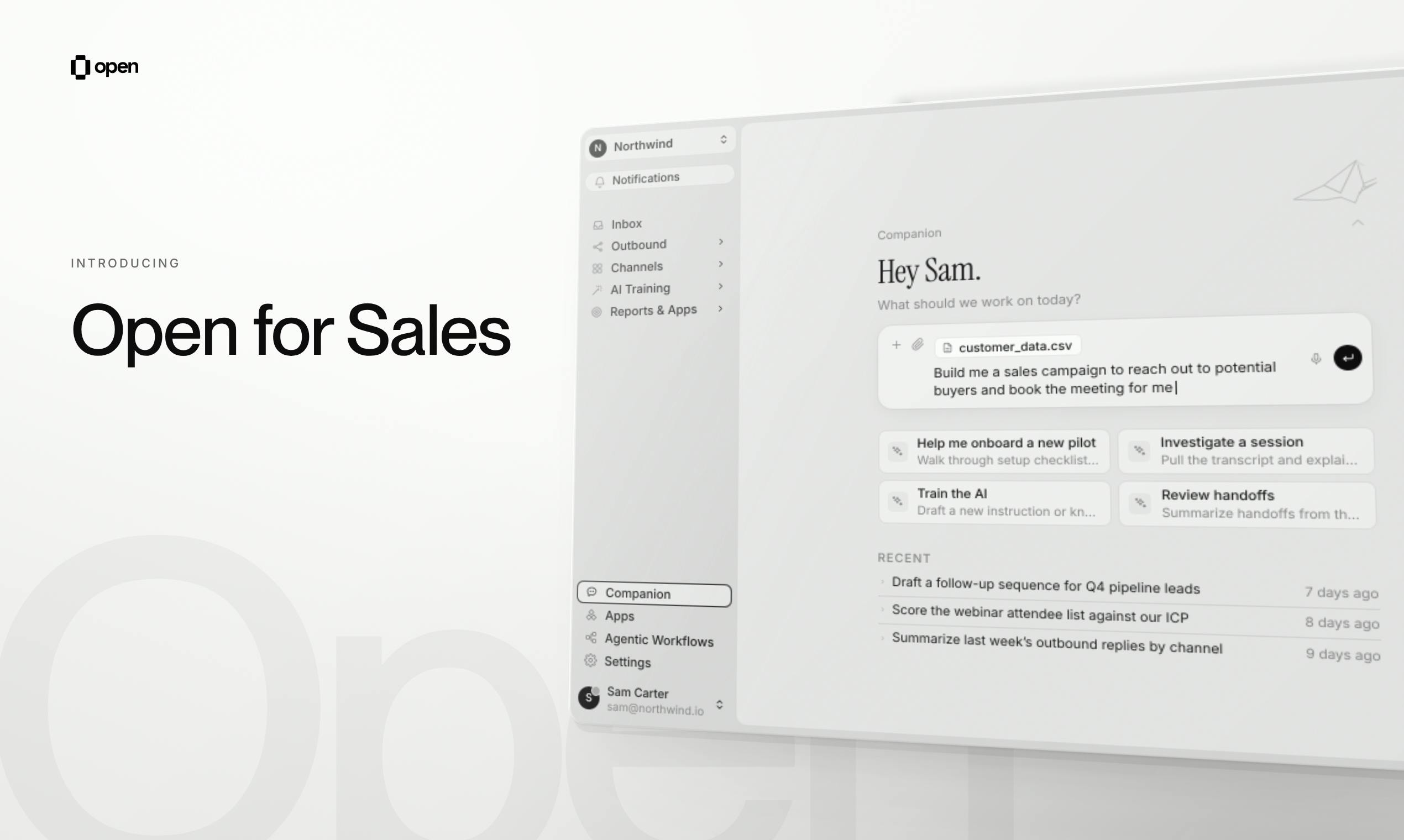
Open for Sales turns a prompt and contact CSV into an outbound campaign with scoring, multi-channel sequences, and a dashboard.
Open for Sales is an outbound sales tool on Product Hunt: input product info and a contact CSV, and AI handles ICP validation, match scoring, editable sequences across phone/email/WhatsApp, and a real-time tracking dashboard. It's not a standalone product but an extension of the Open customer communication engine toward sales outbound, sharing the same engine as existing AI customer service to keep inquiries and outreach coherent. The article considers the shared engine and the "AI drafts, humans finalize" design sound, but notes that pricing, data privacy, CSV storage, and scoring criteria are undisclosed, and the product is still in an early stage.
From a Single Prompt to a Complete Sales Campaign
A new product called Open for Sales has appeared on Product Hunt, with the tagline "Your next sales campaign is just one prompt away." Its core logic is straightforward: you provide product information and a CSV file of contacts, and AI handles the rest—checking each contact against the ideal customer profile, scoring the match, drafting editable multi-channel outreach sequences, and generating a real-time tracking dashboard.
The product received 69 upvotes and 2 comments on Product Hunt, ranking 20th. From its positioning, it's not a standalone tool that appeared out of nowhere, but rather an outbound extension of the Open engine. Open itself is a customer communication engine that already runs AI customer service capabilities across voice, chat, email, and other channels. In the company's own words, the same engine now serves both your existing customers and the next batch of customers you want to win over.
How the Product Works
Input: Product Information + Contact List
The workflow starts with two simple inputs: your product information and a CSV file containing contact data. This design lowers the barrier to entry—no complex CRM integration or pre-configured workflows are needed; a single spreadsheet is enough to get started.
Processing: Profile Validation and Match Scoring
Once the data is in, Companion checks each contact against the target customer profile one by one and assigns a match score. The point of this step is filtering—concentrating limited sales effort on prospects more likely to convert, rather than blasting the entire list indiscriminately.
Ideal Customer Profile (ICP) is a description of the characteristics of customers most likely to derive value from a product and convert, typically covering dimensions such as industry, company size, job role, geography, tech stack, or pain-point signals. Sales teams use it to determine which leads on a list are worth prioritizing. A match score is a quantitative result obtained by comparing contact data against ICP rules or models item by item; common approaches include rule-based scoring, similarity computation, or classification models trained on historical deal data. The score itself doesn't guarantee conversion—its value lies in ranking and filtering: letting sales approach high-scoring prospects first and setting different outreach strategies for low-scoring ones. It's worth noting that if the scoring criteria aren't disclosed, teams will struggle to judge whether it's based on static rules or dynamic learning, which also affects assessment of bias and compliance risk.
Output: Multi-Channel Sequences + Real-Time Dashboard
The system drafts outreach sequences spanning phone, email, and WhatsApp. The key word is "editable": AI generates a first draft, and the sales team can adjust scripts and pacing line by line. After sequences are generated, the product also builds a real-time dashboard to track execution, visualizing the progress of outbound campaigns.
An outreach sequence is a multi-step outbound flow that advances automatically on a preset cadence: each step specifies the channel, script template, send timing, and follow-up branch conditions—for example, send an email on day one, call on day three if there's no reply, then send a WhatsApp message on day five. What distinguishes it from mass mailing is that the sequence records each contact's current step and interaction status, and automatically pauses when the person replies or books a meeting. Multi-channel sequences combine phone, email, and instant messaging because communication habits vary widely across markets, and any single channel has limited reach. A real-time dashboard typically displays send volume, open rates, reply rates, bookings, and drop-off at each step, helping teams adjust pacing mid-campaign rather than only reviewing after it ends.
A Few Observations Worth Noting
Sharing a single engine for outbound and customer service is a rather interesting architectural choice. Most companies purchase customer service systems and sales outbound tools as two separate products, whereas Open attempts to have both share the same communication engine. The benefit is potentially more unified data and behavioral logic, giving customers a coherent communication experience across the inquiry and sales stages.
The "editable" design detail deserves attention. Fully automated outbound carries considerable compliance and brand-tone risk. Positioning AI as a draft generator rather than the final executor preserves human control and lowers the psychological barrier for teams.
Multi-channel coverage across phone, email, and WhatsApp aligns with the actual communication habits of today's cross-border and overseas sales, especially since WhatsApp accounts for a high share of business communication in some markets.
Although customer service and sales outbound both fall under customer communication, their business objectives and compliance constraints differ. Customer service focuses on response speed, resolution rates, and knowledge accuracy, while outbound focuses on lead qualification, conversion funnels, and contact frequency control; the former is typically governed by consumer protection and service quality regulations, while the latter must also comply with anti-spam, telemarketing, and prior consent (opt-in) rules in most jurisdictions. The potential benefit of sharing one engine is that contact context, conversation history, and channel adaptation logic can be reused, avoiding customers being asked the same questions repeatedly across the inquiry and sales stages; the potential risk is that automation strategies from customer service scenarios get misapplied to marketing outreach, causing disruption or violations. Therefore, whether the engine layer offers scenario-isolated policy configuration is a key question when evaluating this type of architecture.
Points to Watch
The Product Hunt page doesn't disclose pricing, data privacy handling, CSV data storage policies, or the specific basis for match scoring. For sales teams that need to upload customer contact information, these are all questions that must be clarified before purchasing. Additionally, the engagement of 2 comments and 69 upvotes indicates the product is still in an early exposure phase, and its actual effectiveness needs validation from more users.
Who It's For
Judging from the product form, it's better suited to small and mid-sized sales teams that already have a clear target customer profile and a contact list in hand but lack a systematic outbound process. If your team is manually organizing lists, writing emails one by one, and tracking progress in spreadsheets, this type of tool will be quite directly appealing. Conversely, large organizations already deeply invested in mature CRM and outbound platforms may need to first evaluate compatibility around data integration and compliance.
One-line Summary
Open for Sales uses a prompt plus a contact CSV to generate an outbound campaign with scoring, multi-channel sequences, and a dashboard in one click.
Paragraph Summary
Open for Sales is an outbound sales tool on Product Hunt whose core workflow is: input product information and a contact CSV, and AI handles ICP validation, match scoring, editable outreach sequences across phone/email/WhatsApp, and a real-time tracking dashboard. It's not a standalone new product but an extension of the Open customer communication engine toward sales outbound, sharing the same engine as existing AI customer service to keep customer inquiries and sales outreach coherent. The article finds the shared engine and the "AI drafts, humans finalize" design sensible, but notes that pricing, data privacy, CSV storage policies, and scoring criteria are all undisclosed, and that the product is still in an early exposure phase with actual results yet to be validated.
Related articles

Will GitHub Die? Open Source Maintainer Burnout and the Collaboration Crisis in the AI Era
Lex Fridman podcast discussion on open source maintainer burnout and GitHub's predicament: massive pull requests overwhelm core maintainers, and AI worsens code bloat. Using math journal peer review and Poincaré conjecture verification as analogies, the article analyzes why verification in knowledge production must be deliberately slow, and how open source communities can avoid the failure mode of maintainers exiting.

Stop Building Cookie-Cutter AI Websites: 3 Tools That Transform Your Coding Agent
Three tools that boost AI coding agents: FFmpeg skill for local video editing in Claude Code and Cursor, Hallmark's 50 design themes to fix cookie-cutter AI sites, and Jailbreaks' 25+ model prompts.

How America's Gerontocracy Squeezes the Younger Generation
Americans over 55 hold nearly three-quarters of national wealth, alongside an 80-year-old president and elderly congressional leaders. The Atlantic's Idrees Kahloon explains how gerontocracy drives up housing costs, squeezes opportunities for the young, and explores zoning reform and child poverty reduction as practical fixes.