Open Models Go to Campus: The AI Talent War Behind a 200-Person Lecture at Seoul National University
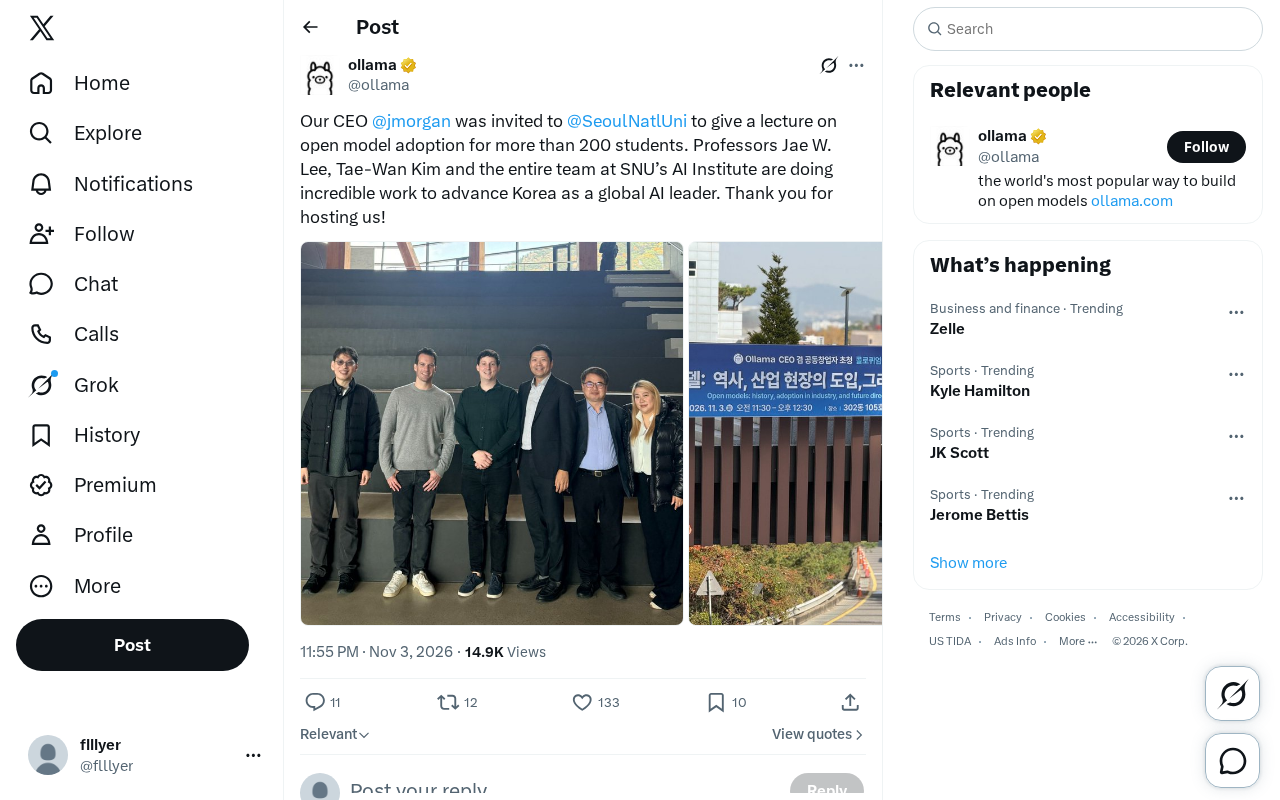
A company CEO lectured at Seoul National University on open model adoption, reflecting the forward shift of open-source AI talent competition.
The article starts from a social media update: a company CEO gave a lecture on "open model adoption" at Seoul National University, with over 200 students attending and two professors and their team from the SNU AI Institute hosting. The author notes that the lecture used "adoption" rather than "training," suggesting practical integration of open models rather than building from scratch—precisely the skills gap for students entering industry. The article analyzes that enterprise-university collaboration on open model courses has low friction and aligned motivations, becoming the frontier of AI talent competition, interpreted alongside South Korea's national AI strategy and SNU's bellwether status. The takeaway for developers is mastering the full pipeline from selection and deployment to fine-tuning and inference cost control. The author also notes the information comes from a single social media update lacking cross-validation and should be treated as a directional signal.
When a company CEO walks into a university lecture hall and talks not about a product launch but about "open model adoption," that in itself is worth pondering. According to a Twitter post, a company CEO @jmorgan was invited to give a lecture on open model adoption at Seoul National University (SNU), with over 200 students in attendance. Professor Jae W. Lee, Professor Tae-Wan Kim, and their team from the SNU AI Institute participated in hosting.
This seemingly simple social media update reveals the accelerating connection between the open-source AI ecosystem and university talent development.
Lecture Content and On-Site Information
From public information, the core topic of this lecture was "open model adoption." The scale of over 200 students in attendance indicates that open models already command considerable attention at South Korea's top engineering schools.
It's worth noting that the term used here is "adoption" rather than "training" or "research." This choice of wording suggests the lecture's focus may lean more toward the practical level—how to integrate existing open models into real workflows rather than building models from scratch. For students about to enter industry, this is precisely the most practical skills gap.
On the SNU side, the AI Institute where Professors Jae W. Lee and Tae-Wan Kim are based led the organization. The tweet specifically mentioned that the team "is doing incredible work to make Korea a global AI leader." This kind of public endorsement from an external corporate executive is not common in academic collaboration settings, indicating that the relationship between the two parties has gone beyond a single lecture.
Why Open Models, Why Universities
Open Models Are Becoming the Industry Default
Over the past year, open-weight models have rapidly approached closed-source frontier models in capability, with significant cost advantages. For enterprises, adopting open models means private deployment, on-demand fine-tuning, and avoiding vendor lock-in. This shift directly translates to the talent demand side—people who can solve problems with open models are more sought after by the market than those who can only call APIs.
University classrooms have therefore become a battleground. Companies want students to be familiar with their toolchains and model ecosystems before graduation, schools want course content to be close to industry practice, and students want what they learn to go directly onto their resumes. The motivations of all three parties rarely align so perfectly.
Open Weights is a technical concept that is unavoidable when understanding "open-source models." Strictly speaking, open-source models require not only that weight files be publicly downloadable but also that training code, data sources, and processing pipelines be open. What the industry commonly calls "open-weight models" usually only releases the parameter files needed for inference, without disclosing training details or datasets. Meta's Llama series and some versions of Mistral fall into the latter category. This distinction directly affects how enterprises adopt them: open weights mean private deployment, fine-tuning, and redistribution are possible, but the training process cannot be fully reproduced, and model behavior is difficult to audit from scratch. For most industrial applications, inference and fine-tuning capabilities are sufficient, so open-weight models achieve a practically usable balance between cost and controllability—this is also the technical prerequisite for their rapid rise as the industry default over the past year.
Vendor Lock-in refers to the situation where an enterprise deeply binds its business to a particular cloud service provider or model vendor, making migration costs extremely high and thereby losing bargaining power and technological choice. In the closed-source API model, model versions, pricing, rate-limiting policies, and deprecation schedules are all unilaterally decided by the vendor, and enterprises can only follow passively. After adopting open-weight models, enterprises can deploy models on their own infrastructure, replace the base as needed, retain fine-tuning results, and maintain business continuity when vendors change. This "exitability" is itself a strategic asset, and it is also why the article emphasizes cost advantages alongside avoiding lock-in.
South Korea's University AI Race
South Korea has been relatively active in national strategic investment in AI. As its top university, SNU's AI Institute trends are a bellwether. The scale and organizational level of this lecture—two professors plus the entire team—show the university's emphasis on industry input.
From a broader perspective, collaboration between enterprises and universities on AI courses is becoming more intensive globally. Lectures, joint labs, co-developed courses, direct internship pipelines—the forms vary. Open models happen to be the entry point with the least friction in such collaborations: no commercial licensing disputes, students can experiment freely, and enterprises can expand ecosystem influence at low cost.
The context of South Korea's national AI strategy helps explain SNU's position in this collaboration. Since 2023, South Korea's Ministry of Science and ICT has been advancing a special initiative on "AI semiconductors and AI models," setting a goal to enter the global top three in AI by 2030 and establishing a sizable AI computing infrastructure fund, while allocating GPU resources to universities through programs such as "AI-centered universities." As South Korea's top university, SNU's AI Institute is both a bearer of national-level research projects and a hub for industry collaboration. Against this backdrop, a corporate executive lecturing at SNU is not an isolated PR act but the product of the intersection of national strategy, university resources, and corporate ecosystem positioning. The lecture being hosted by two professors and their team also fits the usual organizational pattern of Korean universities in industry-academia collaboration, where senior professors lead and institutes serve as the unit for engaging with industry.
Practical Implications for Developers and Students
If you are a student or a developer just starting out, the value of this news is not that "a company CEO went to a university" but that it points to a clear direction for capability building: get hands-on and run the full pipeline of open models.
Specifically, this includes model selection and evaluation, local or cloud deployment, fine-tuning for specific tasks, and controlling inference costs. These steps are difficult to learn systematically outside the classroom, yet they are precisely the real barriers to adopting open models.
Another implication concerns information channels. The content of such lectures is often not fully made public, but following the social accounts of relevant companies and executives, as well as announcements from university AI institutes, is a low-cost way to track frontier practices.
Editorial View
The lecture itself offers limited information—we don't know which models were discussed, what cases were used, or how students responded. But as a signal it is clear: competition in open models has extended from model capability to ecosystem and talent. Whoever can get future engineers accustomed to their technology path during their student years will gain an early advantage in the next wave of adoption. For SNU students, a 200-person lecture is a starting point; for the industry, such campus penetration will only increase.
One note: this article's information mainly comes from a single social platform update. The specific content of the lecture and details of subsequent collaboration have not yet been corroborated by more public sources, and readers should treat it as a directional signal rather than a complete statement of facts.
One-line Summary
A company CEO lectured at Seoul National University on open model adoption, reflecting the forward shift of open-source AI talent competition.
Paragraph Summary
The article starts from a social media update: a company CEO gave a lecture on "open model adoption" at Seoul National University, with over 200 students in attendance and two professors and their team from the SNU AI Institute participating in hosting. The author notes that the lecture used "adoption" rather than "training," suggesting the content leaned toward practical integration of open models rather than building from scratch—precisely the most practical skills gap for students entering industry. The article further analyzes that collaboration between enterprises and universities on open model courses has low friction and aligned motivations, and is becoming the frontier of AI talent competition, interpreted in light of South Korea's national AI strategy and SNU's bellwether status. The takeaway for developers is to master the full pipeline of open models from selection, deployment, and fine-tuning to inference cost control. The author also reminds readers that the information comes from a single social media update and lacks cross-validation, so it should be treated as a directional signal.
Related articles

Nvidia CEO Removal Saga: Trump Intervenes Over the Weekend, Jensen Huang Reinstated Monday
Vergecast podcast reveals Nvidia CEO drama: earnings call said he wouldn't return and a new CEO was being sought; Trump intervened over the weekend, with J.D. Vance brokering a security guarantee to the board; Jensen Huang reinstated at 9 a.m. Monday.

Semantic Caching Explained: Reusing the Same Answer for Similar Questions
Semantic caching uses embeddings to judge whether queries are similar in meaning and reuses cached results for similar prompts. This article explains how it works, the difficulty of threshold tuning (such as the risk of misjudging negations), and its applicable boundaries.

How Did Trump Personally Turn Nvidia into the "Twelfth Board Member"?
A YouTube political commentary offers a sharp view: behind Nvidia's market cap milestone, Trump's deep involvement earns him the title of "twelfth board member." The article breaks down the commentator's logic on stock market achievements, the break from small-government tradition, and power display.