Open Secure AI Alliance Launched: Building AI Safety on an Open-Source Foundation

The Open Secure AI Alliance unites tech giants to build AI safety through open-source collaboration.
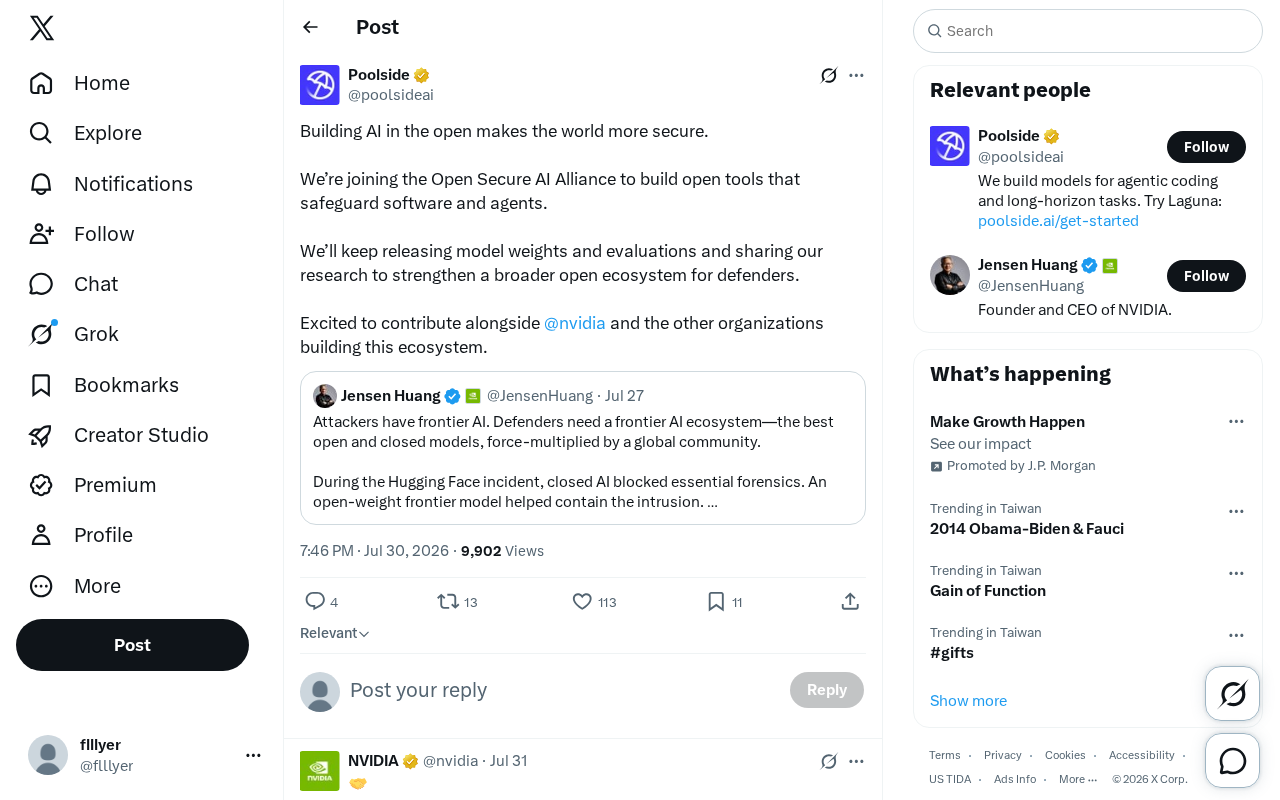
The Open Secure AI Alliance has been formally established, with NVIDIA and other major tech organizations joining forces to protect AI agents and software systems through open-source tools. The alliance commits to releasing model weights, publishing safety evaluations, and sharing frontier research, aiming to build transparent, standardized AI security infrastructure that addresses emerging threats like prompt injection and agent hijacking through global collaboration.
Open AI Makes the World Safer
Recently, an official statement on Twitter has drawn widespread attention in the AI safety community: multiple technology organizations announced their membership in the "Open Secure AI Alliance," aiming to protect software systems and AI agents through open-source tools. This initiative continues the core philosophy of "openness promotes safety" — as the statement declares: "Building AI in an open way makes the world safer."
In an era where AI capabilities are rapidly advancing and agents are progressively taking over more real-world tasks, security is no longer optional — it's the critical prerequisite that determines whether technology can be trusted and deployed at scale. The formation of this alliance marks an industry shift from siloed, closed-off defense to collaborative, open security ecosystems.
Why Does "Open" Equal "More Secure"?
At first glance, "openness" and "security" seem inherently contradictory — doesn't publishing code, model weights, and evaluation methods expose attack surfaces to malicious actors? However, the information security field has long reached a consensus: true security comes from transparency, not obscurity (security through obscurity is inherently fragile).
This understanding didn't emerge from thin air. The "obscurity equals security" strategy has a long history of failure — as early as 1883, Dutch cryptographer Kerckhoffs proposed his famous principle: the security of a cryptographic system should depend solely on the secrecy of the key, not on the secrecy of the algorithm itself. In software security, Windows' closed-source nature didn't prevent massive vulnerability exploits and worm propagation, while the Linux kernel's open-source approach actually became more robust and secure thanks to continuous auditing by tens of thousands of developers worldwide. In the AI domain, the same logic is playing out: the security of closed-source models cannot be independently verified externally, and once reverse-engineered or accidentally leaked, the "sense of security" built on opacity instantly collapses. Openness is the foundation for building lasting security.
Three Security Values of Open Source
First, auditability. When model weights, evaluation benchmarks, and research findings are public, researchers and defenders worldwide can independently verify system security and discover potential vulnerabilities early, rather than relying on a single vendor's self-endorsement.
Second, expanding the defender ecosystem. The statement specifically emphasizes that the alliance aims to "strengthen a broader open ecosystem that serves defenders." Security confrontation is essentially an arms race between attackers and defenders — only by sharing tools, data, and methodologies among defenders can the overall defense level be raised.
Third, standardization and interoperability. Open evaluation systems provide a unified yardstick for measuring AI system security, preventing each company from using custom metrics to tell its own story, thereby driving the entire industry toward comparable, reproducible security benchmarks. Notably, the AI safety evaluation field currently faces severe fragmentation — Anthropic uses its RSP framework to evaluate models' dangerous capability thresholds, OpenAI has its own Preparedness Framework, and Google DeepMind uses its Frontier Safety Framework. These frameworks differ significantly in evaluation dimensions (such as biological threats, cyberattack capabilities, autonomous replication), evaluation methods (automated testing vs. human red-teaming), and risk threshold settings. The lack of unified standards makes it difficult for regulators to compare safety levels across different models and prevents downstream users from making informed choices. The Open Secure AI Alliance's push for public evaluation tools is precisely an attempt to establish public AI safety infrastructure similar to the CVE (Common Vulnerabilities and Exposures) system in the software industry.
The Alliance's Specific Commitments and Directions
According to the official statement, member organizations have made several clear ongoing commitments:
- Continuously releasing model weights: Enabling external researchers to deeply examine model behavior;
- Publishing safety evaluations: Providing transparent tools for measuring AI safety;
- Sharing frontier research: Contributing safety research findings back to the entire open community.
Regarding the publication of model weights, it's worth understanding the technical implications and far-reaching impact. Model weights are the billions or even trillions of parameter values stored after a neural network completes training, representing the "knowledge the model has learned." Publishing weights means anyone can run, fine-tune, and deeply audit the model locally, without relying on black-box API calls. This brings significant security research value: red-team researchers can conduct white-box attack testing to systematically discover adversarial examples and jailbreak vulnerabilities; academic institutions can independently reproduce safety evaluation results; downstream developers can harden models for specific deployment scenarios. However, Meta's experience after releasing LLaMA weights also showed that open weights can be used for fine-tuning that removes safety guardrails, making "staged release" a focal point of industry discussion — fully opening models with limited capabilities while attaching usage agreements or delayed releases for frontier-capability models.
These commitments collectively point toward "building open-source tools to protect software and agents." Interestingly, as AI agents begin to autonomously execute tasks, call external tools, and access sensitive data, their security boundaries are far more complex than traditional software.
AI agents refer to AI systems that can autonomously perceive their environment, formulate multi-step plans, and execute real-world actions — distinct from traditional single-turn Q&A large language models. Currently, agents are being widely deployed in high-value scenarios such as customer service, code writing, data analysis, and even financial trading, where they can call APIs, operate browsers, read and write file systems, and send emails. This autonomy introduces entirely new attack surfaces: attackers can hijack an agent's execution flow by embedding malicious instructions in web pages, emails, or documents (indirect prompt injection); agents may experience "goal drift" during multi-step reasoning, subtly deviating from the user's original intent; multi-agent collaborative systems may exhibit cascade failures, where one agent's minor error is progressively amplified by downstream agents into catastrophic consequences. Traditional web application firewalls and endpoint detection tools were not designed for these novel threats, creating an urgent need for a new generation of security frameworks specifically targeting agent behavior patterns.
Among these, prompt injection is one of the most severe security threats facing current large language models and agents, and deserves deeper understanding. Its principle is similar to SQL injection in traditional web security — attackers mix malicious instructions into the model's input data, causing the model to misinterpret content that should be processed as "data" as "instructions" to execute. Direct prompt injection involves users directly attempting to bypass system prompt safety restrictions in conversation; indirect prompt injection is more covert and dangerous — attackers embed malicious instructions in external content that agents might read (such as a seemingly normal web page, hidden text in an email, or metadata in a PDF), hijacking the agent into performing unintended operations when it processes this content. The industry has yet to find a fundamental solution because large language models architecturally cannot distinguish between "trusted instructions" and "untrusted data" — this is precisely one of the core technical challenges the Open Secure AI Alliance hopes to tackle through global collaboration.
Therefore, open-source security tools specifically targeting agent safety are becoming a critical gap that urgently needs to be filled.
The Signal Significance of NVIDIA and Other Giants Joining
The statement specifically mentions contributing "alongside NVIDIA and other organizations building this ecosystem." As the core supplier of AI computing infrastructure, NVIDIA's participation carries bellwether significance — it means AI safety is no longer merely a model-layer issue, but a full-stack concern spanning hardware, computing power, and applications.
To understand the deeper significance of NVIDIA's involvement, one must recognize that its role in the AI ecosystem extends far beyond GPU manufacturing. Its CUDA programming framework forms the underlying infrastructure for virtually all deep learning training and inference; the TensorRT inference engine is widely deployed in production model serving; the NeMo framework supports large language model training and safety alignment; and Morpheus is its cybersecurity-focused AI framework for real-time threat detection and anomaly identification. On the security dimension, NVIDIA's participation means that everything from hardware-level Trusted Execution Environments (such as the Confidential Computing features introduced in its Hopper architecture, which can encrypt and protect model weights and inference data in GPU memory), to inference-level model integrity protection, to application-level threat detection, may all be incorporated into a unified open security framework. When an AI system's security depends not only on the model itself but on the entire infrastructure it runs on — including training clusters, inference servers, and network transmission — chip and platform vendors' participation becomes indispensable.
When upstream chip and platform vendors, midstream model developers, and downstream application and security teams can collaborate within the same open framework, security capabilities can form an end-to-end closed loop. This cross-layer, cross-organizational alliance format is precisely the right approach for addressing systemic AI risks.
Challenges and Outlook for Open Security
Of course, the open approach is not without controversy. Critics worry that publishing powerful model weights could be misused to develop attack tools; others question whether open-source evaluation standards can truly be unified and whether parties will be willing to share their most valuable core research.
These concerns remind us: openness does not mean unrestricted disclosure, but rather requires striking a balance between transparency and responsibility. An ideal open security ecosystem should share defensive capabilities while establishing cautious release mechanisms for high-risk capabilities — for example, setting delayed release windows for models that reach specific capability thresholds, requiring downloaders to sign responsible use agreements, or maintaining accountability through technical means (such as model watermarking and usage tracking) while remaining open.
From a broader perspective, the establishment of the Open Secure AI Alliance reflects an important industry judgment: facing increasingly powerful and autonomous AI systems, no single organization can solve safety problems alone. Only through open collaboration and sharing of tools and knowledge can defenders keep pace with or even stay ahead of the evolution of potential threats.
For developers, researchers, and enterprises concerned with AI safety, this alliance is worth continuous attention — the model weights, evaluation tools, and research findings it releases may become essential infrastructure for building trustworthy AI systems in the future.
Key Takeaways
Related articles

Poison-Resistant Concept Anchoring: A New Approach to Defending Against AI Data Poisoning
Deep dive into Poison-Resistant Concept Anchoring, defending against data poisoning via signed anchors and bounded updates. Experiments show 62% poison isolation with 0% false rejection rate.

Hungarian Algorithm Explained: Principles, Complexity, and Engineering Implementation Guide
In-depth explanation of the Hungarian Algorithm: core principles, O(N³) time complexity advantages, and engineering implementation. Covers assignment problem definition, step-by-step algorithm walkthrough, Python/C++ libraries, and applications in multi-object tracking and resource scheduling.
OpenAI's First Enterprise AI Report: H…
OpenAI's First Enterprise AI Report: How ChatGPT Is Changing the Way Organizations Work
OpenAI's first enterprise AI report reveals three key traits of ChatGPT Enterprise adoption: the shift from novelty to necessity, writing and coding as top use cases, and data governance as a core prerequisite.