Open-Source Local Decision Model: Nearly 20x Faster Than Cloud APIs

Laya is a lightweight open-source local decision model that runs ~20x faster than cloud APIs with just 9ms latency.
Laya is an open-source local decision model designed to address the high latency, high cost, and privacy risks of cloud APIs. Unlike general-purpose LLMs, it focuses on structured decision tasks like classification and priority judgment — not text generation — enabling 9ms inference at 86 decisions per second locally, nearly 20x faster than cloud solutions. Data never leaves the device. It installs with a single pip command, is fully free under the MIT license, and integrates with mainstream AI orchestration frameworks.
Cloud AI APIs remain hugely popular, yet actually putting them to use involves real friction — applying for access, waiting in queues, paying per token, and enduring a network round trip at every step. For high-frequency, low-latency decision-making scenarios, the cost and delay of that workflow are simply untenable. An open-source local decision model called Laya offers a different answer.
The Hidden Costs of Cloud APIs
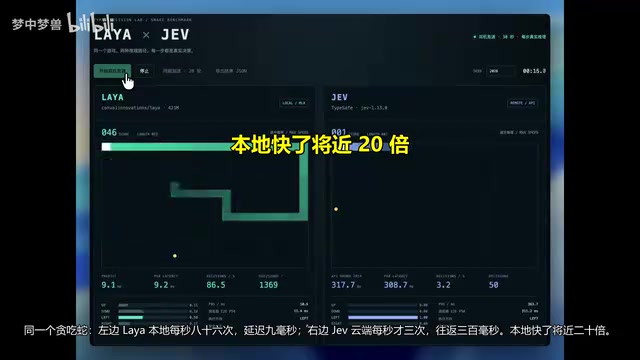
The most obvious pain point of cloud inference is latency. According to a hands-on demo, on the same Snake game task, the local solution completed 86 decisions per second with just 9 ms of latency, while the cloud API-based solution managed only 3 decisions per second with a round-trip latency of 300 ms. That means local inference is nearly 20x faster than the cloud.

This gap is dramatically amplified in applications that require continuous, dense decision-making. Every step of a cloud-based solution waits on a network round trip, and with per-token pricing on top of that, long-running costs and unpredictability are both high. For tasks with strict real-time requirements, a 300 ms round-trip latency essentially rules out cloud inference.
Laya: Built for Decisions, Not Generation
Laya has a clear positioning — it is a local decision model focused on "judgment" rather than "generation." Unlike general-purpose large language models, it does not generate long-form text; instead, it focuses on rapidly producing structured decision outputs. This deliberate narrowing of scope is precisely what enables it to run at high speed locally.
In the demo, the author feeds a support ticket to Laya and asks three questions at once: which category it belongs to, how urgent it is, and whether the customer is at risk of churning. Laya instantly returns answers with confidence scores — all processed locally. The entire process keeps data on-device, ensuring both fast response times and protection against the privacy risks of uploading sensitive data to the cloud.
From a technical architecture perspective, the fundamental difference between decision models like Laya and general-purpose LLMs lies in output space design. A general LLM produces an open-ended token sequence, requiring autoregressive token-by-token generation where compute scales linearly with output length. A decision model's output is closed — category labels, confidence scores, enumerated values, and other structured results — essentially a single forward-pass classification or regression task with no autoregressive iteration overhead. This allows the model's parameter count to be dramatically reduced while keeping inference latency stable and predictable, unaffected by "how many words to output." The confidence score is a key part of its output, reflecting how certain the model is about a given judgment and allowing downstream systems to decide whether human review or escalation to a more powerful model is needed.
Minimal Deployment Overhead
For developers, another major draw of Laya is its simplicity to deploy. It supports one-command installation via pip with no complex environment setup, and running it requires just a single command as well. This out-of-the-box experience lowers the technical barrier for deploying models locally.

Laya is also released under the MIT open-source license — completely free — and supports integration with external calling chains such as Cloud and Core. This means it can function as a standalone local decision component or be embedded into larger workflows as the fast-judgment layer of a broader system.
The MIT license is one of the most permissive in software, allowing users to freely use, modify, distribute, and even integrate it into commercial products, with the only requirement being retention of the original copyright notice. This is particularly important for enterprise users — it means no licensing fees and no concern about future compliance issues should the license ever change (as has happened with some open-source projects in recent years that shifted from permissive to restrictive licenses). Support for calling chains like Cloud and Core suggests Laya is architecturally compatible with mainstream AI orchestration frameworks, functioning as a standardized node in a workflow that collaborates with other components through a unified interface, rather than being an isolated standalone tool.
Where Local Decision Models Shine
The emergence of tools like Laya reflects a broader trend in AI deployment: not every task requires a heavyweight cloud-based LLM. For high-frequency, pattern-stable decision tasks like classification, priority judgment, and risk alerts, a lightweight, specialized local model is often more efficient, more economical, and more secure.
Enterprise use cases like ticket classification and customer churn prediction happen to have high requirements for both data privacy and response speed. Local deployment satisfies data compliance requirements while delivering millisecond-level responses — a better fit for real-world needs than calling a cloud API. Of course, the capability boundaries of local models are equally clear — they excel at judgment, not generation, and complex content creation and reasoning still require larger models.
For teams evaluating AI deployment strategies, Laya offers a useful mental model: separate "judgment" from "generation," use a local specialized model for high-frequency decisions, and use a cloud LLM for complex generation — letting each do what it does best.
Note: This article is based on a single-source demo. Actual performance figures should be verified against official documentation and your own testing.
Related articles

Huberman's Rational Supplement Guide: A Five-Layer Health Framework and Scientific Decision-Making
Stanford neurobiology professor Huberman proposes a rational supplement framework: behavior and nutrition are the foundation, basic combination supplements serve as insurance, and sleep/hormonal/cognitive directions should stick to single-ingredient experiments. Omega-3 is the top single-ingredient choice, and melatonin is not recommended.

The Unsung Painter Behind Gilded Age Manhattan Interior Design
HN discussion highlights the painter behind Gilded Age Manhattan interiors: he created murals and decorative paintings but was long overlooked as his work was seen as architectural appendage.

Can AI Agents Be Socially Engineered? Understanding Prompt Injection and Tool Permission Risks
Through Invariant Lab's GitHub Issue injection and Brave's AI browser attack, this article analyzes how Prompt Injection induces AI Agents to perform unauthorized actions, and offers protection advice across three layers: least privilege, tool validation, and operation auditing.