Open-Source Tool Heretic Goes Viral After PewDiePie Feature — AI Uncensoring Project Breaks Into the Mainstream

PewDiePie's mention of open-source AI uncensoring tool Heretic sent it viral, highlighting AI's spread into mainstream audiences.
After top YouTuber PewDiePie featured open-source tool Heretic in a video, this LLM uncensoring project unexpectedly entered the mainstream spotlight. Heretic works by modifying the weights of locally deployed open-source models to remove built-in refusal mechanisms — but cannot be used with closed services like ChatGPT. The author shared his mixed feelings on Reddit: excited by the exposure, yet bracing for waves of misconceptions and even conspiracy theories. The episode reflects a broader trend of AI technology crossing from geek circles into everyday consumer awareness, while also illustrating the risks of context-free popularization. Heretic 2.0 is also on the way.
How PewDiePie Accidentally Put Heretic on the Map
An open-source tool that had only circulated within a small technical community suddenly found itself in the mainstream spotlight after being mentioned in a video by PewDiePie (real name Felix Kjellberg), one of the biggest YouTubers on the planet. The project's author shared the experience on Reddit in a post that balanced genuine surprise at the unexpected exposure with a dose of self-deprecating humor.
As the author described it, he's not particularly familiar with YouTube culture — he hasn't played a video game in 20 years and knows nothing about Minecraft — yet he'd heard of PewDiePie long before this moment. Partly because the streamer's handle happened to share the same initials as his own name, and partly because he remembered the viral saga of PewDiePie battling Indian music channel T-Series for the top subscriber spot a few years back.
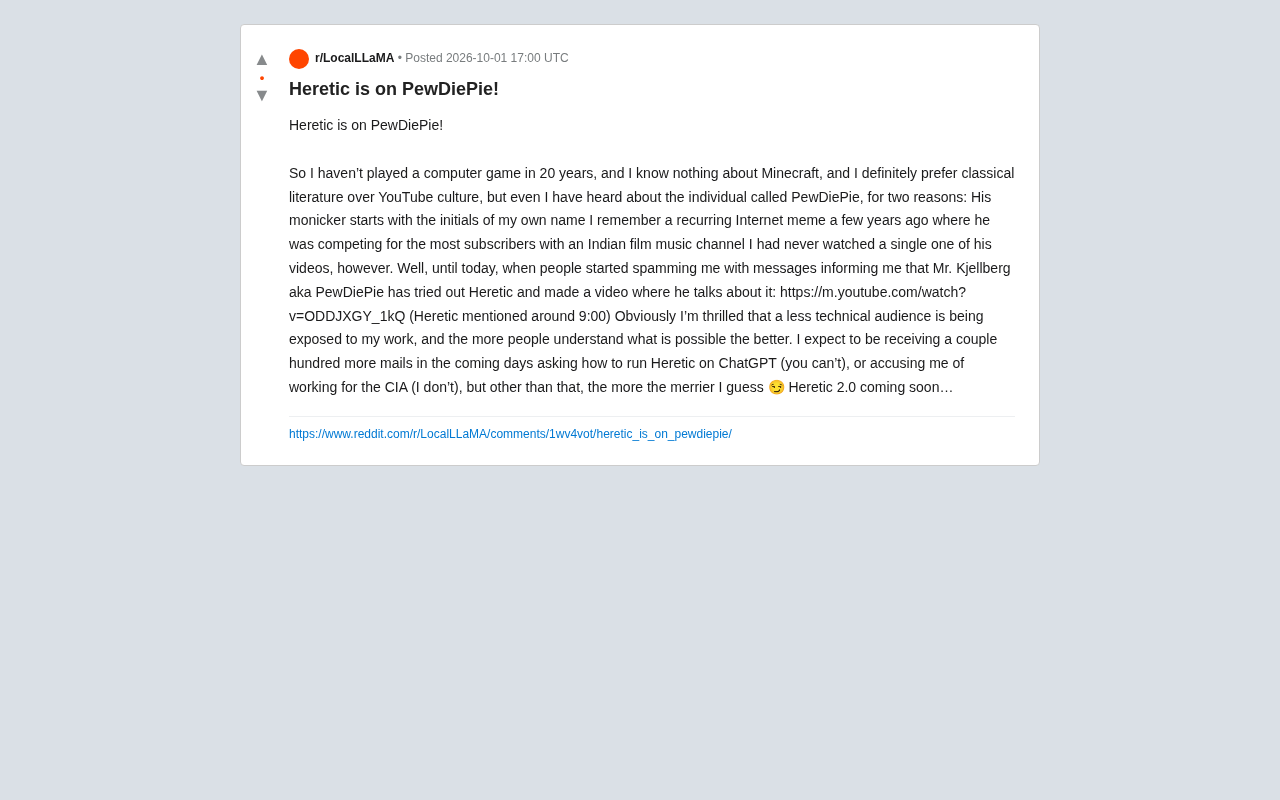
Then one day, his inbox filled up with messages from people telling him that PewDiePie had tried Heretic and filmed a video about it (Heretic appears around the 9-minute mark). For a technically oriented open-source developer, this kind of attention from mainstream audiences is both a form of validation and a harbinger of an incoming wave of questions from non-technical users.
What Is Heretic: A Technical Tool for Model Uncensoring
Based on context and community discussion, Heretic is an "abliteration" or decensoring tool for large language models. The core idea behind this class of tools is to modify model weights or activation directions to remove or weaken a model's built-in refusal mechanisms, enabling open-source models to respond to a broader range of queries without triggering safety filters.
This kind of technology isn't unheard of in the open-source community, but it has historically stayed within a relatively specialized user base — people who can run models locally and understand the basics of weight editing. That's precisely why the author anticipated receiving "hundreds of emails asking how to run Heretic on ChatGPT" and pre-emptively gave the answer: you can't. These tools are designed for open-source models with locally accessible weights, not closed, hosted services like ChatGPT.
The Double-Edged Sword of Going Mainstream
The author's reaction is telling. He explicitly said he was "happy for a less technical audience to be exposed to his work — the more people who understand the possibilities, the better" — a sentiment that reflects the typical open-source creator's desire for broader impact.
At the same time, he was clear-eyed about the cost: hundreds of emails asking how to use it on ChatGPT, and even accusations that he works for the CIA (he clarified that he does not). This pattern — a surge of traffic accompanied by misunderstanding and noise — is almost a rite of passage for any technical project that crosses over into mainstream visibility. Once a specialized tool gets mainstream media exposure, it almost inevitably attracts an audience far outside its intended user base.
The technical approach behind abliteration typically falls into two categories: activation steering and weight editing. Activation steering modifies intermediate activation vectors in real time during inference, subtracting the directional component associated with "refusal" behavior from the activation space. Weight editing, on the other hand, directly modifies the model's weight files to statistically suppress refusal behavior. In early 2024, HuggingFace researchers including FailSpy published an uncensoring approach based on orthogonalization: by comparing the residual stream differences between a model's "refusal" and "normal" responses, they identified the refusal direction vector and projected it out of each layer's weights, effectively preventing the model from triggering safety filters. These methods only work on locally accessible open-source models — such as Llama, Mistral, and Qwen series — because the process requires reading and modifying
.safetensorsor.ggufmodel files directly.
The Tension Between Mass Reach and Technical Barriers
PewDiePie, with his massive subscriber base, has been gradually shifting his content toward topics like AI and local model deployment — a trend that reflects something larger: AI technology is migrating from geek circles into mainstream consumer awareness. When an entertainment creator starts discussing running models locally and adjusting model behavior, it signals that these concepts are achieving a level of public recognition they've never had before.
This kind of spread cuts both ways. On the positive side, more people are discovering that open-source models aren't just "toys for big tech companies" — individuals can deeply customize model behavior on their own hardware. The concern is that context-free popularization breeds misunderstanding: people may come away thinking uncensoring tools are just a way to "unlock ChatGPT," or may project political significance onto a project that has no such intent.
PewDiePie's content evolution in recent years is itself worth noting. His channel started with gaming livestreams and comedy, but as his personal interests shifted, he began producing videos on local AI deployment, privacy tools, and even minimalist lifestyle topics. This shift has made his audience — predominantly young men, enormous in scale but highly varied in technical background — an unlikely distribution node for open-source tech projects. Similar "celebrity effect" events have rippled through the open-source community before: Linux distributions or specific projects have seen sudden influxes of new users following media coverage, forcing maintainers to balance welcoming newcomers with managing documentation and repetitive support questions. This is why many open-source authors, even while enjoying the publicity boost, proactively add "Common Misconceptions" sections to their READMEs.
Heretic 2.0 Preview and What Comes Next
At the end of his post, the author mentioned that Heretic 2.0 is coming soon. Given the current wave of attention, the timing is rather delicate — the new release can ride the visibility PewDiePie's video generated to reach more early adopters, but it will also face more complex community feedback and heightened user expectations.
For those following open-source AI tooling, this case is worth paying attention to — not just for the tool itself, but for what it reflects about the broader ecosystem: open-source model fine-tuning and modification tools are moving out of the lab and into the hands of a much wider audience. As mainstream creators continue to engage with this space, more tools like Heretic are likely to enter public conversation.
A note of caution: the information in this article is primarily drawn from the author's single self-reported Reddit post. Specific technical details about Heretic's implementation and the feature set of version 2.0 remain to be confirmed through official releases.
Related articles

Gemini 4 Argon Hands-On: AI Builds Board Games, Constructs Temples, and Trains Robots Autonomously
Gemini 4 Argon hands-on roundup: AI autonomously builds a desk racetrack and temple in Blender, writes a ray tracing engine, trains a humanoid robot to sink 7 shots, plus API pricing and developer access.

The Magic Octagonal Coin: Why Only 9% of People Can Predict Its Flip?
Only 9% of people can correctly predict the Magic Octagon coin flip. This article explains its spatial rotation mechanism, common cognitive pitfalls, and a new hypothesis based on Relevance Theory, exploring the limits of human spatial reasoning.

Sam Altman: AI Is Entering the Era of Scientific Discovery — Math Breakthroughs Will Replicate in Biology and Energy
Sam Altman says AI is entering the era of scientific discovery — math breakthroughs will replicate in biology, materials science, and energy to help develop new drugs and energy sources.