Open Weight Models: The Strategic Game of AI Accessibility and American Competitiveness

Open weight models serve as both a global AI democratization force and a strategic tool for maintaining U.S. tech dominance.
This article examines how open weight models—such as Meta's Llama—occupy a strategic middle ground between fully closed and fully open source AI. It explores how open weights democratize AI access globally while simultaneously reinforcing American technological dominance through ecosystem standards, developer loyalty, and network effects, drawing parallels to how open internet protocols enabled U.S. tech leadership.
Introduction: A Battle Over the Future of AI
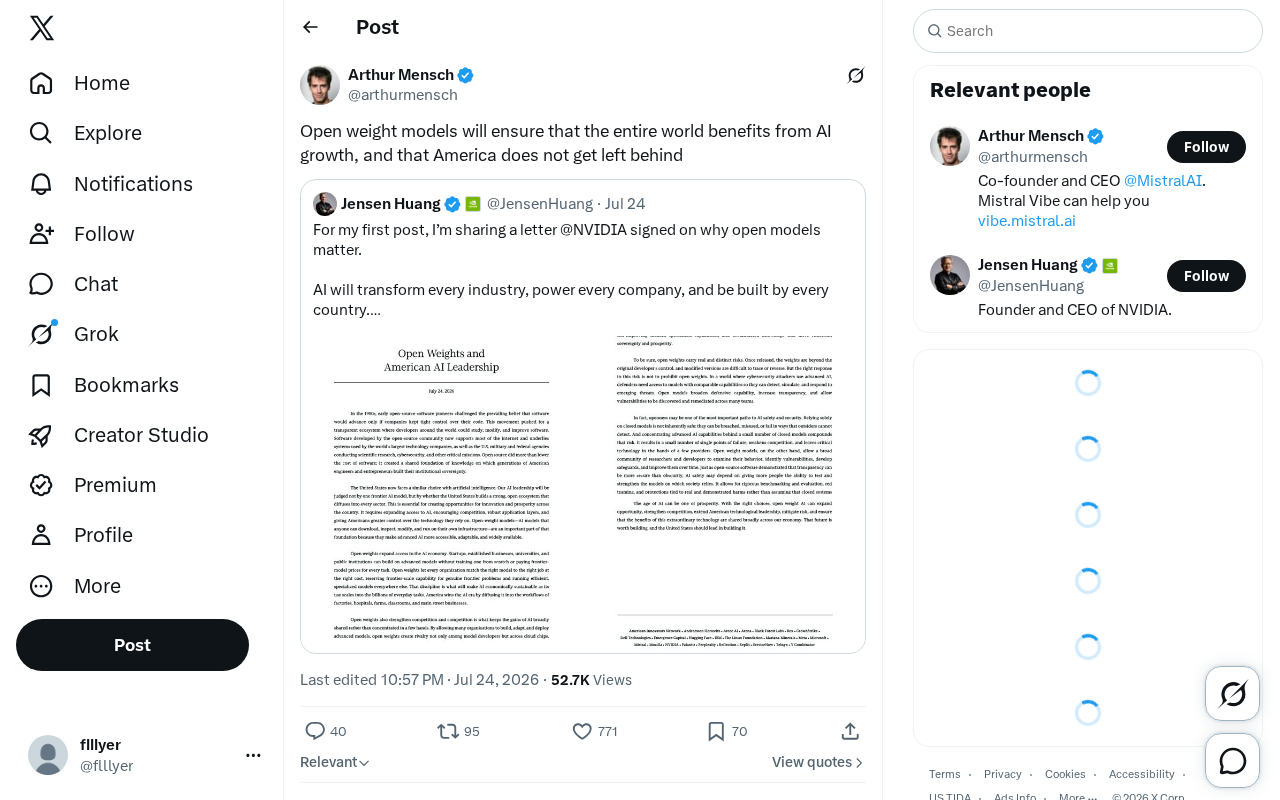
Recently, a statement from a tech leader sparked widespread discussion on social media: "Open weight models will ensure that the entire world benefits from AI growth, and that America does not get left behind."
This seemingly simple statement precisely touches on one of the most critical strategic issues in today's AI industry: Are open weight models a democratizing force for global technology access, or a strategic asset for national competitiveness? By binding "technological openness" and "national interest"—two seemingly contradictory goals—together, this statement deserves deep analysis.
What Are Open Weight Models? Concepts and Definitions
Core Differences Between Open Weight, Open Source, and Closed Source Models
To understand this perspective, we first need to clarify what "open weight models" actually means. In AI, models exist across multiple levels of openness:
-
Fully closed source models: Such as OpenAI's GPT-4 and Anthropic's Claude, where users can only access the model through APIs without access to model weights or internal architecture. API (Application Programming Interface) access means users send inputs to the model provider's servers via network requests, which perform inference computation and return results. Under this model, providers maintain complete control over the runtime environment, enabling input/output filtering, usage-based billing, version updates, and other management. For users, API access lowers hardware barriers but introduces data privacy risks, network latency, and vendor lock-in. From a business perspective, API access creates recurring revenue streams—each call generates fees, similar to SaaS (Software as a Service) subscription economics.
-
Open weight models: Model weight parameters are publicly available. Developers can download, deploy, and fine-tune them. Representatives include Meta's Llama series, Mistral, and DeepSeek. However, complete training data and training code are typically not disclosed.
-
Fully open source models: Not only are weights published, but training data, training processes, and code are all open, enabling complete reproducibility.
Open weight models occupy a middle ground—they lower the barrier to entry, allowing developers, research institutions, and businesses worldwide to run and customize models on their own hardware without relying on cloud services from a handful of companies.
Why Open Model Weights Matter So Much
Model weights are the "crystallization" of AI capability—the final product of massive computational and data investment. From a technical perspective, model weights are the numerical parameters of connections between nodes across neural network layers, determining how the model transforms input information into output results. For large language models, a GPT-4-class model may contain hundreds of billions of weight parameters, gradually optimized through backpropagation training on massive text data. The training process is essentially an extremely expensive search—finding optimal solutions that minimize prediction error in high-dimensional parameter space. Therefore, the final trained weight files condense tens of millions of dollars in compute investment and trillions of tokens of data knowledge, representing the most critical intellectual property of the model.
Once weights are opened, any team with basic computing resources can build upon "the shoulders of giants" for secondary development without training from scratch. Secondary development here primarily refers to fine-tuning—continuing to train a pretrained model with domain-specific or task-specific data to improve performance in that domain. Common fine-tuning methods include full parameter fine-tuning, LoRA (Low-Rank Adaptation), and QLoRA, among other parameter-efficient fine-tuning techniques. LoRA achieves efficient adaptation by adding low-rank decomposition matrices alongside the original weight matrices, requiring only 0.1%-1% of the original parameters to be trained while achieving results close to full parameter fine-tuning. This means a single consumer-grade GPU can accomplish fine-tuning tasks that would otherwise require dozens of high-end GPUs, dramatically lowering the barrier to customizing AI models. This drastically compresses the cost and cycle of innovation, fundamentally changing how AI capabilities are distributed.
How Open Weights Benefit "The Entire World"
Breaking the AI Technology Monopoly
The first layer of meaning in this statement concerns technological accessibility. If the most advanced AI capabilities are controlled by only a few closed-source giants, the vast majority of countries, SMEs, and independent developers worldwide become mere "consumers" rather than "participants" in technology. Open weight models break this potential monopoly.
Developing nations can build localized AI applications based on open models, adapted to their own languages, cultures, and regulatory requirements. Startups can launch competitive products without bearing astronomical training costs. Academia can conduct deep research on models, advancing progress on fundamental issues like safety and interpretability.
Accelerating Global AI Innovation Through Network Effects
Another value of openness is the network effect of innovation. When thousands of developers improve, fine-tune, and explore applications around the same open model, the resulting technology ecosystem and accumulated knowledge far exceed what any single closed team could achieve. The thriving Llama ecosystem is the best proof—a vast number of derivative models, toolchains, and best practices have rapidly emerged on the foundation of openness.
This network effect has profound historical precedents. Since Linux was open-sourced in 1991, it grew from a Finnish university student's personal project to infrastructure supporting over 90% of the world's cloud servers. Similarly, open weight models are replicating this path in AI—the Hugging Face platform now hosts hundreds of thousands of derivative versions based on open models like Llama, spanning healthcare, legal, financial, educational, and other vertical domains.
The Strategic Calculus Behind "America Not Getting Left Behind"
Open Ecosystems as Technological Dominance
The most thought-provoking aspect of this statement is how it directly links "openness" to "American competitiveness." Conventional intuition might suggest that publicly releasing advanced model weights is "helping competitors" and weakening domestic technological advantages. But this viewpoint proposes entirely opposite logic.
The core reasoning is: The standards of an open ecosystem equal dominance. If American open models become the default choice for developers worldwide, then the technical standards, toolchains, and development paradigms built around them will all bear the imprint of American technology. Conversely, if America moves entirely toward closure, global developers may turn to open models from other sources, causing America to lose its de facto "technology standard-setting power."
This logic is highly consistent with lessons from the internet era. By opening TCP/IP protocols and promoting the global adoption of Web standards, the United States ultimately enabled American tech companies to dominate the core layers of the internet industry. If internet protocols had been closed and proprietary, today's global internet landscape would likely look entirely different.
Responding to the New Global AI Competition Landscape
This statement clearly has a real-world context. In today's global AI competitive landscape, beyond America's Meta Llama series, France's Mistral AI has released the Mistral and Mixtral series of open models, while China's DeepSeek, Alibaba's Qwen, and Baichuan Intelligence have also published high-quality open weight models. DeepSeek-V3 and the Qwen2.5 series in particular have demonstrated performance comparable to closed-source models across multiple benchmarks. The EU's AI Act grants certain exemptions to open-source models, signaling policy-level support for open ecosystems. This multipolar landscape means that if any party chooses closure, developers will naturally gravitate toward other open alternatives.
In this context, maintaining an open strategy is seen as key to preserving technological influence and maintaining developer ecosystem loyalty. In other words, the prerequisite for "not getting left behind" is precisely maintaining sufficient openness to retain global talent and ecosystems.
Controversies and Challenges of Open Weight Models
Balancing Openness with AI Safety
Of course, open weight models are not without controversy. Opposition primarily focuses on safety risks: once powerful model weights are fully public, malicious actors can also access and use them for disinformation, cyberattacks, or other harmful purposes, and unlike APIs, usage restrictions and content moderation become difficult to enforce.
The industry is currently exploring multiple technical paths to mitigate this issue. Safety Alignment refers to technical methods that make AI model behavior conform to human values and safety norms. Mainstream approaches include RLHF (Reinforcement Learning from Human Feedback), Constitutional AI, and DPO (Direct Preference Optimization). However, for open weight models, alignment measures can be removed by users through fine-tuning—this is the so-called "jailbreaking" risk. Watermarking technology attempts to embed invisible statistical features in model-generated content for source tracking. Current research directions include embedding specific patterns in token sampling distributions, but these methods face robustness challenges—simple paraphrasing may destroy watermark signals.
Therefore, finding the balance between "inclusive openness" and "risk management" is a question that all institutions advocating openness must answer. This is also the focal point of current policy discussions, industry self-regulation, and technical solutions. Some pragmatic middle-ground approaches are forming, such as tiered openness strategies—fully opening lower-performance models while implementing delayed or conditional release for cutting-edge models.
Sustainability of Business Models
Another practical concern is commercial sustainability. Training frontier models costs hundreds of millions of dollars—if core results are freely opened, how do companies recoup investment and sustain R&D?
Meta's Llama business strategy provides a typical case: by freely opening model weights, Meta attracts developers to build applications within its ecosystem, indirectly driving its cloud computing and advertising businesses. Red Hat's Linux business model serves as a historical precedent—Red Hat didn't sell Linux itself, but created revenue through enterprise-grade technical support, certification, and consulting services, ultimately being acquired by IBM for $34 billion. In the AI domain, similar value-added services include: enterprise private deployment support, model performance optimization consulting, security compliance certification, and custom training services based on open models. Hugging Face, as a distribution platform for open models, has also achieved commercialization through enterprise Hub services.
Whether this model can sustain the enormous investments in frontier research long-term remains to be seen. But notably, companies like Meta that promote open weight models derive their core revenue (advertising, social platforms) not from model sales, which enables them to treat model openness as an ecosystem strategic investment rather than a direct revenue product.
Conclusion: Openness Itself Is Competitiveness
"Open weight models will ensure that the entire world benefits, and that America does not get left behind"—this statement encapsulates a strategically astute AI development philosophy: Openness itself is a form of competitiveness, not a surrender of it.
As AI technology accelerates and global competition intensifies, the debate between open and closed approaches won't have simple, definitive answers. But what's certain is that the degree of model weight openness will profoundly shape the distribution of future AI innovation, the direction of technical standards, and who globally can truly benefit from this technological revolution. For developers, businesses, and policymakers, understanding the logic behind this debate matters more than picking sides.
Related articles

Gemini 3.7 Flash Spotted in Google Cloud Console — Launch Countdown Begins
Developers spot Gemini 3.7 Flash in Google Cloud Console, sparking discussion about its relationship to Pro and Google's model distillation strategy.

AI-Memory: Building a Cross-Tool Long-Term Memory System for Coding AIs
AI-Memory is a Rust-based open-source project providing long-term memory for Claude Code, Cursor, Aider and other Agent coding CLIs, enabling seamless handoff between vendors.

Bullet Enters the Stage: YC Newcomer Bets on a Faster Coding Agent
YC S26 startup Bullet launches a speed-focused coding Agent targeting developer latency pain points. Analysis of its differentiation, acceleration techniques, and market opportunity against Cursor and Claude Code.