OpenAI Agents SDK: A Deep Dive into the Lightweight Multi-Agent Framework
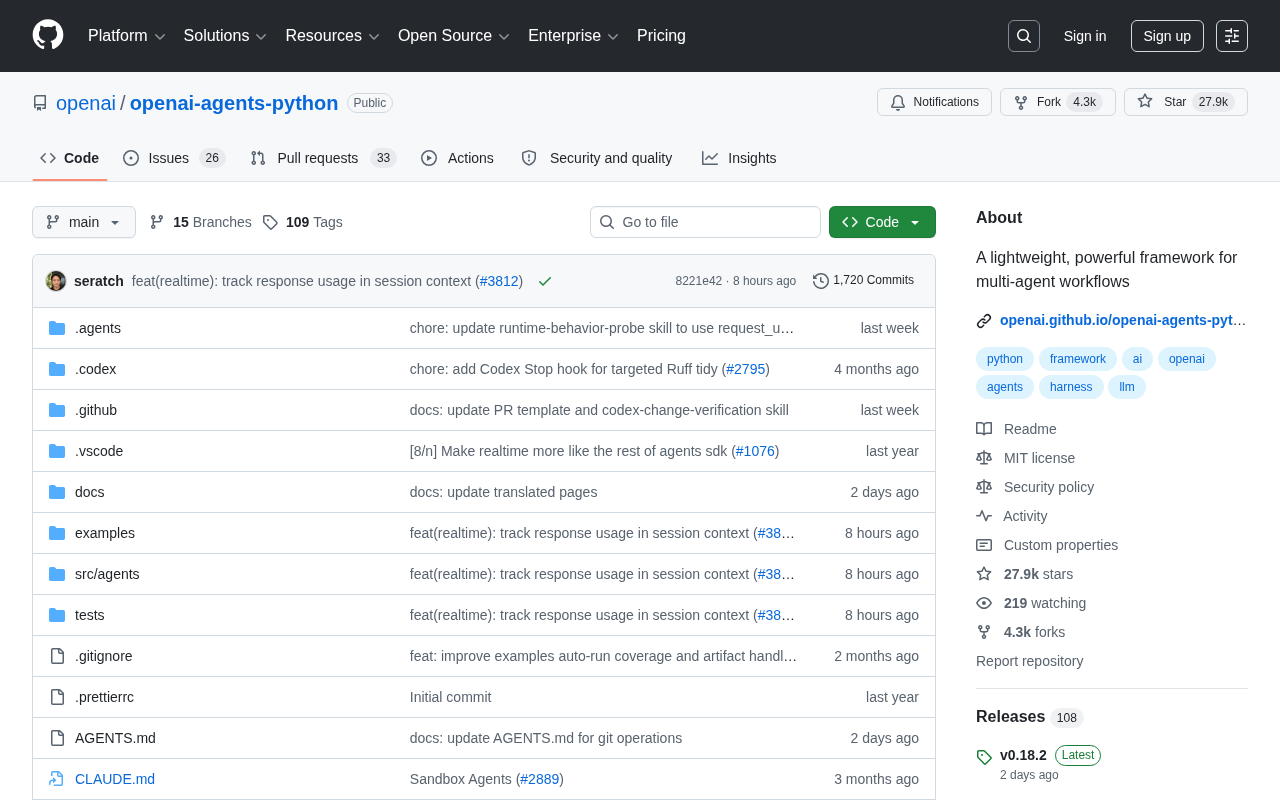
OpenAI's official lightweight Python framework for building complex multi-agent workflows with minimal overhead.
OpenAI's open-source `openai-agents-python` is a lightweight Python framework for multi-agent workflows, with over 26,000 GitHub Stars. Its core philosophy is "maximum coverage with minimal abstractions," using a Handoff mechanism to let specialized agents collaborate on complex tasks — such as splitting intent recognition, data retrieval, and result summarization across independent agents. As an officially maintained OpenAI project, it integrates natively with GPT-series models, offering low migration friction and reliable long-term support. It's ideal for teams that need rapid prototyping or are already deep in the OpenAI ecosystem, though advanced customization may require additional development effort.
OpenAI Agents SDK: A Deep Dive into the Lightweight Multi-Agent Framework
OpenAI's open-source openai-agents-python project is rapidly becoming a go-to choice for building multi-agent workflows. Positioned as "lightweight but powerful," this Python framework has already garnered over 26,000 Stars and nearly 4,000 Forks on GitHub — a clear signal of the developer community's strong demand for agent orchestration tools.
Why a Dedicated Agent Framework?
As large language models grow more capable, a simple "one-shot Q&A" is no longer sufficient for complex real-world applications. Modern use cases require models to call tools, retrieve information, decompose tasks, and even collaborate across multiple specialized agents. This gives rise to the problem of agent orchestration: how do you guide a model to make a coherent series of decisions, rather than hardcoding all the logic into an unwieldy prompt?
OpenAI's SDK aims to solve this with minimal abstraction. Unlike frameworks that chase a "kitchen sink" approach, it deliberately stays lightweight — keeping the learning curve low so developers can get started quickly, while retaining enough flexibility to build sophisticated multi-agent systems.
Core Design Philosophy
The project's positioning makes its philosophy clear: openai-agents-python is built around the idea of covering as many use cases as possible with as few core concepts as necessary. Multi-agent workflows are its central thesis — a complex task can be distributed across multiple purpose-built agents, each with a distinct role, collaborating through handoffs to achieve an overall goal.
This design is particularly valuable for building customer support systems, research assistants, automated pipelines, and more. Developers can define independent agents for different stages of a workflow — one for intent recognition, one for data retrieval, another for result summarization — and let the framework handle the orchestration between them.
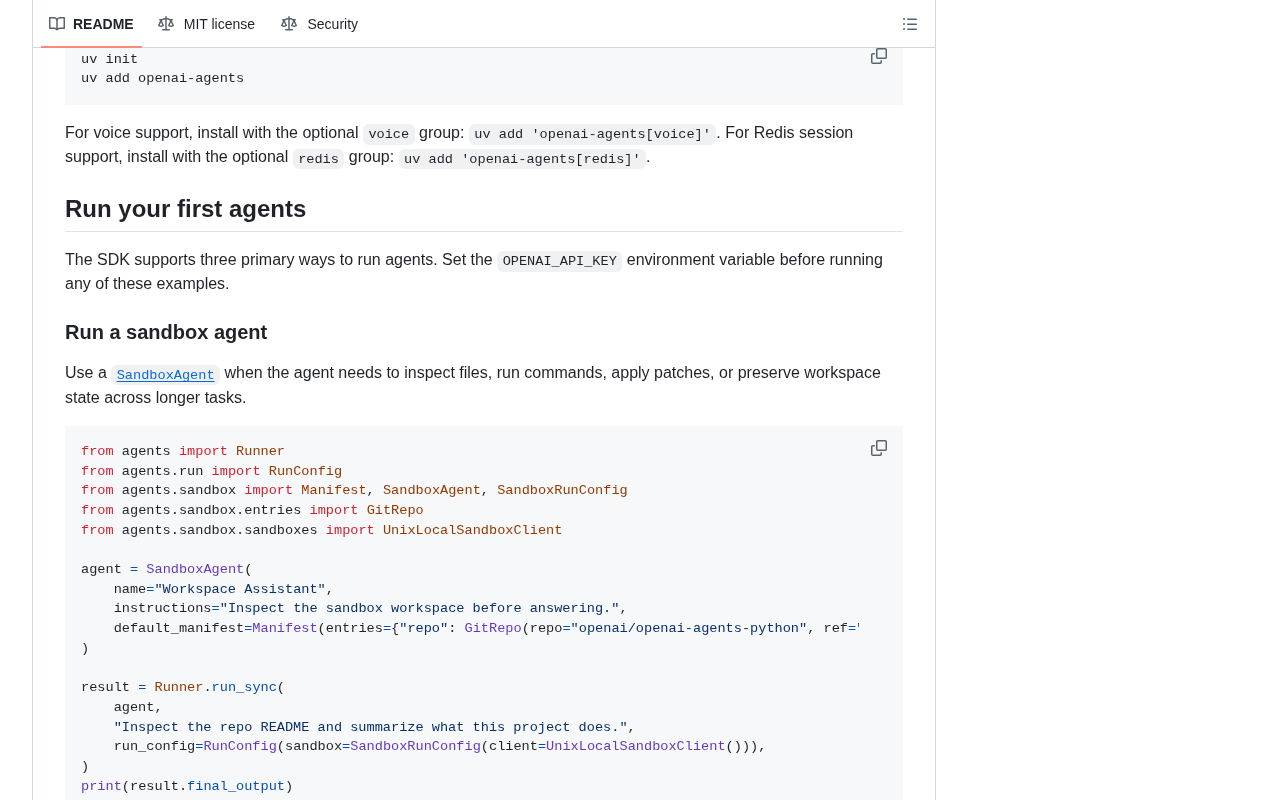
Handoff is a key mechanism in multi-agent frameworks. It refers to one agent passing control and context to another agent better suited to handle the next step. In openai-agents-python, Handoff is treated as a first-class citizen: each agent can declare which downstream agents it can hand off to, and the framework maintains conversational context continuity at runtime to ensure no information is lost during transitions. This differs from a traditional function call chain — Handoff allows the receiving agent to have its own fully independent system prompt and tool set, enabling true separation of responsibilities. The framework also typically includes built-in Guard Rails, which validate inputs and outputs before and after agent execution to prevent harmful or policy-violating model outputs.
Community Traction and Ecosystem Significance
With 26,012 Stars and 3,989 Forks, this project has accumulated substantial attention in a short period. As an officially maintained OpenAI framework, it enjoys deep, native integration with the OpenAI model ecosystem — an advantage that many third-party agent frameworks simply can't match.
For teams already using the OpenAI API, adopting the official SDK means a smoother migration path and more reliable long-term support. Python's status as the dominant language in AI development further lowers the barrier to adoption for both data science and backend engineering teams.
Who Is This For?
If you're evaluating agent orchestration options, this framework is worth serious consideration. It's especially well-suited for:
- Teams that need to prototype quickly
- Engineers looking to minimize framework learning overhead
- Projects already deeply invested in the OpenAI ecosystem
That said, the lightweight nature of the framework does mean that some advanced features may require developers to build their own extensions. When making a selection, consider your actual business complexity, your team's tech stack, and any existing investment in third-party frameworks like LangChain or AutoGen.
Among comparable alternatives, LangChain offers an extensive component library and third-party integrations, but comes with a steep learning curve and heavier dependencies. AutoGen (open-sourced by Microsoft) focuses on conversational collaboration between agents, making it ideal for scenarios where agents need to debate or validate each other's outputs. CrewAI is known for its "role-playing" style of agent definition, emphasizing a team-and-division-of-labor metaphor. What sets openai-agents-python apart is that it's built directly on top of OpenAI's Function Calling and Assistants API, eliminating the intermediate adapter layer. This results in lower latency and more predictable behavior when calling GPT-series models. For teams that don't need to switch between model providers, this "native affinity" is a real engineering advantage.
Conclusion
openai-agents-python represents OpenAI's official move to stake out territory in the agent toolchain space. With its emphasis on being lightweight and easy to use, it targets the fast-growing domain of multi-agent workflows. Whether or not you ultimately adopt it, understanding the design thinking behind frameworks like this will help developers better grasp how AI applications are evolving — from "single-turn conversation" toward "autonomous collaboration."
Related articles
Recurrent Looped Transformers: A New Architecture That Teaches Models to "Think Again"
Recurrent Looped Transformers repeatedly apply the same Transformer block to decouple compute from parameters, enabling variable reasoning depth without scaling model size.
"Everyone Else Should Slow Down AI — Except Me": The Double Standard Trap in Big Tech
A viral Hacker News quip — "Everyone should slow down AI, except me" — exposes the double-standard at the heart of the AI race. We unpack why it's a Prisoner's Dilemma, not mere hypocrisy, and why institutions matter more than moral self-discipline.
OWL: An Open-Source Multi-Agent Framework for Real-World Task Automation
OWL (Optimized Workforce Learning) is an open-source multi-agent framework by camel-ai for real-world task automation, with 19K+ GitHub Stars. Learn how it works.