OpenAI Agents SDK v0.22.2 Released: Image Tool Options and Sandbox Security Fix

OpenAI Agents SDK v0.22.2 patches a sandbox security flaw, fixes session compaction logic, and adds image tool support.
OpenAI's official Python Agents SDK has released v0.22.2, a patch update for the nearly 30,000-star GitHub project. This release focuses on three areas: full support for the latest image generation tool configuration options for more flexible multimodal Agent workflows; a fix for a symlink race condition (TOCTOU) vulnerability in the sandbox's UnixLocal file API to eliminate unauthorized access risks; and a fix for the session module's compaction response chain not resetting correctly after a pop/rollback operation, improving context consistency in long-conversation scenarios. The update signals the framework's shift from "feature completeness" to "production readiness," with security and runtime stability now at the center of its development. Users of sandbox or session compaction features are advised to upgrade promptly.
OpenAI's official Python Agents framework openai-agents-python has released version v0.22.2. With nearly 30,000 stars and over 4,800 forks on GitHub, this SDK has become a key piece of infrastructure for developers building AI Agent applications. While this is a minor release, it brings several noteworthy improvements in image generation tool support, sandbox security, and session management.
What's New in This Release
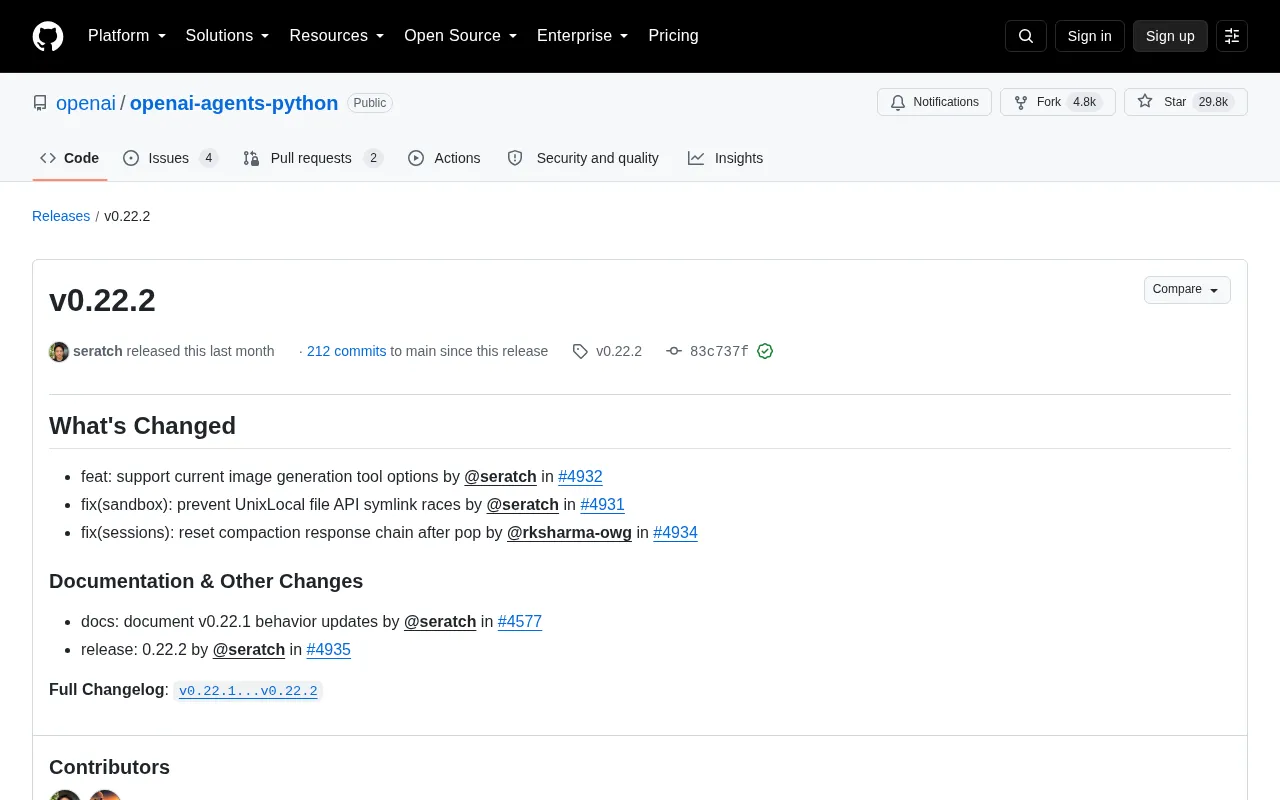
According to the official Changelog, v0.22.2 includes three features and fixes, along with several documentation updates. It's best characterized as a stability and capability patch on top of v0.22.1 — not an architectural overhaul.
Support for the Latest Image Generation Tool Options
The most feature-oriented change in this release is support for the latest configuration options for the image generation tool (PR #4932, submitted by maintainer @seratch). As multimodal capabilities become a standard expectation in Agent applications, fully exposing the image generation tool's configuration parameters means developers can integrate image generation more flexibly into their Agent workflows — without needing extra wrappers or workarounds around the official API.
For teams building Agent products with image generation requirements, this kind of SDK-level alignment is critical. It ensures the SDK keeps pace with the evolution of the underlying model and tool APIs.
Fix for Sandbox Symlink Race Condition
Another important fix targets the sandbox module. PR #4931 addresses a symlink race condition in the UnixLocal file API.
Symlink races are a classic security vulnerability: in multi-process or multi-threaded environments, if there's a time window between checking and using a file, an attacker or unexpected state can exploit a symlink to redirect an operation to an unintended file path, potentially causing unauthorized access or data corruption. For a sandbox module whose core value is "safely executing external code and tools," closing this kind of vulnerability directly impacts the reliability of Agent runtime isolation.
Symlink race conditions are a classic variant of the TOCTOU (Time-of-Check to Time-of-Use) vulnerability. The typical attack path works as follows: the program checks whether a path points to a legitimate file, then during the brief window between that check and the actual operation, an attacker replaces the path with a symlink pointing to a sensitive file. The program then reads or writes that sensitive file using its own permissions. In sandbox contexts, code executed by an Agent often has certain filesystem permissions — if this kind of vulnerability exists, a malicious tool or abnormal state could break out of the sandbox and access private data or configuration files on the host machine. Common mitigations include using atomic file operations, canonicalizing paths (e.g., resolving with
realpath), or using file descriptors instead of path strings to prevent intermediate state from being tampered with.
Fix for Session Compaction Chain Reset Logic
The third fix comes from community contributor @rksharma-owg (PR #4934), addressing an issue in the sessions module where the compaction response chain was not properly reset after a pop operation.
Context compaction is a common technique for long-conversation Agents to control token consumption and maintain contextual coherence. If the compaction chain isn't reset after rolling back (popping) history, subsequent context state can end up inconsistent with expectations. This fix improves the correctness of session management in complex interaction scenarios.
Context Compaction is an important engineering technique for long-conversation LLM applications. Since models have a finite context window (e.g., 128K tokens), when conversation history accumulates beyond a certain length, the framework summarizes or truncates earlier messages to make room for new interactions. The compaction response chain records the results and state of each compaction operation, ensuring semantic continuity before and after compaction. When a user performs a "pop" (rollback) to undo a history entry, if the compaction chain isn't simultaneously reset, the framework's judgment of the current context length goes out of sync — it may incorrectly treat the context as already compacted or not yet compacted, causing subsequent turns to inject incorrect historical summaries or trigger unnecessary re-compaction, ultimately degrading the Agent's reasoning quality and response consistency.
Why a Minor Release Is Worth Paying Attention To
From a semantic versioning perspective, v0.22.2 is just a patch-level update. But it neatly reflects the current trajectory of AI Agent frameworks: three parallel tracks of progress — feature alignment (image tools), security hardening (sandbox), and state correctness (session compaction).
This also signals that frameworks like this have entered a "production readiness" phase. Early Agent frameworks were primarily concerned with getting things to work and adding features. Today, iteration is clearly shifting toward security boundaries, runtime stability, and edge case handling. For developers using Agent SDKs in real production environments, these seemingly minor fixes often prevent more incidents than new features do.
Upgrade Recommendations
Given that this release includes an explicit sandbox security fix, users of the sandbox file API are advised to upgrade to v0.22.2 as soon as possible. Projects that use session compaction — especially those involving history rollback logic — are also worth updating. If your application needs to invoke image generation tools within an Agent pipeline, upgrading will give you access to more complete configuration support.
This release was contributed by @seratch and @rksharma-owg. The full changelog is available at the official release page (v0.22.1...v0.22.2). As an actively developed project still in the 0.x stage, developers are advised to review dependency compatibility and interface changes after upgrading.
Related articles

AI Is Not a Replacement: Human-AI Collaboration Through the Lens of Factory Root Cause Analysis
Starting from factory root cause analysis, this article explains how AI accelerates evidence chain construction rather than replacing human experts, exploring the pragmatic implementation logic and business value of 'AI supporting people rather than replacing them.'

AI Agent Decision Auditing: Building an Evidence Chain in Regulated Workflows
Starting from a Reddit discussion, this article analyzes three core issues in AI agent decision auditing within regulated workflows: what fields audit records should contain, how to handle feedback latency for erroneous decisions, and how to continuously calibrate LLM judge consistency with human judgment.

Apple Opens Multiseat Subscription Purchasing: App Subscriptions Can Now Be Sold in Bulk to Businesses and Schools
Apple opens multiseat purchasing for auto-renewable subscriptions: businesses and schools can bulk-buy via Apple Business and Apple School Manager, adding or removing seats anytime. Enabled by default in App Store Connect—developers should verify settings; group purchasing sandbox testing opens October 2026.