OpenAI Breaks ETH? P=NP Could Upend the Cryptography World

OpenAI reportedly disproved ETH, possibly paving the way for P=NP and threatening encryption.
OpenAI published a proof reportedly overturning the Exponential Time Hypothesis (ETH), which claims 3SAT has no sub-exponential algorithm. The new bound of 2^n/sqrt(log n) is still exponential but falls in the sub-exponential range, contradicting ETH. Overturning ETH doesn't directly imply P=NP but removes a key barrier. If P=NP holds, RSA and SHA-256 could fail and blockchain security would be shaken; conversely, NP problems like protein folding could be solved faster. The proof awaits peer review—no short-term panic, but cryptography must accelerate post-quantum efforts.
Title
OpenAI Breaks ETH? P=NP Could Upend the Cryptography World
Meta Description
OpenAI reportedly published a paper disproving the Exponential Time Hypothesis (ETH), with a sub-exponential algorithm sparking P=NP speculation. This article explains the 3SAT problem, what ETH means, and analyzes the disruptive impact if P=NP becomes reality on RSA encryption, blockchain, and protein folding.
Article Content
OpenAI is making headlines again. This time it's not a new model, but a mathematical proof—reportedly overturning the Exponential Time Hypothesis (ETH), a core assumption in computational complexity theory. The news sent the tech community into a frenzy: if true, it means P=NP is no longer far-fetched, and existing encryption systems could collapse overnight.
What Is the Exponential Time Hypothesis?
To understand this shockwave, we first need to grasp the 3SAT problem. Simply put, 3SAT presents a set of Boolean variable groups (three per group) and asks whether there exists an assignment that makes all groups simultaneously true. The UP host demonstrates with an intuitive example: starting with A or B or C, you can just guess C is true and it's satisfied; add another group not A or D or E, the variables increase to five, and the number of guesses needed clearly grows; add a third group, variables reach seven, and manual verification becomes quite laborious.
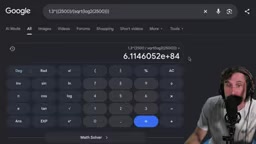
The pattern is obvious: each additional variable causes the number of attempts needed for verification to expand exponentially. ETH's core assertion is precisely this—3SAT has no sub-exponential time algorithm, and its complexity lower bound is approximately 2^n. Even with algorithmic optimizations reducing the base to 1.3, 1.3^2500 is still an astronomical number, far exceeding the total number of atoms in the universe, and utterly impossible to exhaust with current computers.
NP-complete problems are a core concept in computational complexity theory, referring to the hardest class of problems in NP, to which any NP problem can be reduced in polynomial time. Typical NP-complete problems include 3SAT, the traveling salesman problem, and the knapsack problem. Their key property is mutual equivalence: find a polynomial-time algorithm for one, and you can solve all NP problems through reduction. Therefore, proving that a certain NP-complete problem has no polynomial-time algorithm is equivalent to proving P≠NP. As the first problem proven to be NP-complete (Cook-Levin theorem), 3SAT is often used as the standard vehicle for studying complexity lower bounds.
Whose Cheese Did OpenAI's Proof Move?
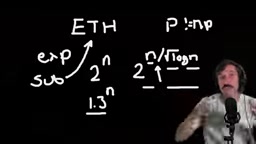
According to the video analysis, among the three findings OpenAI published, the one related to complexity theory gives an algorithmic complexity upper bound of the form 2^n / sqrt(log n). This is still exponential, but has entered the "sub-exponential" range—precisely contradicting ETH's assertion that "sub-exponential algorithms are forbidden."
In other words, if the proof is correct, ETH is overturned. The UP host compares this to OpenAI's earlier breakthrough in integer multiplication: initially just a tiny lower-bound improvement, followed by a cascade of optimizations within weeks. He worries that this "loosening" of ETH will replay the same script, gradually approaching polynomial time.
A key concept needs clarification here: if ETH is true, then P≠NP; ETH being overturned does not directly imply P=NP, but it does remove an important theoretical barrier. In the video's words, "this is a step toward P=NP."
Sub-exponential time refers to algorithm runtimes that grow slower than any exponential function but faster than any polynomial function, commonly of the form 2^{n^ε} (ε<1) or 2^{n/log n}. The Exponential Time Hypothesis (ETH) asserts that 3SAT has no sub-exponential time algorithm, i.e., its complexity lower bound is at least 2^{Ω(n)}. If 3SAT can be solved in 2^{n}/sqrt(log n) time, this is still exponential, but it has already broken ETH's assertion, because this function falls into the sub-exponential category. This distinction is crucial: a sub-exponential algorithm is not equivalent to a polynomial algorithm, but it shows that the exponential lower bound is not set in stone and may open a gap for subsequent optimizations.
What Would the World Look Like If P=NP?
P vs NP is the greatest unsolved mystery in computer science. NP problems have a peculiar characteristic: verifying an answer is easy, but solving it is extremely hard. Sudoku is typical—checking whether a filled grid is valid takes just a glance, but solving from scratch can consume enormous time.
NP-complete problems are the hardest class in NP and are mutually transformable—the traveling salesman problem can be encoded as 3SAT. This means that once any NP-complete problem is conquered by a polynomial-time algorithm, all NP problems will be solved.
On the positive side, if protein folding is an NP-complete problem, drug development cycles could be compressed from decades to a year, and treatments for cancer and other diseases could see qualitative leaps. But the other side of the coin is more unsettling: RSA public-key encryption relies on the hardness of large integer factorization, and SHA-256, HMAC, pseudorandom number generators, and even blockchain security are all built on computational complexity assumptions. If P=NP becomes reality, these encryption methods will be broken in polynomial time, and the foundation of internet trust will instantly crumble.
RSA encryption security is based on the hardness of large integer factorization—given the product of two large primes, it is very difficult to factor it back into those two primes in polynomial time. SHA-256 is a cryptographic hash function whose security depends on the computational difficulty of finding collisions or preimages. HMAC is a hash-based message authentication code used to verify message integrity. The security of these cryptographic primitives all rests on the assumption that certain computational problems have no polynomial-time algorithm (i.e., P≠NP or related assumptions). If P=NP, then polynomial-time algorithms exist that can break these schemes, and the internet's security infrastructure will face fundamental challenges.
A Rational Perspective: Don't Panic Yet
It must be emphasized that this is still a proof awaiting peer review, and there is a huge gap between a sub-exponential algorithm and polynomial time. The history of complexity theory is full of "revolutionary proofs" that were ultimately disproven. But the signal this event sends is worth heeding: AI is shifting from a tool role to a producer of mathematical discoveries, and its output speed has left the theoretical community scrambling. For ordinary users, there's no need to worry about bank card passwords leaking in the short term; for cryptography practitioners, it may be time to accelerate the deployment of post-quantum encryption.
Peer review is a quality assurance mechanism in academic publishing, in which independent experts in the same field review a paper's methods, results, and conclusions to assess its correctness and importance. For mathematical proofs, peer review is especially critical, because proofs may contain subtle logical gaps or errors. Historically, many proofs claiming to solve major mathematical problems were found to be flawed during review. Therefore, until OpenAI's proof passes rigorous peer review, its conclusions should be treated as hypotheses awaiting verification, not established facts.
One-line Summary
OpenAI reportedly proved ETH false, potentially paving the way for P=NP and threatening existing encryption systems.
Paragraph Summary
A mathematical proof published by OpenAI reportedly overturns the Exponential Time Hypothesis (ETH) in computational complexity theory, which holds that the 3SAT problem has no sub-exponential time algorithm. The new proof gives a complexity upper bound of the form 2^n/sqrt(log n), which, though still exponential, has entered the sub-exponential range, contradicting ETH. Overturning ETH does not directly imply P=NP, but it removes a key theoretical barrier. If P=NP ultimately holds, encryption systems such as RSA and SHA-256 would fail, dealing a blow to blockchain security; on the positive side, it could accelerate the solving of NP problems such as protein folding. The proof still awaits peer review, so there's no need to panic in the short term, but the cryptography community should be vigilant and accelerate post-quantum encryption deployment.
Related articles
When an Anti-Fingerprinting Script Is …
When an Anti-Fingerprinting Script Is Flagged as a Bioweapon: The Detection Dilemma of Security Tools
An anti-fingerprinting script was flagged as a bioweapon by security scanning, sparking Hacker News debate. This analysis covers the causes of keyword-matching false positives, how developers respond, and the long-term imbalance between automation and precision in security tools.

41,000 DHS Employee Records Leaked, Including Undercover ICE Agents
Data breach exposes 41,000 DHS employees, including undercover ICE agents. Analysis of sensitive data risks, law enforcement security gaps, and protection measures like access control and auditing.

Can Frontier Models Be Fooled by Visual Decoys? Elorian Breaks Through with Thinking in Images
Elorian releases the decoy counting benchmark, revealing shortcomings in frontier multimodal models' visual reasoning, and proposes Glimpse to let models think with images rather than text.