OpenAI Codex Deep Dive: The AI Tool That Lets You Build Apps with Zero Coding Experience

OpenAI Codex evolves from a code tool into an AI agent for everyone, redefining human-computer interaction.
OpenAI has repositioned Codex as a productivity tool for all ChatGPT users, not just developers. Built on the o-series reasoning models, the new Codex has evolved from a code completion tool into a coding agent that autonomously handles the full workflow — from understanding requirements to writing, debugging, and delivering results. Its three core capabilities include everyday task automation, system-level app integration, and zero-experience product building, turning "everyone is a developer" from a slogan into reality while sparking deeper discussions around security and employment.
How OpenAI Codex Is Redefining Human-Computer Interaction
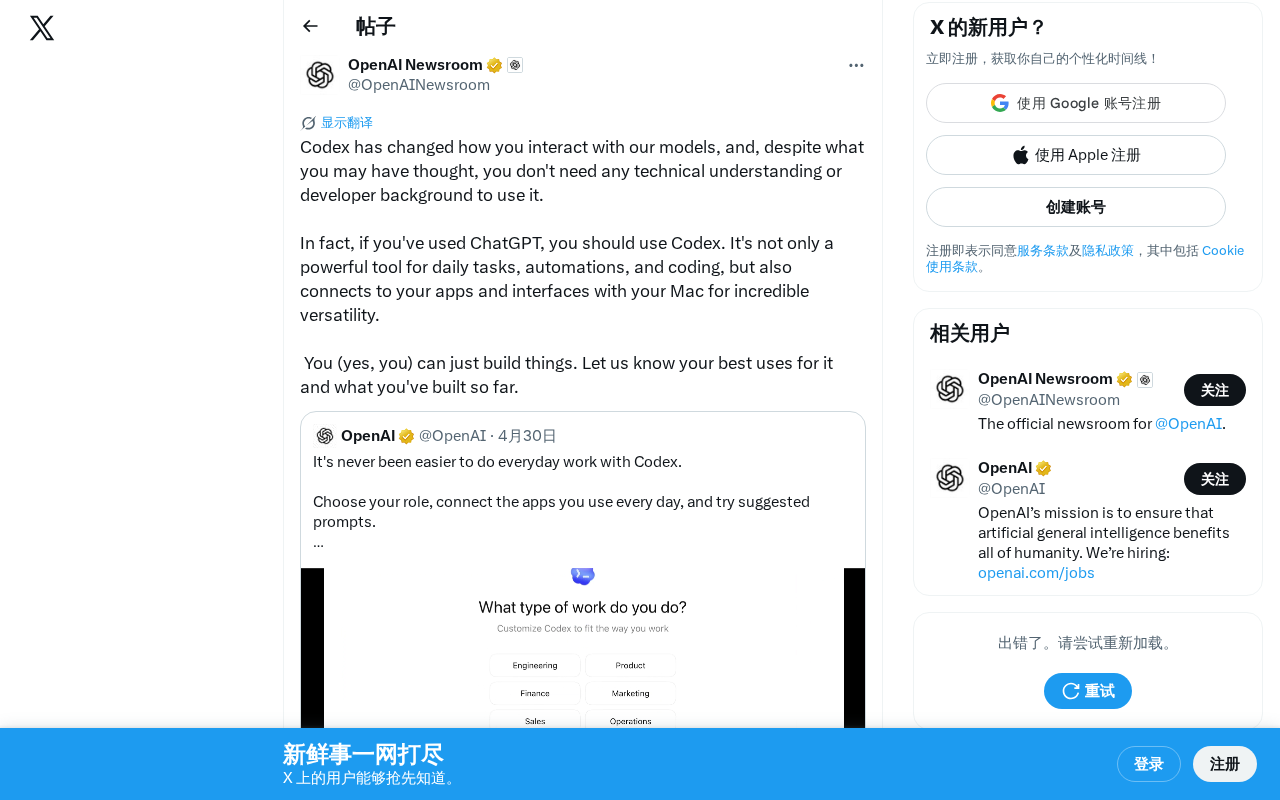
OpenAI recently emphasized Codex's brand-new positioning on social media: this is no longer a tool designed solely for developers — it's a productivity powerhouse that every ChatGPT user should try. This statement signals that AI-assisted development is moving from the professional domain into the mainstream.
Notably, today's Codex is a fundamentally different product from its namesake predecessor. OpenAI Codex originally debuted in 2021 as the underlying model powering GitHub Copilot — a language model based on the GPT-3 architecture, fine-tuned specifically on code datasets, primarily serving IDE plugin scenarios. The 2025 version of Codex represents a ground-up rebuild — it's powered by OpenAI's latest o-series reasoning models, with capabilities for multi-step task planning, tool invocation, and environment interaction. In essence, it's a "Coding Agent" rather than a simple code completion tool. This generational leap explains why OpenAI is confident enough to market it to non-technical users: the old Codex output code snippets that users had to understand and execute themselves; the new Codex can autonomously complete the entire loop from understanding requirements, writing code, debugging and running, to delivering results.
OpenAI explicitly stated: "Codex changes the way you interact with our models, and although you might think you need a technical background, you don't." The weight of this statement should not be underestimated — it means OpenAI is deliberately tearing down the barriers to programming.
Traditionally, "code generation" tools have inherently excluded non-technical users. But Codex's design philosophy is clearly different: its goal is to let users describe their needs in natural language while the AI handles the entire process from concept to implementation. There's a clear technical architecture behind this: at the intent understanding layer, the model converts vague natural language requirements into structured task plans; at the code generation and execution layer, the model generates code in a sandbox environment and runs it in real time, iteratively correcting through observing output results — this "generate-execute-reflect" loop is the key differentiator from traditional code completion; at the system integration layer, it communicates with local applications and operating system APIs through standardized protocols like MCP (Model Context Protocol). All the technical details are encapsulated beneath the AI's execution layer — users only need to verify whether the final result meets their expectations. This isn't just lowering the barrier to entry; it's redefining the very concept of "building."
Three Core Capabilities of Codex: Far Beyond Code Generation
According to OpenAI's description, Codex's capabilities extend well beyond code generation, covering at least three core scenarios:
Automating Everyday Tasks
Codex can help users handle daily repetitive work, such as data organization, batch file processing, format conversion, and more. For non-technical users, these automation tasks that previously required learning scripting languages can now be accomplished simply by describing them in natural language.
App Connectivity and System-Level Integration
OpenAI specifically mentioned that Codex "connects to your apps and interfaces with your Mac," meaning it's not an isolated chat window but something deeply integrated with users' local app ecosystems. This system-level integration capability elevates Codex from a chat tool to a true operating system-level assistant.
This positioning places Codex on a much larger competitive battlefield: OS-level AI assistants. Apple's Apple Intelligence is deeply embedded in the iOS/macOS system call layer, Microsoft's Copilot is integrated into every core application of Windows 11, and Google's Gemini is building its ecosystem moat through Android and Workspace. OpenAI's choice to enter the Mac ecosystem as a "third-party system-level assistant" requires building differentiated advantages through superior code execution and task automation capabilities, even as Apple's own AI capabilities continue to strengthen. The essence of this competition is a battle for the user's "intent entry point" — whoever becomes the first thing users think of when they say "help me do this" will control the core traffic of the next-generation computing platform.
Building Products from Scratch with Zero Background
OpenAI used a highly compelling phrase: "You (yes, you) can just build things." The "you" here is specifically emphasized with parentheses, pointing directly at ordinary users who have never written a single line of code. With Codex, "everyone is a developer" is transforming from a slogan into reality.
This vision doesn't emerge from thin air — it stands on the shoulders of the past decade's Low-Code and No-Code movements. Platforms like Bubble, Webflow, and Zapier have already validated the market demand for non-technical users building digital products, but these tools essentially replace code with "visual operations" and still require users to learn platform-specific logical paradigms. The revolutionary aspect of AI coding tools is that they use humanity's most natural form of expression — language — as the sole interaction interface, completely eliminating the learning curve. Gartner predicts that by 2026, low-code/no-code development will account for over 65% of enterprise application development, and the rise of AI coding assistants is accelerating this process, expanding the beneficiary group from "technically-minded business people" further to "pure business users."
From ChatGPT to Codex: Understanding the User Migration Path
OpenAI's recommendation logic is crystal clear: if you're already using ChatGPT, Codex is your natural upgrade path. There are several layers of meaning worth examining:
First, consistency in interaction. Codex continues ChatGPT's natural language interaction model — users don't need to learn a new operational paradigm. The way you talk to ChatGPT is the way you use Codex.
Second, a significant expansion of capability boundaries. ChatGPT excels at conversation and content generation, while Codex adds the dimension of "execution" on top of that — it doesn't just tell you how to do something, it actually does it for you.
Third, the formation of an ecosystem loop. Through integration with local apps and systems, Codex is building a complete loop from "idea" to "product" — something purely conversational AI cannot achieve.
Codex's Deeper Impact on the AI Development Industry
This development reflects a critical trend in AI tool evolution: from assisting professionals to empowering everyone. When programming is no longer a prerequisite for building digital products, creativity and needs themselves become the most essential competitive advantages.
For professional developers, Codex is an efficiency multiplier; for non-technical users, it's a capability unlocker. This dual value proposition gives Codex the potential to become OpenAI's next breakout product after ChatGPT.
However, the vision of "everyone is a developer" raises important deeper discussions alongside its productivity liberation. When code generation becomes effortless, security vulnerabilities may be produced at an equally accelerated pace, as non-professional users struggle to identify security risks in AI-generated code. Additionally, the impact on the professional developer job market remains an ongoing topic of industry discussion — McKinsey Global Institute estimates that software development is one of the professional categories most deeply affected by generative AI. "Everyone can build" is an inspiring vision, but it demands equally robust guardrails.
Related articles
Deep Dive into AI Agent Skill Design: …
Deep Dive into AI Agent Skill Design: Engineering Practices from Anthropic and Perplexity
A deep dive into Skill design philosophy from Anthropic's Claude Code team and Perplexity's Agent team, covering the Tax Test, Gotchas Flywheel, progressive disclosure, and Eval-First practices for building high-quality AI Agent skill systems.
Deep Dive into OpenAI's Official GPT-5…
Deep Dive into OpenAI's Official GPT-5.6 Prompting Guide: The Shift from Manual to Automatic
A deep dive into OpenAI's official GPT-5.6 Sol prompting guide: conciseness-first, outcome-oriented design, autonomy boundaries, tool routing, and reasoning intensity tuning.
 Deep Dives
Deep Dive into How OpenClaw (Open-Source Crayfish) AI Agent Works
Deep analysis of OpenClaw AI Agent internals: System Prompt, tool calling, SubAgents, Skill system, memory, and Context Engineering explained.